
The CESA Decade in Review: Africa Enrolled More Children and Lost More Ground
The African Union’s Continental Education Strategy for Africa ran ten years. It closed with 75 million more children in school — and more than 100 million still shut out. As the continent launches its next education decade, a data audit of the gap between ambition and outcome.
In 2016, the African Union adopted the Continental Education Strategy for Africa — CESA 2016-2025 — as the defining framework for education across 54 member states. Twelve strategic objectives covered everything from early childhood development to teacher training, higher education, TVET, and science and technology enrolment. The strategy was built to align with the AU’s Agenda 2063 and with the global Sustainable Development Goal 4: quality education for all. It ran until the end of 2025.
By any raw access measure, the decade produced real gains. Seventy-five million more African children were enrolled in school in 2025 than in 2015. Primary completion rates improved across the continent. The share of African governments publicly committed to education reform has never been higher. At an AU Summit in February 2025, heads of state formally adopted CESA 26-35 — the next strategy — signalling institutional continuity. By October 2025, AU Commissioner Banyankimbona was on stage at PACTED 2025 in Addis Ababa, launching the AU Decade of Accelerated Action for the Transformation of Education and Skills Development.
The problem is what sits behind those numbers — and what did not move.
The Paradox of Expanding Access
The most arresting finding from the Second Continental Report on CESA and SDG 4, released at PACTED 2025, is the one that received the least attention in coverage of the launch. Yes: 75 million more children enrolled. Also true: the number of out-of-school children in Africa rose by 13.2 million over the same decade, reaching over 100 million. Population growth, concentrated in the Sahel, the Horn of Africa, and the Great Lakes region, outpaced every gains system the continent built.
Learning quality tells an even harder story. In sub-Saharan Africa, the share of ten-year-olds who cannot read and understand a simple text — the World Bank’s “learning poverty” metric — stood at 86 per cent before the COVID-19 pandemic. By 2025, it had risen to 90 per cent. That is not a system making progress. That is a system running to stand still, and losing ground while doing so.
CESA 2016-2025 did not publish a single headline target in the manner of, say, “50 per cent of students in STEM by 2025.” Its twelve strategic objectives were distributed across a logical framework with indicator-level targets, some of which — the Indicator Handbook acknowledged — were still in “pilot phase” at the strategy’s midpoint. The STEM-specific ambitions were embedded across multiple objectives: increasing the proportion of teachers qualified in science and mathematics; revitalising higher education with a science and technology focus; expanding TVET access and quality. The absence of a hard continental STEM percentage target made accountability difficult to enforce — and, in practice, meant it was not enforced.
The STEM Pipeline: What the Data Shows
Sub-Saharan Africa’s share of tertiary graduates with a science or engineering background stood at approximately 14.2 per cent in 2019, according to UNESCO Institute for Statistics data — compared to a global average closer to 35 per cent. The most recent comparable data does not indicate a structural shift in that gap. African universities were producing more graduates in absolute terms; they were not producing proportionally more engineers or scientists.
Rwanda offers the sharpest illustration of what continental ambition looked like at the national level. The country set a target — consistent with CESA priorities, codified in its own national planning documents — of enrolling 80 per cent of students in higher learning institutions and TVET programmes in STEM fields by 2024, up from 44 per cent in 2016. The Rwanda Education Board introduced a new competency-based curriculum from pre-primary to upper secondary. ICT-enabled education expanded by 64 per cent at primary level and 55 per cent at secondary, according to NEPAD data. By 2025, Rwanda was being cited by the AU’s own development agency as “a model for improving STEM education curricula in Africa.”
Rwanda was the exception, not the replicable norm. Ethiopia saw secondary enrolment rise from roughly 15 per cent of the relevant age cohort in 2010 to nearly 50 per cent by 2019 — a remarkable access expansion that still left the country with tertiary enrolment below 10 per cent and no published data showing a commensurate STEM pipeline improvement. In Tanzania, only 5.4 per cent of early-grade students demonstrated basic reading comprehension in the most recent national assessment. Access expanded; quality did not follow.
The Gender Gap That Did Not Close
CESA 2016-2025 included explicit gender equity objectives in STEM education. The decade closed without meeting them. UNESCO UIS data published in April 2024 found that globally, the share of women among STEM graduates has been completely stagnant for ten years. Africa’s own trajectory reflects this: at the tertiary level, sub-Saharan Africa enrolls only 80 women for every 100 men — the lowest gender parity ratio of any world region. The global average, by comparison, has now tipped to 113 women per 100 men. On current trajectories, sub-Saharan Africa will not reach full tertiary gender parity until 2034.
The gap narrows, then widens, as girls advance through the education system. Research across 49 African universities found women accounting for roughly 47 per cent of students at pre-tertiary STEM entry points — broadly comparable to male participation. By the time those cohorts reached university-level STEM programmes, the share had dropped to approximately 33.6 per cent. Something happens at the transition point between secondary and tertiary STEM that the CESA framework identified, named, and did not solve.
Nigeria, Ethiopia, and Tanzania — the continent’s most populous sub-Saharan economies — all reported women representing fewer than 30 per cent of STEM graduates as of the most recent available data, a figure broadly unchanged or worse than in 2015. Ghana’s Gender-Responsive STEM curriculum reform, backed by UNICEF and running from 2022 to 2025, was designed to address this at secondary level through teacher training and classroom culture change; its outcomes data at scale is not yet available. South Africa’s Fundza Lushaka bursary scheme — which directs qualified graduates into mathematics and science teaching — has achieved over 60 per cent female recipients, creating a measurable pipeline into STEM instruction. The question of whether more female maths teachers produces more female STEM graduates remains open and under-researched.
What Blocked the Decade
Three structural forces defined the implementation gap between CESA ambition and CESA outcomes.
The first was COVID-19. At the pandemic’s peak in mid-2020, more than 50 million students in 40 sub-Saharan African countries were missing school entirely. Uganda recorded the longest school closure of any country globally: 83 weeks — nearly two full academic years. Combined, the DRC, Nigeria, Senegal, and Uganda experienced 120 weeks of total school closure and a further 48 weeks of partial closure. In Uganda, the share of young students who could not identify letters of the alphabet doubled during closure. In Malawi, researchers attributed nearly 40 of 97 measured points of total learning loss — close to one full year — to school closure alone. The CESA 2016-2025 decade was, for practical purposes, a seven-year strategy interrupted by a two-year system collapse.
The second was chronic underfunding. UNESCO has estimated Africa’s annual education financing gap at $77 billion. The internationally endorsed benchmarks — at least 4 per cent of GDP or at least 20 per cent of government budgets allocated to education — were met by fewer than one-third of African countries across the 2013-2023 period. By 2022 and 2023, compliance had fallen to barely one quarter of member states. As of mid-2024, only 9 of 49 African countries for which data existed were allocating 20 per cent or more of public spending to education. Development aid to education in sub-Saharan Africa fell 23 per cent in the most recently recorded year. CESA 2016-2025 was never fully financed; large parts of it were aspirational from the outset.
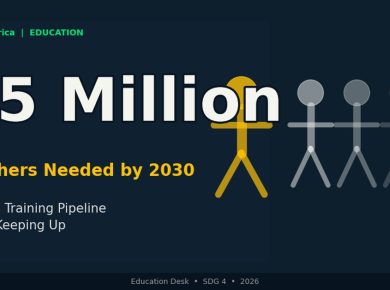
The third was a teacher shortage of continental proportions. Sub-Saharan Africa requires an estimated 15 to 17 million additional primary and secondary school teachers by 2030 — the largest such need of any world region. Of those, approximately 10.8 million are needed at secondary level. No continental STEM training target is achievable against that teacher deficit. Training more STEM students in systems without qualified STEM teachers does not work. The CESA framework acknowledged the teacher pipeline as a strategic objective; the hiring rate required to meet it was never reached.
The Strategy That Follows
CESA 26-35, adopted in February 2025 and launched in October, restructures the continental approach around five transformative pillars: foundational learning for literacy and numeracy; teacher professionalism; skills for employability and entrepreneurship; digital learning and innovation; and robust governance and financing. The STEM agenda reappears in Strategic Area 4 — Higher Education and TVET — with an explicit focus on “incentivising research and innovation, particularly in STEAM fields.” CESA 26-35 was launched simultaneously with a continental TVET strategy, a science and technology innovation framework, and a continental assessment framework, signalling that the AU has learned from the diagnosis of its previous decade’s accountability gap.
Whether that diagnosis translates into different outcomes over the next ten years depends on whether the three structural failures of the 2016-2025 period are genuinely addressed — not reframed, not restated, but structurally changed. The financing gap is not being closed; 79 per cent of AU member countries planned to decrease total government spending as a percentage of GDP between 2023 and 2025. The teacher shortage is worsening, not improving. The population dynamics that turned 75 million additional enrolled children into a net increase in out-of-school numbers have not changed.
The continent’s education problem is not a strategy problem. It has had strategies. It is a delivery, financing, and demographic problem for which no ten-year continental framework has yet found an answer at the scale required.
A High-Level Partners’ Consultation on Accelerating the AU Decade of Education was held in February 2026 — the most recent major AU education policy convening at time of writing. Its communiqué called for “urgent acceleration.” The same language appeared in the communiqué that launched CESA in 2016.
BETA-605 | Education Desk | BETAR.africa | 13 March 2026

 UphivaBETAR