
Africa’s Tech Brain Drain: Are Diaspora Return Programmes Actually Working?
Africa is losing its most educated tech talent at the same time it needs them most. Nature Africa reports fewer than 100 researchers per million people — a figure that amounts to less than one-twelfth of the global average. A generation of diaspora incentive programmes — Ghana’s Year of Return, Rwanda’s tech returnee grants, Nigeria’s Diaspora Commission — claims to be reversing the tide. The numbers tell a more sober story.
The arithmetic of Africa’s talent crisis is not subtle. The continent produces fewer than 100 researchers per million people, according to a March 2026 Nature Africa analysis of Africa’s deep tech research ecosystem — a figure that represents less than one-twelfth of the global average of approximately 1,198 researchers per million. Only 11 per cent of African deep tech founders hold PhDs, versus roughly 90 per cent of their counterparts in European pre-seed deep tech. Meanwhile, approximately 70,000 skilled professionals leave the continent every year, at a cost the AU Commission estimates at roughly US$2 billion in human capital annually.
Governments across Africa have responded with diaspora return programmes designed to reverse those flows — or at least slow them. Ghana launched the Year of Return in 2019 and extended it into a Decade of Return framework. Rwanda built a tech-focused returnee visa and grant programme. Nigeria’s Diaspora Commission has operated incentive schemes and investment bond instruments. The African Union’s Science and Technology Consolidated Plan of Action (SPA2) includes researcher mobility as a structural priority.
The question this piece asks is the one the programmes themselves rarely answer clearly: who is actually coming back, in what numbers, to do what — and is it making a measurable difference to the talent base the continent needs?
The Scale of the Problem
The concentration of departures from the five highest-volume STEM talent-exporting nations on the continent provides the clearest baseline from which to measure any return programme’s impact.
Table 1: Top 5 STEM Talent-Exporting African Nations — Skilled Emigration Profile & Return Programme Status (2026)
| Country | Emigration Profile | Primary Destinations | Return Programme | Programme Status |
|---|---|---|---|---|
| Nigeria | 4,193 doctors/dentists in 2024; 75,000 nurses emigrated since 2017; STEM broader scale undocumented | UK (48.5%), Canada (20.9%), USA (19.4%) | Diaspora Commission; NiDCOM investment bonds | Active; limited documented returnee tech placements |
| Ghana | More nurses in UK than Ghana (WHO 2022 est.); ~500 nurses/month departed 2022–23 | UK (primary), USA, Canada | Year/Decade of Return; creative economy incentives | Active; ~900 tech returnees 2019–2023 |
| Kenya | ~4,000 doctors and nurses annually; 64.4% of health professionals considering emigration (2023 MoH survey) | UK, Middle East, USA | Diaspora directorate (limited tech-specific programme) | Nascent; no aggregated tech returnee data |
| South Africa | ~23,000 annual departures; 914,901 citizens abroad (Stats SA 2023); returnees fell 39% 2011–2023 | UK, Australia, USA, New Zealand | No formal tech returnee scheme | No dedicated programme; returnees declining |
| Ethiopia | Significant engineering/medical emigration; two international patents total despite 70 years of HE | USA, Gulf states, Europe | Ethiopia Diaspora Trust Fund; AU MIDA | Limited; infrastructure focus over tech talent |
Sources: Nigeria Federal Ministry of Health 2024; UK General Medical Council; WHO Nursing and Midwifery Council; Kenya MoH 2023 survey; Statistics South Africa Migration Profile 2023; IOM MIDA programme data; AU Commission.
The healthcare data is the most granular available because institutions track professional registrations. STEM emigration in engineering, computer science, and biomedical research is not tracked in any standardised series following the KNOMAD unit’s wind-down in 2024. The healthcare proxies almost certainly understate the technology sector’s departures: a software engineer leaving Lagos for London generates no government record equivalent to a GMC registration update.
The Return Programmes — What Exists
The longest-running pan-African diaspora return mechanism is the IOM’s Migration for Development in Africa programme, known as MIDA. Launched in the early 2000s, MIDA’s model is built on facilitating short-term and permanent returns of diaspora professionals to contributing institutions — universities, government ministries, hospitals — on the continent. Its cumulative placement figure after more than two decades of operation is approximately 2,000 professionals. That number is not a typo. Set against 70,000 skilled workers leaving annually, it represents a rounding error.
Ghana’s Year of Return, launched by President Nana Akufo-Addo in 2019 to mark 400 years since the first enslaved Africans arrived in the Americas, was primarily a cultural and diaspora investment campaign rather than a structured returnee employment programme. It generated significant media attention, investment conferences, and tourism. In technology specifically, the programme has produced an estimated 900 permanent relocations across the 2019–2023 period — a figure cited in government communications — concentrated primarily in Accra’s emerging tech ecosystem. The Decade of Return framework, which extends the initiative through 2029, has broadened the programme’s focus to include formal skills investment commitments from diaspora professionals, though independently verified returnee data for 2024 and 2025 is not yet published.
Rwanda’s programme is the continent’s most operationally specific for technology talent. The Rwanda Development Board operates a tech-focused returnee visa with a streamlined work permit pathway and, in partnership with the Kigali Innovation City development, has created a physical infrastructure anchor for returnees. Rwanda does not publish aggregate returnee numbers in the same way Ghana’s government communications do, but the Kigali tech ecosystem’s visible growth — Kigali has emerged as one of Africa’s fastest-growing tech hubs — reflects a policy environment that has made return more viable than most alternatives on the continent.
Nigeria’s Diaspora Commission has operated investment bond schemes, diaspora conference platforms, and sector-specific engagement frameworks. The commission does not publish aggregated technology returnee data in a format equivalent to, say, annual skilled worker visa statistics from destination countries. Nigeria’s tech ecosystem has grown significantly through private-sector development — Flutterwave, Paystack, PiggyVest — but the extent to which diaspora returnees, versus locally trained talent, drove that growth is not documented in the commission’s public reporting.
The AU’s Science and Technology Consolidated Plan of Action (SPA2), the continent’s top-level framework for researcher mobility, targets researcher exchange and return as a mechanism for building research density. SPA2’s implementation has been uneven — a pattern consistent with most AU-level frameworks — and its specific returnee placement figures are not reported in a publicly accessible format.
What the Data Says About Effectiveness
The honest reading of the available data is that diaspora return programmes have not come close to reversing — or even meaningfully slowing — the talent outflows they were designed to counter. The best-documented programme on the continent, Ghana’s Year of Return, produced approximately 900 tech-relevant permanent relocations over four years. Ghana’s nurses were leaving at approximately 500 per month during the same period. The economic incentive structures that drive emigration — salary differentials, purchasing power, infrastructure quality, political stability — have not changed sufficiently to make the calculation different for most skilled professionals.
What has changed is the geography of contribution. Two models that are gaining traction do not depend on physical return at all.
Andela’s talent network model — which connects African-trained software engineers with global technology companies in remote-first employment relationships — has created a structure in which African talent generates economic value for African workers and, through remittances and investment, for African economies, without requiring those workers to leave career-growth trajectories in major markets. The model is not brain return. It is brain leverage.
Masakhane, the community-led African natural language processing research collective, operates on a similar logic. Founded in 2019, the collective has produced peer-reviewed research, open-source models for African languages, and a training pipeline for African ML researchers — almost entirely through remote collaboration by diaspora and in-continent researchers working together. Masakhane’s model is not constrained by whether its participants are in Cape Town or Cambridge. It is constrained only by research access and institutional recognition — both more solvable problems than economic migration incentives.
What Policy Should Actually Do
Three specific policy instruments emerge from the evidence as more likely to produce measurable talent retention and return than the current generation of diaspora engagement programmes.
First: salary compression subsidies for in-continent research roles. The single largest driver of STEM emigration is salary differential, not quality of life or political environment alone. South Africa and Rwanda have, in different ways, demonstrated that when compensation for research and technology roles approaches regional private-sector norms — rather than public university pay scales — retention rates improve. A continental mechanism modelled on the EU’s Marie Curie Fellowships — competitive salary-completion grants for African researchers who commit to in-continent institutional roles for defined periods — would address the economic driver directly.
Second: remote contribution recognition frameworks. The Masakhane model demonstrates that diaspora talent can contribute to African research infrastructure without physically returning. AU member states should formalise remote contribution pathways — research affiliation agreements, co-authorship frameworks, IP partnership structures — that allow diaspora researchers to build careers in destination countries while contributing substantively to African institutions. This is not an alternative to physical return; it is a bridge that makes eventual return more likely by maintaining professional ties.
Third: bilateral recruitment ethics enforcement. Nigeria, Ghana, and Zimbabwe are on the WHO Health Workforce Safeguards list, meaning NHS employers are formally prohibited from actively recruiting from these countries. The prohibition functions poorly in practice — UK Home Office data records a 399 per cent increase in Nigerian skilled worker visas between 2019 and 2023. African governments should pursue enforceable bilateral commitments with destination countries that index active recruitment restrictions to healthcare and STEM workforce thresholds, with financial transfers to compensate origin countries for training costs when those thresholds are breached. The precedent exists in bilateral labour agreements; the application to STEM has not been systematically pursued.
Africa’s deep tech ambitions — the UNECA projects 4.3 per cent growth in 2026, anchored by innovation-led sectors — rest on a researcher and technology workforce that the continent is simultaneously building and exporting. The diaspora return programmes that have operated for the past decade have not closed that gap. The question for the next decade is whether the policy instruments deployed are designed to match the economic reality of why people leave, or simply to offer a cultural invitation to come home. The evidence so far suggests the latter — and the arithmetic does not forgive that gap.
This article should be read alongside BETAR.africa’s Research Desk investigation into Africa’s deep tech researcher pipeline: Africa Deep Tech Infrastructure Gap — Can the Continent Train Researchers Fast Enough?
Sources: Nature Africa, March 2026; AU Commission skilled migration estimates; IOM MIDA programme cumulative data; Ghana Year of Return government communications 2019–2024; Rwanda Development Board returnee programme documentation; Nigeria Diaspora Commission annual reports; WHO Health Workforce Safeguards List; UK Home Office skilled worker visa statistics; UNECA Economic Report on Africa 2026 (March 9); UNESCO Institute for Statistics researcher density data; Statistics South Africa Migration Profile 2023; Afrobarometer Dispatch 914, December 2024; UK Nursing and Midwifery Council register data.


 Joseph Busari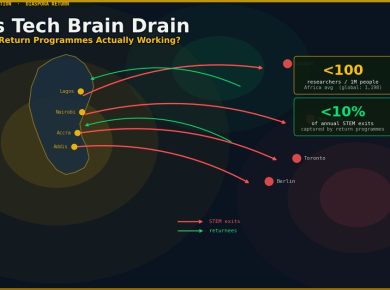
 UphivaBETAR