
Nigeria’s $750M DARES Programme: Africa’s Most Ambitious Solar Mini-Grid Deployment — And It’s Already Working
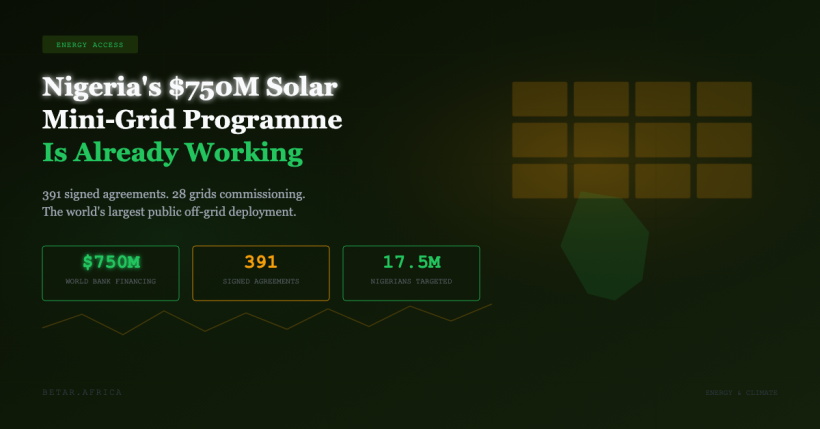
391 signed grant agreements, 28 solar mini-grids commissioning this quarter, and N100 billion in developer credit unlocked. The World Bank-backed DARES initiative is moving faster than the headlines suggest — and building a model that the rest of Africa should be studying.
Nigeria has approximately 90 million people who lack access to electricity. That figure — more unelectrified citizens than any other country on earth — has defined the country’s energy challenge for two decades and frustrated successive government programmes that promised transformation and delivered incremental change. In that context, the numbers coming out of the Distributed Access through Renewable Energy Scale-Up project, known as DARES, deserve closer attention than they have received.
As of early 2026, the programme coordinated by Nigeria’s Rural Electrification Agency has signed grant agreements with eight private renewable energy companies for isolated mini-grid deployment, followed by a second tranche signing with four additional developers. There are now 391 mini-grids under the programme with active grant agreements in place. In Q1 2026 alone, 28 new solar mini-grids are being commissioned. This is not a slow bureaucratic rollout. It is a scaled deployment infrastructure operating at speed, and the mechanism that makes it work is the least discussed part of the story.
The Grant Architecture That Makes Private Capital Work
DARES is structured around a $750 million International Development Association credit from the World Bank, approved in December 2023 in partnership with the Federal Government of Nigeria. But the headline figure understates the total capital mobilisation. Alongside the World Bank financing, the programme has secured $100 million from the Global Energy Alliance for People and Planet, $200 million from the Japan International Cooperation Agency, and is designed to catalyse over $1.1 billion in private sector co-investment.
The instrument that connects development finance to private developers is the Performance Based Grant, or PBG. Under this model, private mini-grid companies receive grant disbursements only after verified customer connections are made and operating. The grant is not an upfront subsidy tied to project construction milestones — it is a payment for demonstrated impact. Developers sign agreements, build the infrastructure at their own risk and cost, connect households and businesses, and then receive performance-verified grant funding as a rebate against that capital expenditure.
This architecture addresses one of the persistent failures of earlier energy access programmes in Africa: the tendency of grant capital to fund construction without ensuring that constructed assets deliver sustained service. By tying disbursement to verified, operational connections, DARES creates a direct incentive for developers to build systems that work, in communities with genuine demand, at a quality level sufficient to keep customers connected. The Rural Electrification Agency provides additional technical support to developers navigating complex rural deployment environments.
Of the $750 million IDA credit, $410 million has been earmarked specifically for performance-based grants to reduce upfront costs for developers. A further $127 million is directed at interconnected mini-grids serving peri-urban areas — communities that exist within nominal reach of the national grid but receive insufficient or non-existent supply in practice.
Who Is Building
The private developers signing DARES grant agreements built Nigeria’s off-grid sector through the predecessor Nigeria Electrification Project. The programme accommodates multiple models — isolated mini-grids, interconnected systems, and standalone solar home systems — reflecting Nigeria’s geographic diversity. Operators such as Husk Power Systems anchor supply around enterprise customers like agricultural processors and health centres before extending to residential communities, illustrating the commercial logic that makes rural mini-grid economics viable at scale.
The Lotus Bank Piece: Unlocking Developer Liquidity
The constraint that most frequently slows private energy access deployment in Africa is not the absence of long-term capital — it is the absence of short-term liquidity to fund procurement and construction before performance-based grants are disbursed. A developer who has signed a DARES grant agreement and identified a community still needs to procure solar panels, batteries, inverters, distribution hardware, and installation labour. Equipment lead times and import logistics mean that capital must be committed months before a single verified connection — and therefore a single grant payment — is possible.
This gap has historically been filled, or not filled, by developers’ own balance sheets and whatever short-term commercial credit they could access. In February 2026, the Rural Electrification Agency announced a partnership with Lotus Bank to address exactly this bottleneck. Lotus Bank is making available a revolving credit facility of one hundred billion naira — approximately $65 million at current rates — specifically for project developers to procure equipment for DARES and related renewable energy projects. The facility offers individual developers up to eight billion naira per draw, with an 18-month tenure designed to bridge the procurement-to-disbursement gap.
The N100 billion facility does not replace the grant funding — it provides the liquidity bridge that enables developers to actually deploy before grants are paid. For smaller operators whose balance sheets cannot absorb months of procurement costs, this instrument is the difference between participation in DARES and exclusion from it. By creating a dedicated short-term credit window linked to an active programme pipeline, the REA-Lotus Bank arrangement is attempting to solve a problem that has undermined energy access programmes across the continent: well-designed grant frameworks that fail to reach the developers who need them most because of a liquidity chasm between grant approval and grant receipt.
What 1,350 Mini-Grids Actually Means
The programme’s headline target — 1,350 solar mini-grids — is best understood not as a construction target but as a market-creation target. The World Bank’s own projections indicate that DARES will by 2030 provide electricity access to 17.5 million people and improved power supply to more than 237,000 micro, small, and medium-sized enterprises. The MSME figure matters as much as the household one. Rural enterprise is frequently the limiting factor in sustainable energy demand at mini-grid scale: a system that supplies only residential load often cannot generate the revenue per kilowatt-hour necessary to sustain commercial operations and maintenance. Anchor enterprise customers — a rice mill, a cold store, a health clinic, a mobile money kiosk — are what make mini-grid economics viable.
The 28 mini-grids commissioning in Q1 2026 are part of the third Rural Electrification Fund call; the government has also committed N100 billion for hybrid mini-grids at public facilities — schools and health centres — to serve as anchor enterprise customers.
For context: Nigeria’s national electricity grid, even at its peak, has never supplied reliable power to more than a fraction of registered consumers. The transmission network, built for a different demand topology and chronically underfunded, cannot absorb distributed renewable generation at scale in many regions. Mini-grids are not a stopgap until the national grid arrives. In much of rural Nigeria, they are the grid — and will remain so for a generation.
The Replication Question
DARES is not unique in its ambitions. Several African countries have designed or announced large-scale energy access programmes using blended finance and private-sector delivery. What makes Nigeria’s programme worth studying — and what the coverage of its $750M headline figure typically misses — is the specificity of its implementation architecture. The PBG model is not new, but its application at this scale, with this level of developer pipeline, with a dedicated short-term credit facility to address the liquidity gap, represents a degree of programme design sophistication that most energy access initiatives have lacked.
The question for the rest of sub-Saharan Africa is whether this architecture is replicable at the national level. Nigeria’s size — both its market scale and the depth of its private energy sector — may be a precondition that smaller markets cannot replicate directly. A country with three credible mini-grid operators cannot generate the competitive developer pipeline that supports 391 active grant agreements. But the components — performance-based grants, dedicated developer credit, public-sector anchor demand, graduated grant structures by deployment type — can be assembled in different configurations depending on what each market’s private sector can absorb.
The Rural Electrification Agency has, through successive programmes starting with the Nigeria Electrification Project, built institutional knowledge in off-grid programme administration that few energy agencies on the continent possess. DARES is building on that foundation. By 2030, if the deployment pipeline holds, Nigeria will have demonstrated something that has never been done before at continental scale: that a performance-based, private-sector-led model can deliver electricity access to tens of millions of people in a single decade. Whether it actually holds — whether the grant pipeline clears, the Lotus Bank facility deploys, and 1,350 mini-grids are commissioned on schedule — is the story that Africa’s energy sector should be tracking closely.


 UphivaBETAR