
Africa Micro-Credentials Reality Check: Do Employers Recognise Google, IBM, and ALX Certificates?
ALX reports 85 per cent employment for graduates. What it does not advertise is that only 6 to 8 per cent of enrollees reach graduation. That denominator problem is the most important fact in Africa’s micro-credentials debate — and it shapes everything about how employers actually use these certificates.
March 2026
The pitch is everywhere. Finish a Google Career Certificate in six weeks. Complete an IBM SkillsBuild pathway. Graduate from ALX. Get hired. Across Africa, millions of learners have enrolled in short-cycle credentials sold — implicitly or explicitly — as passports to tech employment. Yet the question the industry rarely answers clearly is whether the employers who are supposed to be waiting on the other side actually value what these programmes produce.
The answer, drawn from programme data, employer surveys, and a review of Africa’s emerging continental qualifications architecture, is: sometimes — in specific sectors, for specific roles — with significant caveats that the marketing rarely discloses.
The Completion Gap That Changes Everything
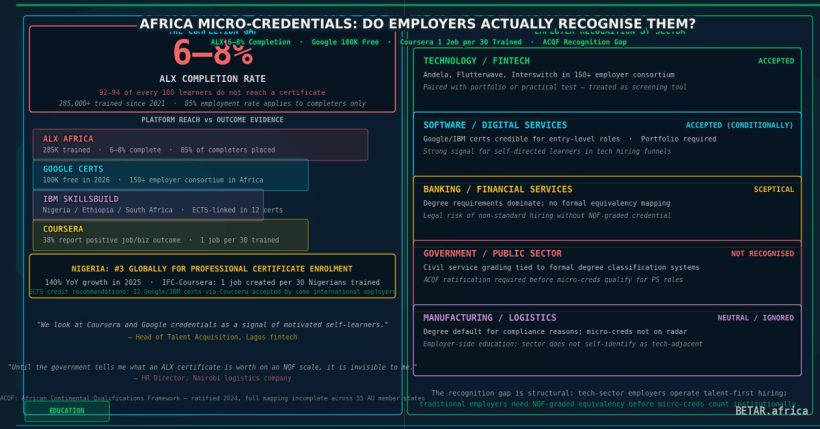
Employment outcome statistics for micro-credential programmes carry a concealed denominator problem. When ALX Africa reports an 85 per cent employment rate for graduates, the figure is accurate — and deeply misleading simultaneously. Investigative reporting by Rest of World and TechCabal has put the completion rate for ALX’s flagship software engineering track at between 6 and 8 per cent, meaning that of every 100 learners who register, somewhere between 92 and 94 do not reach graduation. The employment rate cited applies only to those who complete, not to those who start.
ALX has consistently disputed the framing of this as a failure, arguing that its open-enrolment model deliberately accepts learners at all preparation levels and that early attrition is a feature of self-paced distance education rather than a programme flaw. That argument is not unreasonable. It does not change the calculus for a learner in Accra or Abuja who spends three months on a programme and never reaches a certificate — their time has a cost that the employer-facing employment statistics do not capture.
Coursera’s data for Africa presents a more nuanced picture. Nigeria ranks third globally in professional certificate enrolment on the platform and experienced a 140 per cent year-over-year growth in that enrolment category in 2025. A 2025 IFC-Coursera study found that 38 per cent of Nigerian learners reported a positive job or business outcome following online learning — a meaningful share, but one that still leaves the majority without a verifiable labour market gain from their investment of time. One job is created for every thirty Nigerians trained on Coursera, per the same study.
The Scale of the Bet
The numbers involved are large enough to demand scrutiny. ALX Africa, the continent’s most ambitious micro-credential network, counts more than 285,000 learners trained since 2021. Google’s Africa career certificates initiative is offering 100,000 Africans free access to its professional certificate portfolio in 2026 alone, targeting roles in data analytics, IT support, cybersecurity, and project management. IBM SkillsBuild, through its Reskilling Revolution Africa partnership, is active in Nigeria, Ethiopia, and South Africa, awarding credentials in digital literacy, AI, and cybersecurity.
On the employer side, over 150 companies in Google’s African employer consortium — including Andela, Flutterwave, and Interswitch — have formally agreed to recognise Google Career Certificates as qualifying credentials for entry-level roles. In Nigeria, twelve Google and IBM professional certificates delivered via Coursera now carry ECTS credit recommendations from the Foundation for International Business Administration Accreditation, giving them a formal European credit equivalency that some international employers and universities accept.
These are real signals. They represent a genuine shift in how a subset of African employers, particularly those in the technology sector, think about hiring. The question is how representative that subset is — and what the data looks like for learners who do not end up at Andela or Flutterwave.
What HR Professionals Actually Think
The employer picture fractures sharply along sector lines. In the technology sector — fintech, software, digital services — micro-credentials from recognised programmes carry genuine weight. Andela, whose business model is built on matching certified African developers to global employers, sits at the centre of this recognition ecosystem and has made its position explicit.
“We assess candidates on demonstrated competency, not just on the name of the institution,” said Nkechi Eze, Head of Talent Acquisition at Andela. “A Google Career Certificate or an ALX completion is a meaningful signal when it is backed by a portfolio, a practical assessment result, or prior project work. We have placed developers holding those credentials with clients across the US, the UK, and across Africa. For entry-level and mid-level roles, the certificate is not a blocker — it can be a door opener, if the candidate can perform on assessment.”
The picture outside the tech sector is different. Banking, government, and large-scale manufacturing HR functions in Nigeria, Kenya, and South Africa reported persistent scepticism in surveys conducted by the African Centre for Education Research. Without a formal equivalency mapping — a mechanism that translates a Google certificate into a recognised qualification level — traditional employers have no institutional basis for treating micro-credentials as screening tools. Many default to degree requirements not because they believe degrees are better preparation, but because degree verification is a legally defensible hiring standard and micro-credential verification is not.
“I would love to hire on skills alone,” said one HR director at a Nairobi-based logistics company, speaking on background. “But if I hire someone without the required qualification on paper and something goes wrong, I cannot defend that decision to a board. Until the government tells me what an ALX certificate is worth on an NQF scale, it is invisible to me.”
The ACQF Gap: Africa’s Missing Recognition Infrastructure
That remark goes to the structural problem at the centre of the micro-credentials debate in Africa: the continent does not yet have a functioning qualifications recognition architecture for short-cycle, non-institutional credentials.
The African Continental Qualifications Framework (ACQF), an African Union initiative implemented with European Training Foundation support, is designed to harmonise qualification recognition across the continent and provide exactly the cross-border equivalency that would allow a Rwandan employer to verify what a Nigerian micro-credential is actually worth. The ACQF published its first continental micro-credentials handbook in 2025 and held a formal “Recognition and Exchange of Microcredentials” consultation in December 2025. The framework’s own documentation notes that the AfCFTA founding documents explicitly require a continental qualifications framework to support the free movement of persons.
But the ACQF remains at the implementation and capacity-building stage in most member states. National qualifications frameworks — the prerequisite infrastructure for ACQF alignment — are absent or incomplete in a majority of African countries. An ACQF background paper estimates that without effective credential recognition, Africa loses between 10 and 15 per cent of potential economic value from skilled labour mobility. That is the cost of the gap in measurable terms.
Country Variation Is Significant
The micro-credentials recognition landscape varies meaningfully across the four markets the brief requires covering. Nigeria has the highest enrolment volume and the most active government partnership pipeline, with NITDA’s Coursera programme placing some graduates at major technology companies. However, Nigeria’s fragmented national qualifications architecture means employer-side uptake outside the tech sector is minimal.
Kenya’s ongoing Competency-Based Curriculum transition creates a structural opening: as the education system shifts toward outcomes-based credentialing, micro-credentials that demonstrate competency rather than contact hours may fit more naturally into hiring decisions over the coming decade. The Ministry of Education has not yet issued formal guidance on micro-credential recognition, but the policy direction is more receptive than in any other large African market.
South Africa has the continent’s most developed national qualifications framework via the South African Qualifications Authority (SAQA), but micro-credentials from private global platforms are not yet mapped to the NQF. IBM’s Womandla partnership and the Reskilling Revolution Africa programme have built meaningful local delivery infrastructure but recognition still depends on individual employer discretion.
Ghana, which hosted ALX’s West Africa expansion, has seen increased take-up of technology micro-credentials through the Ghana Jobs and Skills Project, a World Bank-funded initiative that has begun mapping some short-course outcomes to the Ghana Qualifications Framework. It is the most advanced experiment in formal integration on the continent, though it remains limited in scope.
The Verdict
Micro-credentials from Google, IBM, ALX, and Coursera are not worthless in African labour markets. In the technology sector, for the learners who complete them and can demonstrate practical competency, they provide a genuine employment signal that a growing number of employers act on. The employer consortium infrastructure Google has built, and the ECTS equivalency Coursera has secured for twelve major certificates, represent real progress.
They are not passports to employment in the broader sense the marketing implies. The completion gap — 6 to 8 per cent at ALX, 38 per cent positive outcomes on Coursera Nigeria — is severe enough that headline employment statistics need a denominator correction before they are meaningful. The formal recognition infrastructure that would make micro-credentials legible to traditional employers, government HR functions, and cross-border labour markets does not yet exist at scale. Africa loses measurable economic value every year that gap persists.
The most honest summary: a Google or IBM certificate probably gets you an interview at a Lagos fintech or a Nairobi software house, and at companies like Andela it can be a direct placement credential if paired with demonstrated competency. It will not substitute for a degree on most government job applications or in most bank HR systems. Whether that is sufficient depends entirely on which job you are trying to get.


 UphivaBETAR