
Africa’s Early Childhood Education Crisis: Why Less Than 4-in-10 Children Enter School Ready to Learn
Sub-Saharan Africa has the world’s lowest pre-primary enrolment rate. Ghana has shown what universal access looks like. Rwanda has shown that outcomes-based financing can move the needle. Neither model has spread fast enough — and now USAID is gone.
March 2026
Africa’s learning poverty crisis — the fact that 89 per cent of sub-Saharan African children cannot read a simple text by age 10 — has attracted significant policy attention since the World Bank made it a headline metric. What has received far less scrutiny is the crisis one step upstream: sub-Saharan Africa sends the largest share of its children into primary school without any organised learning preparation whatsoever. The pre-primary enrolment gap is not a consequence of the learning poverty crisis. It is, in substantial measure, its cause.
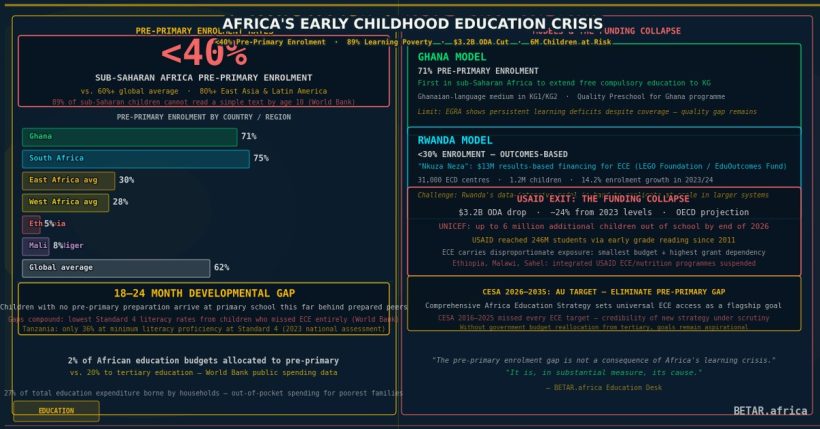
UNESCO Institute for Statistics data and UNICEF MICS assessments consistently place sub-Saharan Africa’s attendance rate in organised early childhood education at below 40 per cent for children aged 36 to 59 months — against a global average that has stabilised above 60 per cent and above 80 per cent in East Asia and Latin America. UNICEF’s most recent regional analysis finds that no sub-region within sub-Saharan Africa has closed the gap to the global average. The region lags on every early childhood development metric: pre-primary enrolment, home learning environment quality, and school readiness indicators including early numeracy and pre-literacy skills.
The consequences are not abstract. Children who have not participated in any structured early learning programme arrive at primary school with an 18-to-24-month developmental gap versus their prepared peers, according to World Bank early childhood development assessments. Those gaps compound. By Standard 4 — the grade at which learning poverty is typically measured — children who missed pre-primary education show markedly higher rates of foundational literacy failure. In Tanzania, whose Standard 4 national learning assessment found only 36 per cent of students at minimum literacy proficiency in 2023, EGRA data shows that the weakest performers are overwhelmingly drawn from the two-thirds of children who entered primary school with no pre-primary preparation.
The Sub-Regional Picture
The aggregate figure conceals variation that matters for policy. In West Africa, pre-primary enrolment rates range from below 10 per cent in Mali and Niger to above 40 per cent in Côte d’Ivoire and Senegal, where Francophone early childhood infrastructure — driven partly by French bilateral education cooperation — has created a broader formal ECE sector than in comparable Anglophone systems. In East Africa, Ethiopia and Sudan anchor the bottom of the range at below 5 per cent enrolment, while Kenya, Uganda, and Tanzania cluster between 25 and 35 per cent. Southern Africa presents the continent’s most favourable sub-regional picture, with South Africa, Botswana, and Namibia running pre-primary systems that approach 70 to 80 per cent coverage — though quality and equity within those systems remain significant concerns.
“We track the enrolment number because it is countable, but enrolment in ECE is a floor measure, not a quality measure,” said Dr. Hasina Rakotomalala, an early childhood development specialist at the UNESCO Regional Bureau for Education in Africa in Dakar. “What we know is that the majority of children across sub-Saharan Africa are not in any organised learning environment before primary school, and the data on those who are formally enrolled shows highly variable quality. The region’s pre-primary system is thin, inequitable, and underfunded — and we are now adding the shock of the US aid withdrawal on top of a system that was already fragile.”
Ghana’s Model — and Its Limits
Ghana represents the clearest demonstration that universal pre-primary access is achievable in sub-Saharan Africa within a national public system. The country is the first in the region to have extended free, compulsory basic education to kindergarten, driving a pre-primary enrolment rate that the Ghana Education Service estimates at approximately 71 per cent — the highest in sub-Saharan Africa and the product of two decades of deliberate policy, not a sudden investment surge. The government’s commitment to kindergarten as part of the universal basic education mandate, its integration of Ghanaian languages as early literacy mediums in KG1 and KG2, and the Quality Preschool for Ghana programme — a partnership between the Ghana Education Service and international development partners — have together created a system that now reaches the majority of children before primary enrolment.
The Ghanaian model’s limits are instructive. Despite near-majority coverage, Early Grade Reading Assessment data collected with Ghana Education Service support shows persistent learning deficits at the end of KG — meaning that coverage without quality is still insufficient preparation for primary learning. Teacher professional development for ECE has not kept pace with enrolment expansion. The urban-rural quality gap is acute: community KG classes in the Northern, Savannah, and Upper East regions operate with larger class sizes, fewer trained ECE teachers, and less materials support than their Greater Accra counterparts. Ghana’s experience demonstrates that the access problem is solvable — and that solving it is necessary but not sufficient.
Rwanda’s Outcomes-Based Bet
Rwanda’s approach to early childhood education reflects the country’s broader preference for structured, monitored, outcomes-linked programming over enrolment-only expansion. The National Child Development Agency currently oversees approximately 31,000 ECD centres serving over 1.2 million children — a system that has grown substantially since the establishment of the NECDP Strategic Plan. Enrolment in ECD centres grew 14.2 per cent in the 2023/24 academic year, reaching approximately 692,000 children across the formal early childhood system, according to the Ministry of Education’s Statistical Yearbook.
In 2024, Rwanda launched “Nkuza Neza” — meaning “raise well” — the country’s first national results-based financing programme for early childhood care and education. The $13 million initiative, led by the NCDA in partnership with the Education Outcomes Fund and supported by the LEGO Foundation, ties disbursements to measurable child development outcomes rather than input metrics. Over four years, it is designed to reach more than 25,000 children across 390 community ECD centres, generating evidence on which delivery models produce the strongest school readiness results for the most vulnerable children. “We are not just expanding coverage — we are building the evidence base to know what quality looks like at scale,” Rwanda’s Minister of Education told the Global Partnership for Education at the GPE 2024 summit. “Nkuza Neza is designed to answer the question that most ECE programmes do not: which investments actually move child development outcomes?”
Rwanda’s pre-primary enrolment rate remains below 30 per cent in the formal system, but the trajectory is upward and the policy architecture is more rigorous than anywhere else on the continent. The challenge is that Rwanda’s model — data-intensive, outcomes-monitored, centrally coordinated — is difficult to replicate in larger, more heterogeneous systems without comparable institutional capacity.
The Private ECE Trap
Across sub-Saharan Africa, the structural response to underfunded public ECE has been the growth of a private early childhood market — ranging from unregistered community crèches and church-run nurseries to the expanding networks of affordable private pre-schools that have proliferated in peri-urban areas of Lagos, Nairobi, Accra, and Dar es Salaam. The private ECE market fills a genuine gap. It is also, by design, inaccessible to the families with the least resources and the most to gain from early childhood intervention.
African governments spend an average of 2 per cent of their education budgets on pre-primary education, against 20 per cent directed to the tertiary level, according to World Bank public spending data. The resulting vacuum has been filled by private providers and by household out-of-pocket spending — which the World Bank estimates at 27 per cent of total education expenditure across the continent. For the rural poor and the urban informal sector — the majority of Africa’s population — private ECE is simply unaffordable. Many parents enrolled children in primary school at age 4 and 5 precisely because formal pre-primary fees are out of reach, creating the overcrowded lower-primary classrooms that further undermine early learning quality. The children who miss ECE are the children who need it most.
The USAID Gap in Early Childhood
USAID’s early grade reading programmes are the most cited element of the US education withdrawal — and rightly so, given that USAID reported reaching nearly 246 million students through early grade reading interventions since 2011. Less discussed is USAID’s role in early childhood specifically: supporting school readiness programmes, community ECE centre quality assessments, and the training of ECD facilitators in countries where government capacity to deliver that training is lowest. In Ethiopia, Malawi, and several Sahel countries, USAID-funded ECE components formed part of integrated early childhood and nutrition programmes. Those programmes have been suspended under the 2025-26 aid freeze.
The OECD now projects that Official Development Assistance for education will fall by $3.2 billion — a 24 per cent drop from 2023 levels. UNICEF warns that up to 6 million additional children could be out of school by end of 2026 as a direct consequence of funding cuts. The early childhood segment — smaller and less politically visible than secondary education — carries a disproportionate share of the exposure, because it sits in the portion of the education system where domestic government investment is most limited and external grant funding was most load-bearing.
The CESA 2026-2035 Test
The African Union’s new continental education strategy, CESA 2026-2035, carries a pre-primary enrolment target, and the AU’s mid-2026 Children Summit is expected to put early childhood development explicitly on the continental political agenda. The strategic question — which CESA drafters are still working through — is whether the financing architecture of the new strategy accounts honestly for the disappearance of US bilateral education support and the structural limits of private ECE markets.
The return on investment case for early childhood spending is clear: the World Bank estimates that every dollar invested in pre-primary education yields up to $14 in lifetime economic benefits — the highest return of any educational stage. African governments have known this for two decades. The 2024 Africa Foundational Learning Exchange conference produced a collective pledge to eliminate learning poverty by 2035. The pledge will be tested, first and most directly, against whether the continent can reverse a pre-primary enrolment gap that has barely moved in a generation.
Rwanda and Ghana have demonstrated that the gap is closeable. The mechanisms — results-based financing, free universal KG, community ECD investment — are documented and replicable. What has been missing is the combination of domestic political will and financing sufficiency to take those models to continental scale. The USAID withdrawal makes the domestic financing question non-negotiable. The $14-to-$1 return on early childhood investment is a compelling argument. It has not yet produced the budget allocations to match.

 UphivaBETAR