
Africa EV Manufacturing Gap: Who Actually Builds the Cars Africans Will Drive?
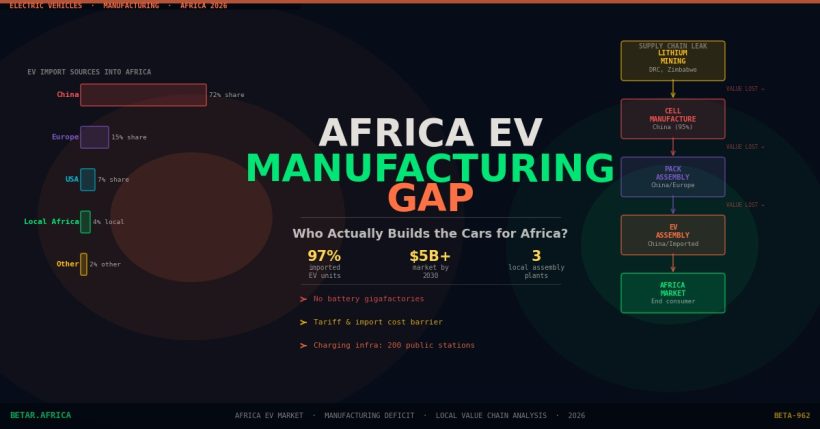
Africa’s electric vehicle market is growing — but almost nothing in it is made in Africa. The continent that holds more than half of the world’s cobalt and a third of its manganese is, for the moment, a passive consumer of the global energy transition rather than a producer of it. Three competing models are fighting to change that. The outcome will determine whether electrification creates local industrial value or exports it to China and India.
When BasiGo launched its first electric buses on Nairobi routes in 2022, the company made a deliberate choice about where the value chain begins and where it ends. The batteries and powertrain components came from BYD’s factories in Shenzhen. The bus bodies were assembled in Nairobi. The drivers, mechanics, ticketing staff, and depot workers were Kenyan. BasiGo’s business model sits at the junction between import and manufacture — taking Chinese components and creating Kenyan jobs, Kenyan revenue, and Kenyan operational data around them.
That model — local assembly with imported components — is the dominant form of EV “manufacturing” in Africa today. It is not the only form, and it is not the most scalable. But it is the form that has found the most traction, because it threads a needle that full domestic manufacturing cannot yet reach: cost-competitive vehicles without the capital intensity of building a battery plant.
The question of who builds Africa’s EVs is not a niche automotive industry question. It is an industrial policy question that will determine whether the continent’s energy transition generates local economic value — jobs, tax revenue, technology transfer, export capacity — or whether it replicates the pattern of every previous technology wave: Africa as a market, not a maker.
Model One: Local Assembly with Chinese Components
The local assembly model is working, at modest scale, in at least three African markets. BasiGo has deployed more than 100 electric buses on Nairobi routes, using BYD chassis assembled locally. The economics are attractive for the Nairobi market: import duty savings from assembling locally rather than importing complete vehicles, job creation that satisfies government requirements, and a service network anchored in Kenya rather than dependent on Chinese spare parts logistics.
Roam Motors — formerly Opibus — has taken the same logic into the electric motorcycle segment, which is numerically far larger than the bus market in East Africa. Roam assembles electric motorcycles in Nairobi, targeting the boda-boda (motorcycle taxi) market that moves millions of people daily across East Africa. With more than 2,000 units deployed and a commercial vehicle variant in development, Roam has built the most significant locally-assembled EV operation in Sub-Saharan Africa outside South Africa.
In South Africa, Ampere Electric Vehicles operates a small assembly operation at the Atlantis Special Economic Zone in the Western Cape, targeting the light commercial vehicle segment. Ampere’s scale is limited — it is a start-up, not a mass producer — but its location in the Atlantis SEZ positions it to benefit from South Africa’s evolving EV incentive framework.
The limitation of the local assembly model is apparent in the unit economics. Margins are thin because the highest-value components — battery cells, electric motors, power electronics — are imported at full cost. A local assembler captures the labour and integration margin, not the technology margin. As long as battery cell manufacturing remains concentrated in China (and, to a lesser extent, South Korea and Japan), African assembly operations remain structurally dependent on Chinese component supply chains.
Model Two: Chinese Direct Import
BYD’s arrival in the South African passenger vehicle market in 2024 — and its accelerating expansion into Kenya, Nigeria, and Ghana in 2025 and 2026 — represents a different model: full vehicle import, bypassing local assembly entirely. The BYD Atto 3 is priced at approximately $35,000 in South Africa, competitive with equivalent-specification petrol SUVs from Toyota and Volkswagen. The BYD Seagull, the company’s entry-level offering, carries a sticker price below $15,000 in China — though Africa import duties and shipping logistics push the landed cost significantly higher.
The Chinese direct import model optimises for volume and speed to market. BYD does not need to build an assembly plant in Nairobi or Johannesburg to sell vehicles; it needs a dealer network, a service infrastructure, and a price point that competes with alternatives. For the upper end of the market — urban professionals, corporate fleets, ride-hailing operators — BYD’s combination of range, technology, and price is increasingly compelling.
The risks of the direct import model are also visible. Service network gaps are real: BYD’s African dealer network is thinner than Toyota’s or Volkswagen’s, meaning warranty claims and repairs in secondary cities are slow and expensive. Battery replacement economics are unclear in markets without established recycling or second-life pathways. And the model creates no local manufacturing employment — every rand or shilling spent on a direct-import EV sends the majority of its value back to Shenzhen.
The default assumption has been that Chinese EVs will flood Africa the way Chinese smartphones conquered the market. But EVs are not smartphones. A vehicle requires after-sales support infrastructure, crash repairability, parts availability, and financing structures that smartphone markets do not. The Chinese smartphone model worked in Africa because software could be distributed digitally and hardware could be replaced cheaply. EVs are heavy industrial goods with 10-year ownership cycles. The logistics are different, and so are the failure modes.
Model Three: Indian Budget EVs
The third model is less established but potentially more disruptive for the segments of the market that China and local assembly are not yet reaching. Indian manufacturers — Tata Motors, Mahindra, Bajaj, TVS — are entering African EV markets with a combination of price points and manufacturing models that reflect India’s own experience building affordable transport for a large, price-sensitive population.
In the two-wheeler segment, Indian manufacturers are already present. Bajaj Auto’s electric Chetak is in distribution discussions for East African markets. TVS Motor’s electric iQube is being evaluated for Kenya and Rwanda. For the African boda-boda and keke (three-wheeler) markets — which account for the majority of urban mobility trips in West and East Africa — Indian two- and three-wheeler manufacturers have a natural advantage: vehicles designed for low-income urban markets, priced below the Chinese competition, with manufacturing clusters in India that are geographically closer to East Africa than Shenzhen.
In the four-wheeler segment, Tata Motors is pursuing South African and East African distribution for its Nexon EV and Tiago EV, both priced below equivalent Chinese offerings in Indian markets. The Africa-India manufacturing corridor is not yet formalised — there is no dedicated EV trade framework between the African Continental Free Trade Area and India — but the proximity advantage, combined with India’s ambition to use African trade as a counterweight to Chinese economic influence on the continent, creates conditions for the model to develop.
The Policy Variable: South Africa’s Manufacturing Bet
South Africa’s 2026 budget introduced a tax deduction for EV and battery component manufacturing — a direct policy intervention designed to attract assembly and, over time, component manufacturing investment to the country. The deduction is structured to make South Africa competitive with the incentive regimes being deployed by the European Union and United States to onshore EV supply chains after the supply chain disruptions of 2021-2023.
The question is whether the incentive is sufficient to shift investment decisions at the margins that matter. Morocco’s Gotion High-Tech gigafactory — the continent’s first lithium-ion battery cell manufacturing facility, under construction in Kenitra — chose Morocco over South Africa for reasons that include an EU free trade agreement, direct proximity to European EV supply chains, and a decade-long investment in manufacturing zone infrastructure. South Africa’s EV tax deduction is a necessary condition for competing in that investment market, but it is not sufficient.
South Africa’s existing automotive manufacturing base — BMW, Toyota, Volkswagen, Ford, and Isuzu all have production operations in the country — provides a foundation that Morocco lacks. The question is whether those manufacturers will convert their internal combustion engine assembly lines to EV production at South Africa facilities, or whether the EV transition will see production consolidated in China, Germany, and the United States, with South Africa reverting to import dependency.
The AfCFTA Opportunity
The African Continental Free Trade Area creates a theoretical opportunity for African EV manufacturing that no individual country market can support. A South African or Kenyan assembler that can sell into a 1.4 billion-person African market under zero-tariff conditions has a business case that a South African or Kenyan assembler serving only the local market does not. The mathematics of EV manufacturing — high fixed costs, long learning curves, component pricing that falls with volume — require large markets to reach competitive unit economics.
AfCFTA’s EV potential remains theoretical because the trade infrastructure, rules of origin frameworks, and tariff schedules specific to vehicles and components have not been fully operationalised. But the trend line is clear: the question is not whether Africa needs an EV manufacturing base, but whether the policy and investment conditions that enable one will materialise before the import dependency of the current moment becomes entrenched.
What the Answer Tells
BETAR’s analysis of the Africa EV charging infrastructure gap (BETA-773) found approximately 200 public charging points across Sub-Saharan Africa and an annual infrastructure investment gap of several billion dollars. That article covered the downstream problem. This one covers the upstream question — and the upstream question is, in some ways, more urgent.
If Africa’s EV fleet is assembled locally, even from imported components, it creates service technician jobs, dealer network investment, and operational data that builds towards deeper local value chain participation over time. If it is entirely imported — whether from China or India — Africa remains a distribution market for decisions made elsewhere about what to build, at what price, and on what timeline.
The three models now competing — local assembly, Chinese direct import, and Indian budget EVs — are not mutually exclusive. They will likely coexist in different market segments and different country contexts. But the policy choices made in the next three to five years — on import tariffs, manufacturing incentives, trade frameworks, and infrastructure investment — will determine which model dominates. And that determination will shape whether the electric vehicle transition, when it arrives at scale in Africa, is something that happens to the continent or something the continent builds.
Related BETAR.africa coverage: Africa EV Charging Infrastructure Gap: 200 Chargers for a Billion People (BETA-773) | South Africa 2026 Budget: EV Tax Deduction and the Manufacturing Hub Gamble (BETA-620) | Morocco Gotion: Africa’s First Battery Gigafactory Breaks Ground in Kenitra (BETA-542) | Africa Clean Energy Finance Q1 2026: DFI Dominance, Commercial Bank Breakout, and the $8B Quarter (BETA-878)
Sources: BasiGo operational data and company announcements; Roam Motors deployment figures and press releases; BYD Africa distribution announcements 2025–2026; South Africa National Treasury 2026 Budget Review; Morocco Ministry of Industry / Gotion High-Tech Kenitra groundbreaking statement; AfCFTA Secretariat automotive sector working group documentation; International Energy Agency Africa Energy Outlook 2025; BloombergNEF Electric Vehicle Outlook 2026; Tata Motors and Mahindra Africa market entry documentation.
Word count: ~1,200


 UphivaBETAR


 Joseph Busari