
One Licence, Two Markets: What the Kenya-Rwanda Payment Passporting Deal Means for East African Fintech
The Kigali Declaration on Fintech Licence Passporting moves faster than the EAC multilateral process. Here is who benefits, who is left out, and what Rwanda’s bilateral playbook means for the rest of the continent.
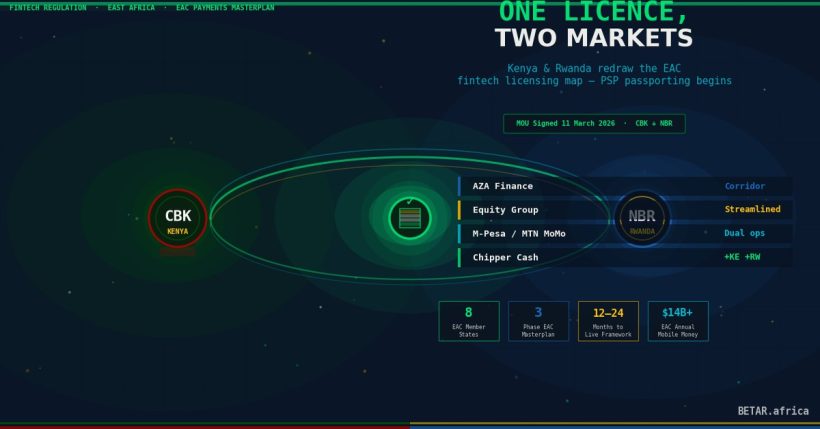
On 11 March 2026, at the Inclusive FinTech Forum in Kigali, the Central Bank of Kenya and the National Bank of Rwanda signed what they are calling the Kigali Declaration on Fintech Licence Passporting. The agreement allows payment service providers licensed in one country to expand into the other without undergoing a full second licensing process. It is the most concrete bilateral step toward East African payments integration in years — and it lands in two markets that are each pursuing aggressive digital finance agendas on their own terms.
The declaration was signed by Soraya Hakuziyaremye, Rwanda’s central bank governor, and Gerald Nyaoma, CBK’s deputy governor. A joint technical committee from both institutions will now define the administrative procedures that turn the framework operational — meaning no PSP can skip a full licence just yet. The timeline for that implementation work has not been publicly set, but both sides have framed this as a standing-up phase, not a long-term workstream.
Why This Is Harder Than It Looks — and Why It Still Matters
Getting a payment service provider licence in either Kenya or Rwanda is not cheap. Depending on licence category, cost and capital requirements, the total burden of securing PSP authorisation in a single East African market can run between $70,000 and $700,000. Multiply that across two jurisdictions — with duplicative KYC infrastructure, compliance reporting, and supervisory engagement — and regional expansion becomes a capital problem, not just a regulatory one. Smaller, well-regulated fintechs are the ones squeezed hardest.
The passporting framework addresses this by establishing mutual recognition: a firm that meets one regulator’s standards should not have to prove the same things to the other from scratch. It does not mean zero scrutiny on the second side. Both central banks have made clear that supervisory cooperation, not supervisory abdication, is the model — the home regulator remains responsible, but the host can rely on that supervision rather than starting fresh.
Which Fintechs Stand to Move First
The immediate beneficiaries are likely to be firms already embedded in one market with clear commercial ambitions in the other. MTN MoMo and Airtel Money both operate in Kenya and Rwanda, but under separate regulatory regimes for each market — the passporting framework, once operational, would allow the existing licence in one jurisdiction to accelerate the regulatory pathway in the other. Chipper Cash, which has been deepening its Rwanda presence for remittances, holds a CBK-recognised structure and could benefit from reduced friction entering Rwanda’s formal payments layer. M-Pesa’s operator Safaricom, dominant in Kenya but absent from Rwanda, is a plausible medium-term play if the operational procedures are drawn broadly enough to include mobile money operators, not just standalone PSPs.
Wave, which has built significant mobile money infrastructure across West Africa but has not established a substantive presence in the East African Community, is unlikely to be an immediate mover — the Kenya-Rwanda deal does not lower the barrier of building from zero in a new region. The passporting benefit flows to firms that are already regulatory incumbents in one of the two markets.
There is also a question of what gets left out. Crypto and virtual asset service providers are operating on a different regulatory track in both Kenya — where VASP regulations are still in public consultation — and Rwanda, which is running its own dual-track approach on digital assets. The passporting declaration covers payment service providers under existing frameworks; it does not extend to the VASP licensing regimes that both countries are still constructing.
Rwanda’s Pattern — and What It Signals
This is not Rwanda’s first passporting agreement. In February 2025, the National Bank of Rwanda and the Bank of Ghana signed what was described at the time as Africa’s first fintech licence-passporting deal. The Ghana-Rwanda MoU covered a different corridor — West Africa to East Africa — with limited bilateral payment flows but significant symbolic value. The Kenya-Rwanda deal is more commercially material: Kenya and Rwanda share a land border, strong trade ties, and a large population of cross-market workers, students, and businesses for whom cross-border digital payments are a regular need.
Rwanda’s strategy is becoming clear: the National Bank is systematically building a web of bilateral passporting arrangements that position Kigali as the regulatory hub of African fintech expansion. Each deal adds to Rwanda’s attractiveness as the jurisdiction-of-first-choice for fintechs seeking continental reach. BNR’s parallel CBDC pilot (the e-FRW) and the RNDPS 2.0 infrastructure upgrade are part of the same architecture.
The EAC Masterplan Context
The Kenya-Rwanda declaration does not exist in isolation. Both countries are signatories to the EAC Cross-Border Payment System Masterplan, a framework designed to cut regional transaction costs by more than 50% over the long term and built around four pillars: governance, infrastructure, inclusivity, and capacity building. A Rwanda-Tanzania pilot for a regional instant payment network is already underway under the EAC’s Eastern Africa Regional Digital Integration Project, which is World Bank-funded.
What Kenya and Rwanda have done with this bilateral MoU is move faster than the multilateral EAC process can move. They have established a two-market proof-of-concept that, if the joint technical committee delivers workable operational procedures, gives the rest of the bloc a template to replicate — much as the Ghana-Rwanda deal gave East Africa a template to follow. Whether SADC, which is running its own payments harmonisation agenda through SADC-RTGS and TCIB, will look to model similar bilateral passporting arrangements remains to be seen. The EAC is ahead on this specific mechanism.
The implementation work now before the joint committee is unglamorous — jurisdiction mapping, supervisory information-sharing protocols, escalation procedures. But the declaration is signed, and the direction is set. For payment firms operating in East Africa, the question is no longer whether the regulatory landscape will shift toward regional integration, but how quickly the technical committee will make that shift actionable.
— Technology Desk, BETAR.africa


 UphivaBETAR



 Joseph Busari