
Africa’s School-to-Work Gap: Why 60% of Youth Are Neither Employed Nor in Training
Sub-Saharan Africa’s NEET crisis is not primarily a skills mismatch story. It is a structural failure in the transition infrastructure between education and employment — a gap that no institution owns, no budget funds, and that informal apprenticeship, EdTech platforms, and rural-to-urban migration have partially filled, each with significant limits.
March 2026
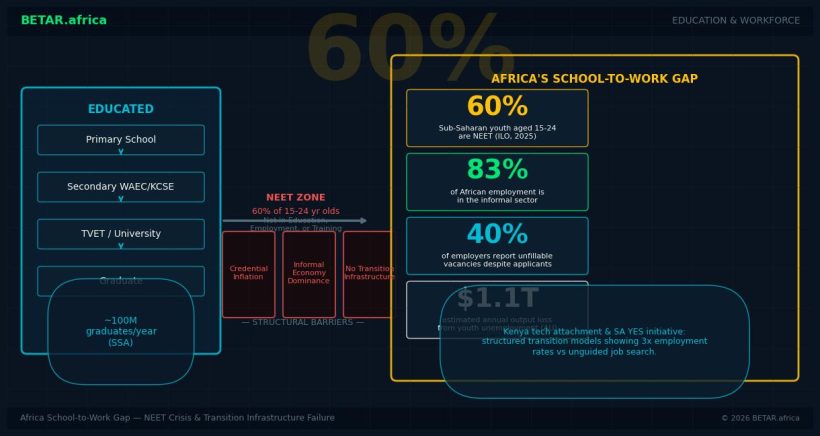
Every year, millions of young Africans collect their secondary school certificates and walk into a gap. Universities cannot absorb them — fewer than one in ten finds a tertiary place. Formal employers will take fewer still. The ILO estimates that roughly 60 per cent of young people aged 15–24 across sub-Saharan Africa are NEET — not in education, employment, or training — at any given time. The AfDB’s continental youth jobs data tells the same story. Africa is producing more school completers than at any point in its history and placing fewer of them into formal employment.
The common framing is skills mismatch: young people have the wrong training for available jobs. That is not wrong, but it is incomplete. Africa’s school-to-work gap is primarily a transition infrastructure problem. The continent has invested in schools on one side and employer hiring processes on the other, with almost nothing built between them. The void has been filled by informal apprenticeship, private EdTech, and migration — each a rational individual response, none a structural solution.
The Credential Inflation Trap
The first obstacle most school-leavers encounter is not a lack of skills but a credential that no longer signals what it was designed to signal. WAEC reported that 77.4 per cent of Nigerian candidates achieved five credits including English and Mathematics in May/June 2024 — up from roughly 36 per cent a decade earlier. Kenya’s KCSE results show a similar upward trend. On paper, the continent is producing better-educated school-leavers than ever.
Employers are not reading the same data. Across Lagos, Nairobi, Accra, and Johannesburg, HR professionals describe a consistent pattern: minimum hiring thresholds have drifted above what official pass marks require, because employers no longer trust that a certificate indicates a reliable level of competence. “We stopped using WAEC scores as a filter at first shortlist,” said one Lagos-based HR manager at a logistics company hiring around 200 entry-level staff per year. “We run our own numeracy and comprehension test now. The scores have nothing to do with the certificate.” The company introduced its in-house assessment in 2022, after successive cohorts of graduates with strong WAEC results required remedial training before performing basic tasks accurately. As employers discount the credential, more learners pursue additional certificates — inflating time out of the labour market and producing diminishing returns for the economy.
Informal Apprenticeship: The System Nobody Designed
In the absence of formal transition infrastructure, informal apprenticeship has become Africa’s dominant school-to-work bridge. The World Bank estimates that more than 80 per cent of vocational skills acquisition in West Africa occurs through arrangements between a master artisan and a learner, governed by social norms rather than state regulation. Nigeria alone is estimated to have between 3 and 5 million active informal apprentices at any given time. The system works for what it was designed to do: transfer practical skills in a defined trade within a community that enforces quality standards through reputation. Its limits are structural. Informal apprenticeships do not prepare learners for the digital economy, do not produce credentials recognised outside the local trade community, and require the learner to be physically present where the trade is practiced — which increasingly means a city.
What Structured Transition Looks Like
A small number of interventions have attempted to build structured school-to-work transition at meaningful scale. Kenya’s technical attachment programme, operated through TVETA, places TVET graduates with employer partners for a supervised period before formal hire. A 2024 evaluation by KIPPRA found that TVET graduates who completed a structured attachment were 34 per cent more likely to be in formal employment within 18 months of graduation than those who had not. The challenge is scale: attachment slots depend on employer participation, and uptake has been concentrated in manufacturing and hospitality rather than the digital economy sectors where demand is growing fastest.
South Africa’s YES (Youth Employment Service) initiative takes a different approach. Established in 2018 through a partnership between government, business, and labour, YES incentivises companies to create 12-month paid work experiences for unemployed youth through tax credits linked to the number of black youth employed. Over 165,000 work experiences had been created by 2025 across retail, financial services, and agriculture. “The YES programme gave us a structured way to test candidates before a permanent hire,” said Sibusiso Dlamini, HR director at a South African retail group participating in the scheme. “We’ve converted about 40 per cent of our YES cohort into permanent roles. Without the subsidy, we wouldn’t have taken the risk on that volume of first-time workers.” Both models share a common architecture: a defined, funded transition period with an employer on one end and a supported learner on the other. Neither the credential nor the market does the bridging alone.
EdTech’s Narrow Lane
Over the past decade, Africa’s coding bootcamp sector — led by ALX Africa, Moringa School, and Decagon Institute — has produced strong placement outcomes for its graduates, driven primarily by selectivity. Decagon’s income-share model and Moringa’s paid cohort structure have delivered employer trust in their specific markets. But the sector’s reach is defined by its limits: all three platforms train primarily for software engineering and data roles, a segment that is growing but remains a fraction of the total school-leaver cohort. “The bootcamp conversation is about the 2 per cent,” said Ama Owusu, director of a Ghanaian workforce transition programme supported by government and employer funding. “We’re proud of what ALX and Decagon have done. But we need solutions for the 98 per cent who are not going to become software engineers.”
Migration as Default Policy
For a significant share of African school-leavers, the school-to-work transition is not a local process. It is a migration. Rural-to-urban movement remains one of the continent’s most rational individual responses to the transition gap: cities offer higher concentrations of informal work, greater employer network density, and — in the absence of structured pathways — the best available substitute for a designed mechanism. Research by the International Growth Centre in 2023 found that the median time-to-first-income for a rural-to-urban migrant in sub-Saharan Africa’s major cities was 47 days — nearly seven weeks of urban costs before any income arrives. For families near the poverty line, this is a significant investment with no guaranteed return. As migration accelerates toward a majority-urban continent by 2040, the informal labour markets absorbing most school-leavers will face increasing saturation.
Nobody Owns the Gap
The uncomfortable answer to the school-to-work question is that nobody owns the transition. Schools deliver graduates to a certificate. Employers hire from an applicant pool. The space between belongs to no institution, no budget line, and no accountability structure. The AU Continental Education Strategy 2026-2035 includes a dedicated objective on school-to-work transition for the first time. The AfDB’s 2030 jobs strategy identifies youth transition infrastructure as a discrete investment category. The USAID withdrawal has removed structured programming across 14 African countries at precisely the moment demographic pressure is highest. Policy recognition now exists. Funded mechanisms, at the scale Africa’s NEET numbers require, do not.


 UphivaBETAR



 Joseph Busari