
Africa Education Budget Accountability: Are Governments Meeting the UNESCO 20% Commitment?
All 54 AU member states pledged to allocate 15–20% of public spending to education. A decade on, only one in four is compliant — and that share is declining at precisely the moment donors are exiting.
In a classroom in Kano, 80 students share a room designed for 40. In Accra, public school teachers wait months for salary arrears. In Addis Ababa, newly built classrooms sit dark because there is no budget for electricity. These are not isolated failures. They are the arithmetic consequence of a promise 54 governments made — and most are not keeping.
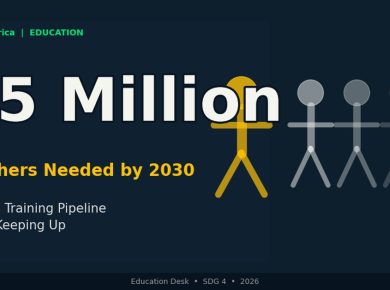
In 2015, all African Union member states formally endorsed the UNESCO benchmark: allocate at least 15 to 20 percent of national public expenditure, or 4 to 6 percent of GDP, to education. The commitment was not aspirational. It was the minimum considered necessary to achieve universal quality education by 2030 under Sustainable Development Goal 4.
More than a decade later, data from UNESCO’s 2025 Global Education Monitoring Report shows that only one in four African countries is meeting that benchmark — and the share has been falling, not rising. In 2013 to 2015, about one third of countries were on track. By 2022 to 2023, that had dropped to 25 percent. Sub-Saharan Africa faces an estimated $70 billion annual financing gap in education.
The timing is now critical. With USAID’s withdrawal from African education programming creating a gap of more than $2 billion annually — funds that supported school feeding programmes, teacher training, and literacy initiatives across 35 countries — the adequacy of domestic government financing is no longer an abstraction. It is an emergency.
The Four-Country Audit
BETAR examined education budget data for four of the continent’s largest economies against the UNESCO benchmark they all agreed to meet.
Nigeria: The Chronic Underperformer
Nigeria allocated N3.52 trillion to education in its 2025 federal budget — approximately 7.3 percent of total government expenditure. The UNESCO floor is 15 percent. Nigeria has not met that floor in any year on record.
The scale of underinvestment is difficult to overstate. Nigeria has more than 20 million out-of-school children — the largest number of any country on earth. The government spends less than half of what it committed to spend, on a system serving more children than most African countries have in their total populations. The 2025 allocation is nominally larger in naira terms but continues to shrink in real terms against inflation running above 30 percent.
Political economy explains much of the gap. Education spending competes with debt service (which consumed 46 percent of federal revenue in 2024), security outlays, and recurrent expenditure on a bloated civil service. Education has no powerful constituency in Nigeria’s federal budget negotiations in the way petroleum subsidies or infrastructure spending does.
Kenya: The Model With Caveats
Kenya’s FY2025/26 budget allocated Ksh 702.7 billion to education out of Ksh 4.24 trillion total — approximately 16.6 percent of public expenditure, within the UNESCO range. On headline numbers, Kenya is one of the few large African economies meeting the benchmark.
But the headline masks structural strain. Kenya’s education-to-GDP ratio sits at 3.96 percent (World Bank, 2023), just below the 4 percent floor. The Higher Education Loans Board is under pressure as graduate repayment rates fall and new Competency Based Curriculum costs — not budgeted when CBC was designed — pile onto the system. The student debt crisis has already forced NELFUND in Nigeria and KALF in Kenya to ration disbursements.
Kenya remains the regional model. It also demonstrates that meeting the benchmark percentage is a floor, not a ceiling — and that hitting the number does not guarantee spending effectiveness.
Ghana: The Fiscal Stress Erosion
Ghana has historically allocated 13 to 20 percent of government expenditure to education. Recent data shows a slide to the lower end. World Bank figures for 2023 show government expenditure on education at approximately 12 percent of total public spending — below the 15 percent floor. Ghana’s GDP allocation has deteriorated more sharply, dropping to 2.9 percent in 2022 against a benchmark of 4 to 6 percent.
The context is important. Ghana entered an IMF-supported debt restructuring programme in 2023. Education has not been protected from fiscal consolidation — a pattern seen across indebted low-income countries in previous IMF programmes. The lesson from Ghana is that without explicit legal ring-fencing, education budgets are among the first to be cut when governments face fiscal pressure. CESA 2026–2035 calls for exactly this kind of legislative protection, but none of the four countries in this audit have enacted it.
Ethiopia: The Structural Paradox
Ethiopia presents the most analytically interesting case. In 2022, Ethiopia allocated approximately 23 percent of government expenditure to education — comfortably above the 15 percent threshold. Yet GDP-based spending sits at just 2.3 percent (World Bank, 2024), far below the 4 percent floor.
The explanation lies in Ethiopia’s narrow tax base. The government spends a high share of what it collects on education, but what it collects is genuinely insufficient relative to the size of the economy and the scale of need. This matters because the CESA 2026–2035 framework does not simply ask governments to reallocate within a constrained envelope. It requires expansion of fiscal capacity itself — broader tax bases, domestic resource mobilisation, and reduction of illicit financial flows that UNESCO estimates at $50 billion annually across Africa.
Ethiopia is meeting the expenditure share benchmark while failing the GDP benchmark, making it a case study in why the targets are designed as a pair.
Why the Gap Persists
The UNESCO benchmarks were set knowing that meeting them would require political choices, not just technical ones. The three structural drivers of non-compliance are consistent across the continent.
First, debt service competition. Across Africa, governments are allocating larger shares of revenue to servicing external debt, leaving smaller envelopes for social spending. The IMF estimates that 22 African countries are in debt distress or at high risk — each is a country where education budgets face pressure.
Second, narrow tax bases. The Ethiopian case is the archetype: when governments collect only 8 to 12 percent of GDP in revenue (compared to 35 percent in OECD countries), even a high proportional allocation produces inadequate absolute spending.
Third, political economy. In most African legislatures, education spending lacks the organised constituency that can defend it in budget negotiations. Teacher unions are often powerful but focused on wage levels rather than total sector allocation. Parent associations are weak. Civil society budget tracking is thin.
What CESA 2026–2035 Requires
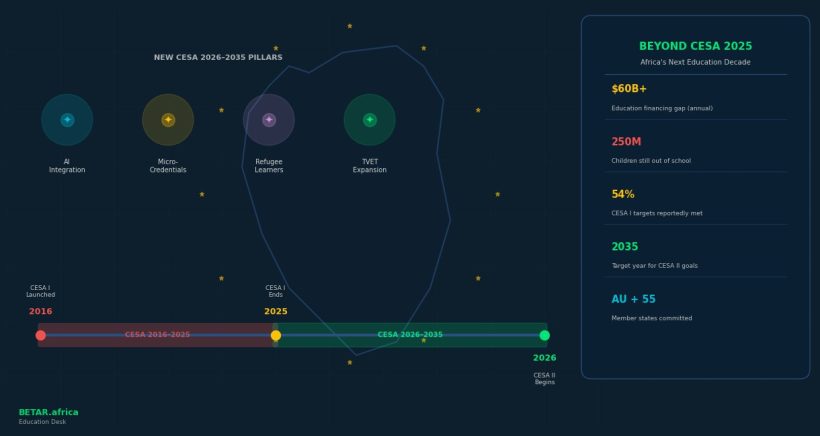
The African Union launched CESA 2026–2035 — the Continental Education Strategy for Africa — in early 2026 with explicit domestic financing commitments at its centre. The strategy’s financing pillar calls on member states to increase domestic education spending to 6 percent of GDP by 2035, establish dedicated education financing funds insulated from annual budget cycles, and report publicly on compliance every three years.
The first compliance review is scheduled for 2028. For the four countries in this audit, that is two years away. Nigeria would need to more than double its allocation share. Ghana would need to reverse its decline and increase by approximately 3 percentage points of expenditure. Ethiopia would need to expand its tax base significantly. Only Kenya is close — and even Kenya needs to close the GDP ratio gap.
UNESCO projects that without a course correction, SDG4 — quality education for all — will not be achieved in Sub-Saharan Africa before 2080. With USAID now exiting the sector and other Western bilateral donors under budget pressure, the domestic accountability question can no longer be deferred.
The 2028 review will be the first real test of whether CESA 2026–2035’s accountability mechanism has teeth. The baseline, established by this audit, is not encouraging. But the framework exists, the benchmarks are agreed, and the political case — that no country can sustain economic growth on an undereducated workforce — is stronger now than it has ever been.
The question is whether African finance ministers are listening.
Sources: UNESCO Global Education Monitoring Report 2025; World Bank Education Statistics (EdStats) 2022–2024; Nigerian Federal Ministry of Finance Budget 2025; Kenya National Treasury Budget Estimates FY2025/26; Ghana Ministry of Finance Budget Statement 2023; Ethiopian Ministry of Finance Budget 2022; African Union CESA 2026–2035 Framework Document; IMF African Regional Economic Outlook 2025.

 UphivaBETAR