
Breadfast Confirms IPO Track at $400 Million Valuation: Africa’s Biggest Consumer Tech Exit in the Making
By Business Reporter, BETAR.africa
Filed: 22 March 2026 | Word count: ~1,100
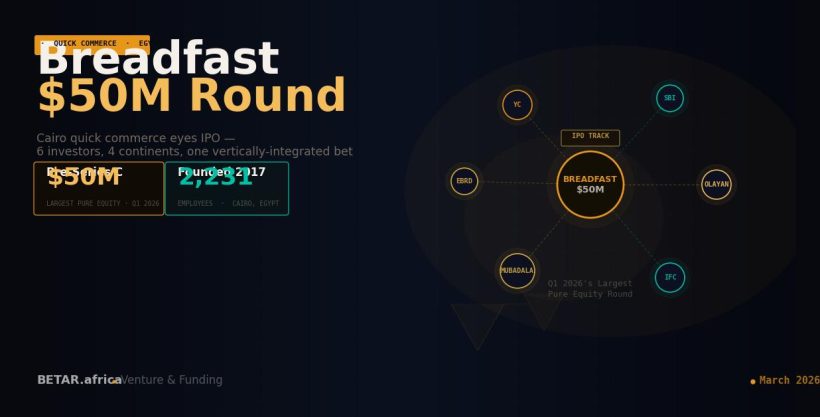
Breadfast has confirmed it is on an IPO track at a reported valuation of $400 million — making it Africa’s most advanced consumer tech listing candidate of 2026 and, if it closes, the continent’s largest consumer internet exit to date. The announcement follows the Egyptian quick commerce operator’s $50 million Pre-Series C in Q1 2026, a round that assembled an investor coalition whose exit logic pointed directly to public markets.
The questions now are not about intent. They are about architecture: which exchange, at what multiple, and on whose timeline.
The $400 Million Question
A $400 million pre-money valuation is a specific claim that deserves interrogation.
Breadfast’s revenue is not publicly disclosed, but the company’s operational profile provides a reasonable sizing frame. With 2,231 employees, a network of dark stores serving greater Cairo and Alexandria, and approximately 40 percent private label product penetration, Breadfast is operating at a scale consistent with an annual revenue run rate of $80 million to $150 million at prevailing Egyptian quick commerce take rates.
Against that range, the $400 million valuation implies a revenue multiple of between 2.7x and 5x. For context: Jumia — Africa’s only currently listed internet company — trades at roughly 0.5x to 1x revenue, a reflection of persistent losses and the structural damage of a 2019 NYSE debut that outran its fundamentals. Breadfast’s investor coalition is betting that its valuation case is categorically different from Jumia’s, and on the financial evidence available, they may be right.
The difference is margin architecture. Jumia operated as an open marketplace, taking a commission on third-party goods. Breadfast manufactures and white-labels roughly 40 percent of what it sells. In an inflationary Egyptian market, where consumer goods pricing has been highly volatile since 2022, private label penetration gives Breadfast a margin buffer that Jumia never had. Investors underwriting a $400 million valuation are, in part, underwriting that private label mix as a structural moat.
Breadfast Pay — the company’s embedded financial services product, operating under a Central Bank of Egypt licence — extends the monetisation logic further. A delivery company with a payment product is not valued like a pure logistics operator. The comparable set shifts toward Grab, Gojek, or MercadoLibre: super-apps that monetise the financial relationship built on top of a service relationship. The $400 million figure may not be pricing Breadfast as a quick commerce company at all. It may be pricing the embedded finance runway.
The Exchange Decision
Breadfast has not publicly confirmed a listing exchange. Three venues are credible; one is most likely.
The Egyptian Exchange (EGX) is the natural home for an Egyptian company with a predominantly local revenue base denominated in Egyptian pounds. The EGX has hosted successful listings in consumer and industrial sectors, and Egyptian institutional and retail investors are more familiar with Breadfast’s brand than any foreign exchange’s investor base could be. A domestic listing would also sidestep the FX translation problem that has complicated African tech listings on Western exchanges — Breadfast earns in EGP, and an EGX listing means investors price it in EGP, removing the currency mismatch that has eroded listing valuations for Nigerian and Kenyan companies.
The challenge: EGX’s institutional depth is limited for a company seeking to raise a significant primary or secondary tranche at $400 million. Local absorption may require substantial retail participation.
NASDAQ or NYSE would provide the deepest institutional capital pool and the highest international visibility. But the post-Jumia credibility bar on US exchanges for African internet companies is high. Breadfast would need to demonstrate a clear profitability path — not just strong GMV — to price at its target valuation on a US exchange. The legal, compliance, and investor relations costs of a US listing are also substantial for a company at Breadfast’s current scale.
A dual listing — EGX primary with a depository receipt programme on a secondary exchange — represents a path that some Egyptian and pan-African companies have explored. It allows domestic price discovery while providing international investor access. For Breadfast’s investor coalition, which includes institutions based in Abu Dhabi, Washington, Tokyo, and San Francisco, a structure that allows each investor to exit on their preferred venue has obvious appeal.
The most likely scenario: an EGX primary listing, with a secondary international structure that gives Mubadala and IFC the liquidity options their portfolios require.
Reading the Investor Exit Map
Breadfast’s Pre-Series C cap table is not a random collection of capital. Each institution entered with a different return horizon, and those horizons will shape IPO timing.
Mubadala Investment Company manages Abu Dhabi’s long-duration sovereign capital. Mubadala’s venture portfolio has a 7-to-10-year investment horizon as a typical parameter, but its strategic mandate — building Egypt as an economic gateway from the Gulf — means it has both financial and geopolitical incentives to see Breadfast list successfully and at a premium. Mubadala is not a distressed seller. It can afford to wait for the optimal window.
IFC and EBRD are development finance institutions whose mandates explicitly include creating public market liquidity options for portfolio companies. Both institutions typically target exits within 5-to-7 years and prefer structured processes — a trade sale or a listing — over secondary market transactions. Their simultaneous presence in Breadfast’s Pre-Series C implies they are aligned with management on a credible IPO timeline.
SBI Investment, the venture arm of Japan’s SBI Holdings, entered Africa through Breadfast as a first direct bet on an Egyptian company. SBI’s parent manages over $10 billion in market capitalisation and is a patient, institutions-first capital provider. Its exit horizon is likely 5 years or beyond, and its preference — given SBI Holdings’ own public market status — is almost certainly a listing over a private sale.
Y Combinator is the outlier. YC holds equity from an earlier stage at a lower cost basis. It has more flexibility on exit timing and venue than any other investor at the table. Its continued stake through a Pre-Series C is itself a signal: YC does not typically participate in late-stage rounds unless it expects a material near-term liquidity event.
The consensus timeline implied by this investor coalition: an IPO in 2026 or 2027, with Q4 2026 or H1 2027 as the most credible window.
What This Signals for Gulf-Africa Capital Strategy
Mubadala’s position as the anchor investor in Africa’s largest potential consumer tech exit is not incidental to the story. It is the story.
Gulf sovereign capital — Mubadala, ADQ, PIF, QIA — has been Africa’s most consequential source of new institutional investment in 2025 and 2026, displacing US and European VC as the marginal buyer of growth-stage African equity. BETAR has documented this shift across multiple sectors: energy infrastructure, fintech, education. Breadfast represents the Gulf thesis applied to consumer commerce.
What Mubadala is doing in Egypt is not simply capital deployment. It is market-making. By anchoring Breadfast’s Pre-Series C at a $400 million implied valuation, Mubadala has established a price floor for Egyptian consumer tech that will inform how every subsequent deal in the sector is priced. When Breadfast lists — and the investor coalition suggests it will — the EGX’s ability to absorb a technology listing at this valuation will determine whether Cairo becomes a genuine technology listing venue or remains a market where tech companies list overseas.
The stakes of the Breadfast IPO extend beyond one company. They touch the architecture of African public capital markets.
Why This Is Different From Jumia
Africa’s only prior major tech IPO — Jumia’s 2019 NYSE debut — is the reference case every stakeholder in the Breadfast process will have internalised.
Jumia listed on a growth narrative across 14 markets, with no clear profitability in any single one. Its investor base included venture-oriented institutions with short-duration exit mandates. The mismatch between the company’s actual financial maturity and the market’s pricing expectations produced a collapse from $45 per share at peak to under $3 within three years.
Breadfast’s conditions differ materially. It operates in two cities, not 14 markets. It has a private label margin architecture that Jumia never had. It has an embedded finance product under regulatory licence. Its investor base includes development finance institutions that, by mandate, do not impose short-duration exit pressure. And unlike Jumia in 2019, Breadfast is entering a public market conversation in which African internet company investors — burned once — will demand a financial case, not a narrative.
That discipline, embedded into the pre-IPO process by the investor coalition itself, is the clearest signal that the architecture this time is different.
Breadfast is headquartered in Cairo, Egypt. The $400 million valuation and IPO plans are based on company statements and investor disclosures. No listing exchange or timeline has been formally confirmed. BETAR.africa previously covered Breadfast’s Pre-Series C in BETA-469 and the Africa IPO pipeline in BETA-498.


 UphivaBETAR


 Joseph Busari