
Africa’s Teacher Training Pipeline Crisis: Who Prepares the Next Educators?
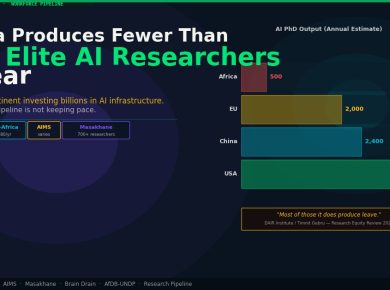
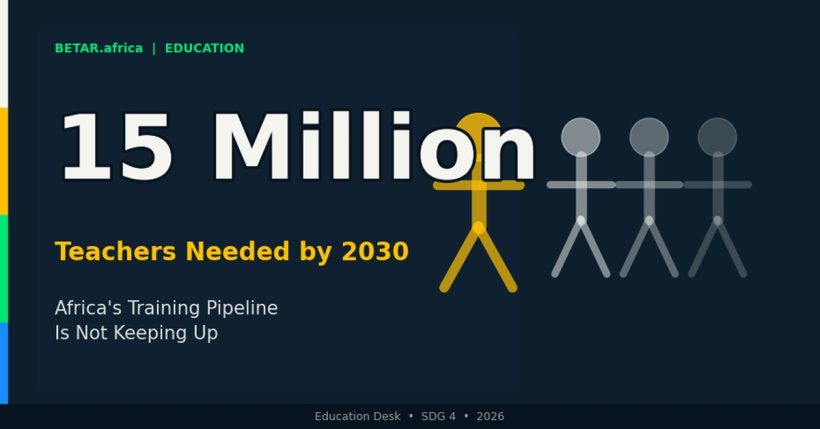
The continent needs 15 million additional teachers by 2030 to meet its own SDG 4 commitments. The colleges that train them are underfunded, their graduates don’t always reach classrooms, and the political attention is almost entirely elsewhere.
March 2026
The Adeyemi Federal University of Education in Ondo, Nigeria, is one of the country’s two federally funded teacher training universities — by African standards, a reasonably well-resourced institution. Its annual intake runs to several thousand students. Its faculties cover mathematics, science, and language pedagogy. Its graduates, in theory, supply classrooms across Nigeria’s south-west. In practice, a significant share do not. They take NYSC postings, complete them, and redirect into private sector roles where salaries are more reliably paid. The institution trains teachers. The system does not always retain them.
That gap — between training and the classroom — is the central problem of Africa’s teacher crisis. It is not primarily a story about technology, or connectivity, or curriculum reform. It is a story about a pipeline that is underfunded at its source and leaks at every stage before it reaches a child.
The Scale of What Is Missing
UNESCO estimates that Africa must recruit at least 15 million additional teachers by 2030 to achieve universal primary and secondary education under SDG 4. The UNESCO Institute for Statistics’ projections break this into two distinct deficits. The first is quantity: not enough teachers exist to staff classrooms that current enrolment numbers require. The second is distribution: the teachers who do exist are concentrated in urban areas and in humanities subjects. Rural schools, northern Nigeria, eastern DRC, the Sahel periphery — these face a shortage far more acute than the continental aggregate captures.
“The 15 million number is real, but it can obscure a more urgent picture,” said Benoît Sossou, Chief of Education at UNICEF’s Eastern and Southern Africa regional office. “When you disaggregate to district level, some of the gaps are extreme. We have districts in the DRC, in South Sudan, in parts of Ethiopia, where pupil-to-trained-teacher ratios exceed 100 to 1. These are not systems struggling toward an aspirational target. These are systems where basic primary instruction is not reliably occurring.”
Africa’s school-age population is expanding faster than the teacher supply pipeline can absorb. UIS data indicates that current annual graduation output from teacher training institutions continent-wide falls materially short of demand — before accounting for attrition, retirement, and the share of graduates who never enter the profession.
Who Trains the Trainers
Africa’s teacher training infrastructure spans federal universities of education, state colleges of education, private institutions, and distance-learning programmes. Nigeria has 65 government-approved colleges of education. Ethiopia has expanded its network of Teachers Education Institutes substantially. The DRC runs a network of Institut Supérieur Pédagogique institutions, though many are functionally compromised by chronic budget shortfalls.
“We have built the institutions. The issue is that we have not built the financing architecture to make them function,” said Seun Adewale, Director of Teacher Development at Nigeria’s Federal Ministry of Education, speaking at a regional teacher education forum in Abuja in November 2025. “A college of education that cannot pay its own faculty competitive salaries cannot attract the people needed to train the next generation. We are asking institutions to do more with structural underinvestment.”
The structural problem is not the number of institutions. It is what they receive. Nigerian colleges of education operate under sustained federal funding pressure. In the DRC, teacher salaries at state schools are so low and so irregularly paid that many teachers survive on informal parent contributions — removing their attention from the official classroom. Ethiopia has expanded teacher training access but faces persistent quality gaps in science and mathematics, where instructors for training colleges are themselves in short supply.
“The training system is chronically underfinanced and then we are surprised when the output is insufficient,” said Professor Amina Hassan, Dean of the Faculty of Education at Addis Ababa University. “We are training teachers with laboratories that have no equipment, with libraries that have no current materials, with faculty leaving for better-paid positions elsewhere. The pipeline has multiple holes. You cannot fix it by widening the entrance.”
The Attrition Problem
The gap between graduation and classroom deployment is a critical failure point. Across countries with available data, an estimated 20 to 40 per cent of teacher college graduates do not enter government classroom roles within two years of graduation. The reasons are consistent: salaries uncompetitive with private sector alternatives, rural posting requirements, irregular salary payment, and classroom conditions — overcrowding, missing materials, infrastructure deficits — that make retention difficult at any pay level.
Mid-career attrition compounds the recruitment problem. Urban private schools and international school networks compete directly for the trained teachers government systems spent years developing. Africa is, in effect, subsidising private education through public teacher training — producing graduates at state cost and watching a material share migrate to better-compensated roles the original investment did not intend to fill.
“The salary question is fundamental and it is being avoided,” said Dr. Josephine Nkosi, a senior education specialist with the World Bank’s Africa Human Development team, which tracks teacher workforce data across 23 countries. “You cannot recruit at scale and retain people once they are there if teaching is structurally a second-best choice. Every country we work with knows this. Almost none have found the fiscal space to act on it.”
What Technology Can and Cannot Do
The EdTech investment flowing into African education — chronicled in BETAR’s Q1 2026 funding analysis — is overwhelmingly directed at learner-facing products: adaptive learning platforms, digital curricula, mobile-first content delivery. Very little targets the teacher training pipeline. Teacher training institutions are complex institutional partners, slow to procure, and unable to offer the growth curves that venture capital requires.
The consequence is a mismatch between where investment goes and where leverage lies. An adaptive learning platform cannot operate without a teacher capable of embedding it into instruction. A digital science curriculum cannot be delivered by an instructor without the pedagogy to use it. The foundational layer — the trained teacher in the classroom — is a prerequisite for everything above it. BETAR’s learning poverty coverage has documented the downstream result: 89 per cent of children in sub-Saharan Africa unable to read with comprehension by age 10, a figure connected directly to the quality, not just the quantity, of the teachers they encounter in their primary years.
CESA 2026–2035, adopted by African Union Heads of State in February 2025, designates teacher development as a strategic priority. The critical test is whether accountability moves from the document to the budget line — whether African governments treat teacher college financing as a core fiscal commitment rather than a residual allocation. Africa’s technology ambition is being built on a classroom infrastructure without enough trained people to staff it. That is not a technology problem. It is a policy choice about where the money goes — and for now, most of the money is going elsewhere.

 UphivaBETAR