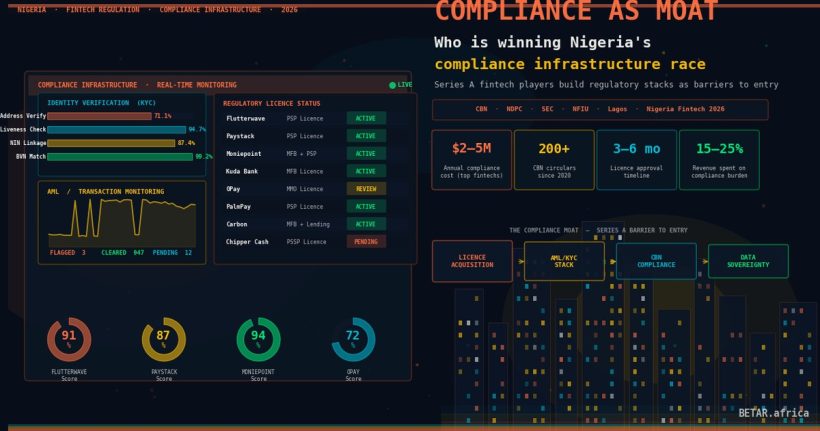

The same CBN regulatory wave that is costing mid-tier Nigerian fintechs $52,000–$87,000 to survive is turning a handful of compliance infrastructure companies into the most defensible businesses in the Nigerian tech ecosystem. While operators scramble to meet four stacked mandates by July, a quieter race is underway: which companies have built the certifications, integrations, and operational track records that make them structurally irreplaceable — and therefore worth acquiring?
The answer has implications not just for M&A, but for how Series A capital is being deployed in Nigeria in 2026. Investors who backed identity and compliance infrastructure two years ago are now sitting on assets that the entire regulated fintech sector is legally obligated to use.
The NIBSS Certification Moat
At the centre of the compliance infrastructure stack is the Nigeria Inter-Bank Settlement System. NIBSS certification — required for BVN phone number lock implementation, real-time identity verification, and transaction monitoring connectivity — is not something a startup can replicate. It requires regulatory standing, audit history, and a certification process that takes months under normal conditions. The companies that already hold it have a structural advantage that is not about product quality; it is about access.
Prembly, Seamfix, Smile Identity, VerifyMe, and Dojah are the five identity infrastructure companies in Nigeria that are NIBSS-certified or have established direct integration agreements with NIBSS-certified intermediaries. Each has been building toward this position for years. The CBN mandates have not created their moat — they have fenced it.
Smile Identity’s liveness verification API is now directly relevant to the July 1 biometric account-opening deadline. Seamfix’s PGATE integration — connecting its identity stack to the Pan-African Payment and Settlement System — adds a cross-border compliance rail that none of its domestic competitors has matched. Prembly has the broadest SDK coverage across the Nigerian developer ecosystem, which matters when the bottleneck is integration speed, not capability.
The AML Pre-Position
If NIBSS certification defines the identity layer moat, the CBN AI and Anti-Money Laundering Baseline Standards have created a parallel opportunity in transaction monitoring. The mandate requires machine-learning-based monitoring, independent annual model validation, and a documented data governance framework by June 2026 — and compliance teams at Nigerian banks and licensed fintechs are discovering that most international AML platforms were not built for naira-denominated transaction patterns.
SmartComply’s Adhere platform has been deployed at three licensed fintech operators ahead of the CBN mandate — making it the only AML platform with documented production experience in the Nigerian regulatory context before the compliance deadline. The CBN circular’s requirement for annual third-party model validation means any operator who selects a platform in April faces an immediate re-validation cycle. Operators who deployed early, like Adhere’s existing clients, are already inside the compliance window.
The market size is unambiguous: every payment service bank, licensed neobank, and VASP operating in Nigeria needs a compliant AML platform by June. At an estimated 180–220 licensed operators in scope, the annual contract value for the platforms that win the Nigerian compliance stack runs into the tens of millions of dollars.
The MoniePoint Precedent and the M&A Thesis
The compliance infrastructure M&A thesis has a clear precedent in the Nigerian market. MoniePoint’s dominance in the merchant payments segment was not built on a superior product — it was built on a distribution network and merchant lock-in that made switching economically irrational. The same logic applies to compliance infrastructure: once an operator has passed a CBN audit using a specific identity or AML platform, migrating to a competitor means re-running the audit, re-documenting the integration, and accepting implementation risk during the window when enforcement is most active.
This switching cost profile is what Series A investors are pricing. BETAR’s analysis of CBN compliance cost modelling (detailed in companion piece BETA-1027) puts year-one compliance infrastructure spend for a mid-tier Nigerian fintech at $52,000–$87,000. Of that, identity verification and AML monitoring account for roughly 60–70 percent of the ongoing cost base. The companies that own those line items own a recurring revenue stream that is contractually anchored by regulatory obligation.
Several Nigerian and pan-African financial groups are understood to be evaluating compliance infrastructure acquisitions in the current window. The FATF grey-list exit in October 2025 removed an estimated $30 billion in suppressed investment friction — capital that had been sitting on the sidelines precisely because Nigerian fintech’s regulatory risk profile was too uncertain to underwrite. That friction is now gone. The M&A horizon for compliance infrastructure — 12 to 18 months, in the assessment of investors tracking the sector — aligns exactly with when the operational value of early-certified platforms will be most legible in audit trail data.
The Risk: Regulatory Concentration
The compliance moat thesis has one structural risk: regulatory concentration. A company whose value proposition is built on being the compliant option in a specific regulatory environment is exposed to the same authority that created the mandate. CBN guidance revisions, changes in approved platform certification processes, or a shift toward a nationalised compliance infrastructure model could erode the moat quickly.
For now, the mandate timeline is fixed, the enforcement posture is clear, and the window for operators to select compliant infrastructure is closing. The companies best positioned to capture the compliance infrastructure opportunity — those with the certifications, audit history, and production deployments already in place — are not emerging. They are already there.
BETAR Africa | Technology Desk analysis. Companion pieces: BETA-1027 — Nigeria Fintech Compliance Cost Stack, BETA-719 — Africa Developer Stack Compliance Wave.


 UphivaBETAR


 Joseph Busari