
Africa’s IPO Clock Is Running
The Forces Converging on a 2026–2027 Listing Moment
By Business Reporter, BETAR.africa | 28 March 2026
Three independent pressures are now pointing the same direction, toward the same narrow window, and toward the same set of companies. Africa’s IPO moment is not a matter of investor optimism or founder ambition. It is a matter of structural mathematics.
The first pressure: African private equity managers are sitting on more than $10 billion in unrealised portfolio value from 2016–2019 fund vintages that are three to five years past their original exit horizon. IPOs are the exit route of last resort when strategic buyers are absent and secondary markets are thin. That backlog will not clear through trade sales alone.
The second pressure: the Series A funding drought that BETAR has documented through early 2026 means the cohort of African startups that raised large growth rounds in 2020–2022 has no obvious next private round. The capital structures built on US venture logic — raise every 18 months, grow into the valuation, raise again — have no continuation path. The alternative is profitability and public markets.
The third pressure: development finance institutions, which now anchor the cap tables of Africa’s most plausible listing candidates, operate under governance and mandate structures that create real exit deadlines. IFC, EBRD, Norfund, and BII cannot defer returns indefinitely. They are not passive sellers — but they are time-bounded ones.
When three structural forces point toward the same outcome simultaneously, the question shifts from whether to when — and specifically, which companies are in position when the window opens.
The Candidates: What Has Changed Since March
BETAR mapped the IPO candidate cohort in early March 2026. The landscape has sharpened in the weeks since.
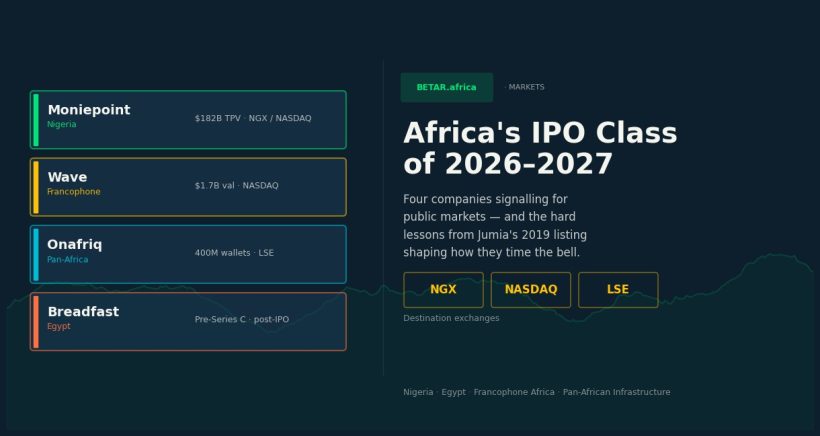
Breadfast has confirmed its IPO track at a $400 million pre-money valuation, following a Pre-Series C that assembled Mubadala, IFC, SBI Investment, EBRD, and Y Combinator. The investor coalition is not built for another private round. Breadfast’s embedded finance product — Breadfast Pay, operating under a Central Bank of Egypt licence — extends the valuation logic beyond quick commerce into financial services, making the $400 million figure more defensible than it appears on raw revenue multiples. The Egyptian Exchange is the most likely primary venue, with a secondary international structure for international investor liquidity.
Moniepoint processed over $182 billion in total payments volume in 2024 as Nigeria’s largest business banking platform. Its NGX listing signals have grown more explicit through Q1 2026. The company’s unit economics — transaction fees on POS agent network operations, SME credit products with defined default rates — are built for the financial disclosure requirements a public listing demands. Moniepoint is the most credible candidate for Africa’s first genuine tech listing on a domestic African exchange.
Wave is the structural outlier. Operating in six Francophone and East African markets with near-zero transaction fees and network-effect economics, Wave’s financial profile is harder to read at a distance. But its 2021 $200 million Series A at $1.7 billion valuation — backed by Sequoia, Stripe, and Partech — is four years old. Sequoia’s Africa-adjacent investment pace and fund lifecycle suggest that 2026 or 2027 is the window where LP pressure begins to build toward a structured liquidity process.
Onafriq (formerly MFS Africa), as payment infrastructure rather than consumer fintech, occupies a different pricing category. Its $100 million Series C from 2022 positioned it for an infrastructure-style listing on London or Luxembourg — venues with deeper institutional appetite for African rails businesses than New York or Lagos.
The Exchange Competition
Africa’s listing candidates are not choosing from a single venue. They are being actively recruited.
The Nigerian Exchange Group has been the most publicly aggressive. NGX CEO Temi Popoola has stated explicitly that the exchange is building a technology listing pathway that accommodates pre-profitability companies — closing the structural gap that has historically pushed Nigerian founders to London or New York. For Moniepoint, with naira-denominated revenue and a Nigeria-first brand, the NGX case is compelling: domestic price discovery, Nigerian institutional and retail investor familiarity, no FX translation problem.
The Egyptian Exchange made quiet progress in 2025 with regulatory reforms aimed at attracting technology listings. President El-Sisi’s administration has been explicit about positioning Egypt’s capital markets as the listing venue for the wave of Egyptian-founded companies coming out of the Gulf-backed investment boom. Breadfast would be the proof of concept. If it lists successfully on the EGX at or near its $400 million target, the exchange’s credibility for technology listings is established.
The Johannesburg Stock Exchange remains the most liquid African public market by a significant margin — R18 trillion in listed equity, a functioning institutional base, and investment banking infrastructure that no other African exchange can match. But for West and East African founders, JSE listing costs, governance requirements, and investor relations demands create friction that the NGX or EGX, in principle, do not. The JSE’s realistic IPO pipeline in 2026–2027 is concentrated in Southern African businesses with existing JSE-adjacent governance.
London — specifically AIM for earlier-stage companies or the Main Market for larger listings — remains relevant for Onafriq and for pan-African businesses with European DFI-heavy cap tables. The LSE’s Africa-oriented investor community is thin outside natural resources, but it is growing. The exchange’s recent structural reforms to attract growth companies are designed precisely for the Onafriq profile: infrastructure-adjacent, pan-continental, DFI-backed.
The exchange competition matters because it is competitive. Each venue that succeeds in attracting an African tech listing claims a precedent that influences the next decision. The first mover — NGX listing Moniepoint, EGX listing Breadfast, or LSE listing Onafriq — will have shaped the default option for the next twenty companies in the pipeline.
What the First Mover Gets — and What It Costs
The first successful African tech listing in 2026 or 2027 will not just create a liquidity event for one company. It will create infrastructure for every company that follows.
Post-listing, a credibly traded African tech stock creates three things the private market currently lacks. First, a comparable valuation reference. Currently, African tech investors price based on a mix of US comps and local discount — a methodology that satisfies no one and produces wide bid-ask spreads. A listed, traded Moniepoint provides a market-determined multiple that every subsequent Nigerian fintech funding round can reference.
Second, a sell-side coverage ecosystem. Coverage generates institutional attention. Institutional attention drives deal flow and subsequent IPO demand. No listed African tech stock currently attracts meaningful sell-side coverage from the global investment banks that move institutional capital. Rand Merchant Bank, Stanbic IBTC, and Absa CIB are building equity research capability, but it requires a listed company to cover before the flywheel turns.
Third, proof for international LPs. The institutional investors who fund African PE and VC — pension funds, sovereign wealth funds, endowments — have limited appetite for a market without exit proof. A successful IPO produces the track record that the 2028 fund vintage will be able to point to. It unlocks the next cycle of private investment.
The cost of being first is real, though. Jumia’s 2019 NYSE listing — which collapsed from $45 per share to under $3 within three years — established an African internet company credibility deficit that has required years to clear. The first company to list in 2026 or 2027 will be priced against the Jumia reference by every investor in the room. Its governance, its audited financials, its profitability trajectory, and its disclosure quality will be scrutinised to a standard that would not apply if African tech listings were routine.
The companies now approaching public market readiness have absorbed that lesson structurally. Moniepoint’s management has explicitly used the language of “public market discipline.” Breadfast’s investor coalition includes development finance institutions whose governance mandates require IFRS financial statements, independent audit committees, and board structures that are closer to a listed company than to a startup. The pre-IPO preparation is more advanced than the timeline suggests.
The Risks That Close the Window
Three scenarios close the IPO window before any of these companies lists.
FX volatility is the most persistent threat. Nigeria’s naira and Egypt’s pound have both experienced significant devaluation since 2022. A company reporting revenue in naira that seeks a USD-denominated valuation faces a translation problem that has eroded the listing case for multiple Nigerian and Kenyan companies in the past. If the naira weakens materially through the remainder of 2026, Moniepoint’s NGX case strengthens — domestic listing in naira avoids the FX problem — but international capital cannot access NGX equity at scale without a depository receipt structure.
A global rate environment that sustains pressure on growth multiples would push institutional capital away from pre-profitability African tech stories. The macro tailwind that supported 2021 African tech valuations was a zero-rate world. The current environment is more demanding. Companies that cannot demonstrate a credible profitability path within 24 months of listing will not find institutional buyers at the multiples their cap tables imply.
The third risk is the governance gap. Africa’s most advanced IPO candidates are still, in many cases, founder-controlled companies with governance structures designed for private market operation. Converting to public-market governance — independent directors with relevant expertise, audit committees, disclosure frameworks, related-party transaction rules — takes twelve to eighteen months and cannot be rushed. If a company moves toward listing before its governance conversion is complete, the resulting scrutiny will damage rather than create value.
BETAR Assessment
The 2026–2027 window is real. It is narrow. The structural forces — PE exit pressure, VC drought, DFI mandate timelines — are genuine and converging. The companies are more financially mature than the companies that failed the last time Africa tried to build a public market moment.
The most likely sequence: Breadfast lists on the EGX in Q4 2026 or H1 2027, establishing an Egyptian tech listing precedent. Moniepoint initiates an NGX listing process in 2027, the first Nigerian unicorn to attempt a domestic listing. Both events would collectively represent the opening of the African tech public market in a way that Jumia’s 2019 outing, for all its scale, did not.
The $10 billion PE backlog will not clear on the back of two IPOs. But the first IPOs create the infrastructure — the comparables, the coverage, the international LP proof points — that the next generation of exits will need. That is the logic of the first mover. It is not about one company’s valuation. It is about building the architecture that makes the next twenty companies’ exit options real.
Africa’s public market clock is running. For the first time in a decade, the forces that drive it are aligned.
Related BETAR coverage: BETA-498 — Africa IPO Pipeline 2026–2027 | BETA-964 — Breadfast Confirms $400M IPO Track | BETA-1054 — Africa PE Has $10B It Cannot Exit | BETA-566 — Africa’s Series A Desert | BETA-822 — Africa Q1 2026 Investor League Table
— Business Reporter, BETAR.africa

 UphivaBETAR

 Joseph Busari