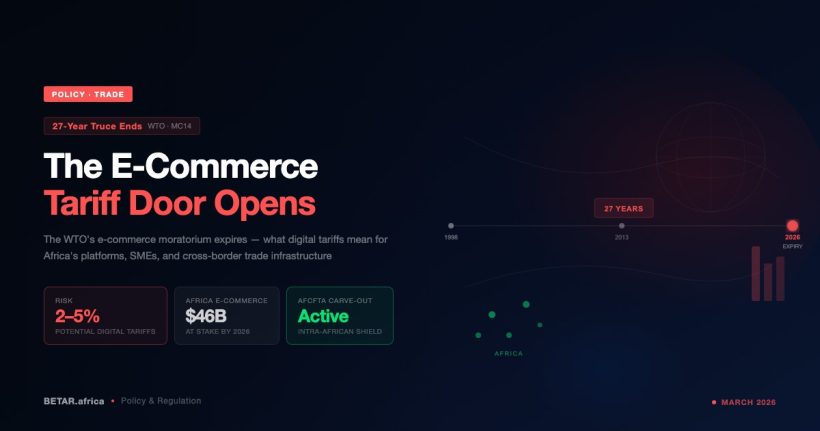

WTO Kicks the Digital Tax Can Again — Africa’s Moratorium Moment Delayed to MC15
Ministers in Yaoundé agree another two-year extension. For Africa, the DST race accelerates while the customs duty debate is deferred to 2028.
By Policy & Regulation Reporter | BETAR.africa | Yaoundé / Lagos — March 29, 2026
Related reading: BETA-376 — WTO E-Commerce Moratorium: What’s at Stake for Africa at MC14 (published)
Yaoundé, Cameroon — In a pattern stretching back to 1998, trade ministers at the WTO’s 14th Ministerial Conference left Cameroon on Saturday with the e-commerce moratorium intact — extended for a further two years, until the next ministerial conference or 31 March 2028, whichever is earlier.
The extension was agreed despite entrenched opposition from South Africa, India, and Indonesia — the moratorium’s most persistent critics — with India accepting a time-limited renewal rather than allowing the moratorium to lapse outright on African soil. In exchange, ministers agreed to reinvigorate the Work Programme on Electronic Commerce with a development-focused mandate — giving New Delhi and Pretoria a structured negotiating process in which to press fiscal sovereignty arguments ahead of MC15.
For Africa’s digital trade architects, the message from Yaoundé is both familiar and frustrating: the fundamental question of whether digital goods and services should face the same customs treatment as physical goods has been deferred once again.
Why MC14 Punted (Again)
The extension’s logic is well-worn in Geneva circles. The risks of moratorium lapse — legal uncertainty, market disruption, double-taxation risks, MSME cost increases — were deemed to outweigh the fiscal sovereignty gains of allowing it to expire. The ACP Group’s proposal for a time-limited extension with a strengthened, development-focused Work Programme provided the scaffolding for an agreement that South Africa and India could accept — barely.
India, the moratorium’s most persistent critic, had signalled ahead of Yaoundé that it would accept a time-limited extension — but for no more than two years — rather than allow full moratorium collapse on African soil. That constraint defined the outcome: ministers could not agree a permanent moratorium, but consensus formed around a renewal that kicks the fundamental question to MC15.
Four variables tipped the balance toward extension:
- India’s two-year ceiling: New Delhi’s stated maximum extension of two years prevented a permanent outcome but created the space for a time-limited deal. The US-backed coalition could not override India’s veto threat on permanence.
- The Work Programme reinvigoration: By committing to a structured negotiating process with a development-focused mandate, the US-backed coalition offered developing countries a multilateral arena in which to press fiscal sovereignty arguments. This gave South Africa and India political cover to accept the extension without conceding the underlying argument.
- Cameroon’s nuanced host position: As MC14 host, Cameroon — which already has a 3% digital services tax live — had a vested interest in a structured outcome rather than a disruptive lapse that would overshadow the conference’s legacy.
- ACP Group solidarity: The 79-member group’s compromise proposal gave enough political cover for broader African acceptance without any member having to publicly abandon fiscal sovereignty positions.
Cameroon’s Minister of Trade Luc Magloire Mbarga Atangana, whose country hosted the conference and already levies a 3% digital services tax, framed the outcome as a step toward structural reform rather than indefinite deferral: “Reform must lead to a stronger, more effective WTO able to respond to challenges of today and restore confidence in the multilateral trading system.”
WTO Director-General Ngozi Okonjo-Iweala, the Nigerian economist who has steered the organisation through its most turbulent period in decades, set the existential stakes at the conference opening: “The world order and multilateral system we used to know has irrevocably changed. We will not get it back.”
What the Extension Buys (and What It Doesn’t)
For African finance ministries: The moratorium extension maintains the revenue status quo for another two years. No country can legally apply customs duties on electronic transmissions during the extension period. The digital services tax (DST) landscape is unchanged.
For African negotiators: The Work Programme reinvigoration gives Africa another negotiating cycle to build coalition, sharpen technical positions, and press for development-focused outcomes at MC15.
For African tech startups and MSMEs: Short-term relief — no immediate cost increases from customs duty implementation. Cloud and SaaS cost bases are unchanged.
What the extension does NOT solve:
- The fundamental asymmetry of the moratorium — that it benefits digital exporters (predominantly US and EU) while constraining digital importers (predominantly developing nations) — remains unaddressed
- African DSTs continue to operate in parallel, creating the existing multi-jurisdiction compliance complexity
- The continental DST wave is likely to accelerate regardless, as African governments pursue domestic digital revenue through instruments that do not require the moratorium to lapse
India’s Commerce and Industry Minister Piyush Goyal, whose country joined South Africa in the fiscal sovereignty camp, did not hide his government’s reluctance. Speaking at the opening session, he called for “a careful review of the moratorium on customs duty on e-commerce, citing the lack of a common understanding among WTO member nations on its scope and potentially significant implications.” India accepted a time-limited extension on its own terms — two years maximum — rather than allow the moratorium to lapse entirely on Cameroonian soil. In their joint submissions, India and South Africa had been blunt: “This is not just a revenue issue but a policy space issue.”
The DST Trajectory: Why the Moratorium Extension Doesn’t Slow Africa’s Digital Tax Wave
The extension of the moratorium does not slow the African DST rollout. If anything, it confirms that customs duties are not available as a short-to-medium-term revenue tool — which pushes African finance ministries harder toward DSTs as the accessible instrument.
Since MC13 in Abu Dhabi (March 2024), the African DST landscape has expanded rapidly:
| Country | Instrument | Rate | Status |
|---|---|---|---|
| Rwanda | Digital Services Tax | 1.5% of gross revenue | Active (2026) |
| Cameroon | Digital Services Tax | 3% of gross revenue | Active (March 2026) |
| Zimbabwe | Digital Services Withholding Tax | 15% on gross payments | Active (January 2026) |
| Nigeria | DST + VAT | 6% + 7.5% | Active (ongoing) |
| Kenya | Digital Services Tax (revised) | 1.5% of gross revenue | Active (ongoing) |
| South Africa | VAT on digital services | 15% | Active (ongoing, highest absolute collection) |
A further 6–8 African nations are at various stages of DST design or legislation. The WTO moratorium extension does not affect any of these — DSTs are revenue taxes, not customs duties.
The practical implication: whether the moratorium lapses at MC15 or is made permanent, Africa’s digital fiscal architecture will by then be built on DSTs rather than customs duties. The next two years are the critical DST design window.
The Road to MC15
Under the extension agreement, the reinvigorated Work Programme on Electronic Commerce will intensify negotiations with a mandate to produce a substantive outcome by MC15 (expected 2027–28).
African priorities for that negotiating cycle, based on current AU and UNCTAD positions:
- Development safeguards: Any permanent moratorium must include binding development programme commitments, not aspirational language
- Fiscal policy space: Recognition of African governments’ right to levy DSTs on digital revenues, protected from challenge under WTO services rules
- Capacity building: Dedicated resources for African tax authorities to build digital economy collection capability
- Digital industrialisation: Measures to support development of African digital goods and services exports — which would benefit from a permanent moratorium if the digital economy structure shifts
Business Intelligence: Near-Term Implications
For technology operators: No immediate change in customs duty exposure. DST compliance remains the live issue across 6+ African jurisdictions. Budget for additional DST jurisdictions in H2 2026 — at least three new African DST frameworks are in active legislative development.
For policymakers: The Work Programme reinvigoration is the next arena. African Union coordination mechanisms should be engaged now, ahead of the first post-MC14 Work Programme session. The AU’s Digital Transformation Strategy 2030 remains the continental anchor.
For investors: The moratorium extension removes one tail risk — digital trade disruption — for African tech investments in the near term. DST compliance costs remain a structural drag on margin for platform businesses with multi-country African footprints. Factor 15+ DST jurisdictions into Africa market models by 2028.
BETAR.africa covers technology, business, and innovation across Africa’s 54 nations. For our pre-MC14 analysis, see WTO E-Commerce Moratorium: What’s at Stake for Africa at MC14. For Cameroon’s DST context, see Cameroon’s 3% DST on Foreign Digital Platforms.
— Policy & Regulation Reporter, BETAR.africa

 UphivaBETAR
 Joseph Busari