
After the EdTech Crash: Who Is Actually Training Africa’s Workforce in 2026?
$1.8 billion, zero unicorns, and a training patchwork that is not closing the skills gap
By the Education Reporter, BETAR.africa
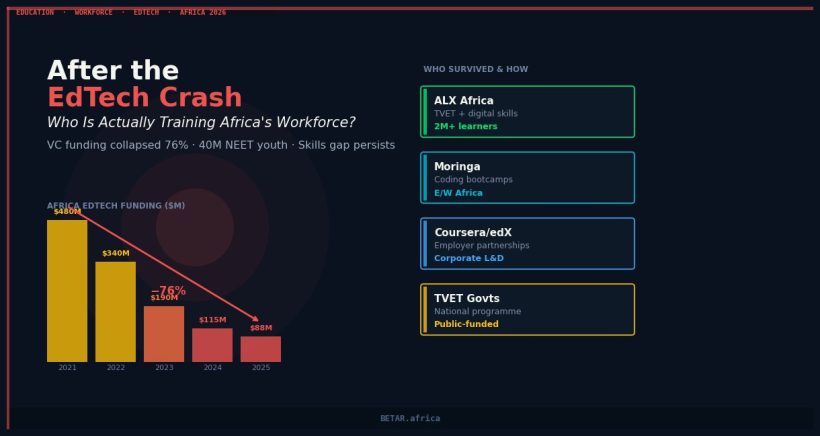
Africa’s venture-backed EdTech sector raised $1.8 billion, generated zero unicorns, and spent 2023 and 2024 shutting down. The platforms that survived pivoted to institutional sales or government contracts; the ones that did not returned capital to investors or simply went dark. BETAR documented the collapse in detail earlier this year. The more important question for 2026 is not what broke, but what replaced it — and whether the replacement is actually working. IFC analysis of Coursera’s Nigeria programme found that one job is created for every thirty Nigerians trained. That ratio tells you more about the state of African workforce training in 2026 than any headline enrolment figure.
Three actors stepped into the vacuum EdTech left: large employers building their own training academies, Big Tech companies deploying credentialling programmes at continental scale, and governments dramatically expanding technical and vocational education enrolment. Together, they represent the de facto workforce training architecture for sub-Saharan Africa in 2026. The question no one is asking clearly enough is whether that architecture produces workers who can do the jobs the economy needs — or whether it has simply relocated the continent’s structural skills mismatch into new institutional forms.
The Corporate Turn
The most underreported development in African workforce training is how aggressively large employers have concluded that the market will not solve their talent problem, so they must build their own pipeline.
Safaricom’s M-Pesa Academy, established outside Thika in Kenya, trains secondary school students in STEM and entrepreneurship on a full scholarship model — a direct response to what Safaricom’s leadership has described as a systemic gap between university graduate output and the technical skills the company needs. Equity Group Foundation’s Wings to Fly and Equity Leaders Programme, which has supported more than 430,000 scholars since 2010, has evolved from bursary provision toward a structured talent development model with scholarship conditions explicitly linked to mentorship and employment pathways within the Equity ecosystem.
In Nigeria, the Dangote Academy and Standard Bank’s learning infrastructure represent the same strategic logic: if the national education system cannot produce the talent a major employer needs at volume and quality, the employer builds a parallel system. The aggregate investment across these programmes is not trivial — the Mastercard Foundation alone committed $500 million to its Scholars Program across 32 universities in 14 African countries, with explicit employability outcomes baked into programme design.
The limitation of the corporate model is structural: it is only available at scale to large companies with the capital to sustain it, and it is, by design, talent acquisition dressed as philanthropy. The graduates of Safaricom’s academy enter Safaricom’s pipeline. Standard Bank’s investment in learning infrastructure serves Standard Bank’s hiring. The workers trained this way are not a public good; they are a private asset.
Big Tech’s Certificate Push
Google, IBM, and Microsoft are running what amount to the largest job-training initiatives in Africa that most media coverage has not adequately scrutinised.
Google’s Africa Career Certificates initiative is offering 100,000 Africans free access to its professional certificate portfolio in 2026, targeting data analytics, cybersecurity, IT support, and project management. ALX Africa counts more than 285,000 learners trained since 2021; its corporate pipeline, built through the broader African Leadership Group, funnels completers toward partner employers including Andela, Flutterwave, and other technology companies. IBM’s Reskilling Revolution Africa partnership is active in Nigeria, Ethiopia, and South Africa.
The scale is real. The outcomes are not what the marketing implies.
BETAR’s investigation into micro-credentials, published in March 2026, documented the denominator problem that distorts all public-facing statistics from these programmes. ALX reports 85 per cent employment for graduates — accurate for the 6 to 8 per cent of enrollees who reach graduation. Coursera’s own data for Nigeria finds that 38 per cent of learners reported a positive job or business outcome from their training. Google’s employer consortium — 150-plus companies that have agreed to treat Google Career Certificates as qualifying credentials — is concentrated in the technology sector, which employs a small fraction of Africa’s workforce.
A Decagon survey of Nigerian technology employers in Q1 2026 found that 74 per cent still report significant skills gaps in recent graduates, including completers of coding bootcamps and micro-credential programmes. The certificates are being issued. The competency gap is not closing at the same rate.
The TVET Surge
The most structurally significant shift in African workforce training is happening in the sector with the least private capital: government TVET.
Kenya’s TVET Authority reported 380,000 enrolments in 2025, up 40 per cent from 2020 — a jump that reflects both the Competency-Based Curriculum pipeline coming through Senior Secondary and a deliberate government investment in technical college capacity, including a Kenya-China modernisation programme that has equipped 70 colleges and retrained more than 1,190 instructors. Nigeria’s National Board for Technical Education is running dual apprenticeship pilots across multiple states, aligning polytechnic and technical college curriculum with industry standards in a way the legacy system never attempted. Rwanda’s Workforce Development Authority, which publishes graduate employment outcomes through a tracking system almost no other African country operates, has maintained formal industry linkage agreements across its TVET institutions.
The signal in the CESA 2026-2035 framework — the African Union’s new decade-long continental education strategy — is that TVET expansion is the headline workforce target. The gap is also in the CESA 2026-2035 framework: it flags TVET as a priority and provides no financing mechanism for the infrastructure that would require.
Does the Patchwork Work?
Taken together, the three systems — corporate academies, Big Tech certificates, expanded TVET — represent a significant increase in training activity across the continent. The ILO’s Q1 2026 data on Africa’s NEET population suggests it has not been enough.
Youth not in employment, education, or training has risen in 12 of 18 tracked countries since 2022, despite the training initiatives described above. The number of young Africans entering the labour market each year — an estimated 18 million — is growing faster than any combination of these programmes can absorb.
The structural problem is that the three actors filling the EdTech vacuum are each solving a different and partial problem. Corporate academies produce trained employees for specific companies, not workers for the broad economy. Big Tech certificates produce credentialled candidates for a technology labour market that employs a small share of Africa’s workforce. TVET expansion produces technical graduates into labour markets that in many countries still lack the formal employer infrastructure to absorb them.
What none of them produces at scale is what the ILO’s NEET data shows the continent needs most: workers with transferable, verified, employer-recognised skills across the full breadth of the economy — in agriculture, construction, healthcare, and the service sector — not just in technology.
The Structural Diagnosis
The post-EdTech training patchwork is not failing because the initiatives within it are badly designed. Some of them are well-designed. It is failing to close the workforce-readiness gap because it is not coordinated, not financed at the required scale, and not connected to the national qualifications frameworks that would make credentials legible to employers who are not already inside the relevant ecosystem.
The African Continental Qualifications Framework, which would provide exactly the cross-border and cross-sector recognition architecture needed, remains at the implementation stage in most member states. National qualifications frameworks — the prerequisite for ACQF alignment — are absent or incomplete in a majority of African countries. Nigeria’s NQCF exists as a policy document but has not been operationalised across the TVET sector. The DRC, Ethiopia, and Cameroon have yet to align their qualification frameworks to ACQF standards. Even South Africa, which has Africa’s most developed NQF infrastructure, has struggled to make its credentials routinely portable within SADC, let alone the continent.
Until a Kenyan TVET certificate is automatically legible to a Nigerian employer, until a Google Career Certificate maps to a National Qualifications Framework level, until a corporate academy graduate’s training has a public credential rather than a company-specific badge, the patchwork remains a collection of parallel systems that cannot sum to a labour market.
What would fix it is not more training programmes. Africa has training programmes. What it needs is a recognition architecture that connects what people are learning to what employers across the full economy can verify — and a public financing commitment to TVET at 15 to 20 per cent of education budgets, the UNESCO-UNEVOC benchmark for systems that produce graduate employment outcomes at scale, rather than the sub-5 per cent share most African governments currently deploy.
The EdTech platforms that collapsed had identified a real problem. The actors who replaced them are real. The workforce crisis they were all trying to address is still real. What the continent does not need is another training programme. What it needs is a recognition architecture — one that makes what people learn legible to every employer across the full economy, not just to the institution that did the training.
Related BETAR coverage: Africa’s EdTech Graveyard; TVET and Africa’s Digital Economy; Africa Micro-Credentials Reality Check; Africa School-to-Work Gap.
Sources: ILO Africa youth employment and NEET data Q1 2026; CESA 2026-2035 (African Union Commission); Kenya TVET Authority enrolment statistics 2025; Decagon Q1 2026 Nigerian employer skills survey; IFC-Coursera Nigeria learning outcomes study 2025; ALX Africa programme data; African Continental Qualifications Framework handbook 2025 and background papers; UNESCO-UNEVOC TVET benchmarking data; Mastercard Foundation Scholars Program impact data 2026; ACET/Mastercard Foundation NEET study 2024.


 UphivaBETAR