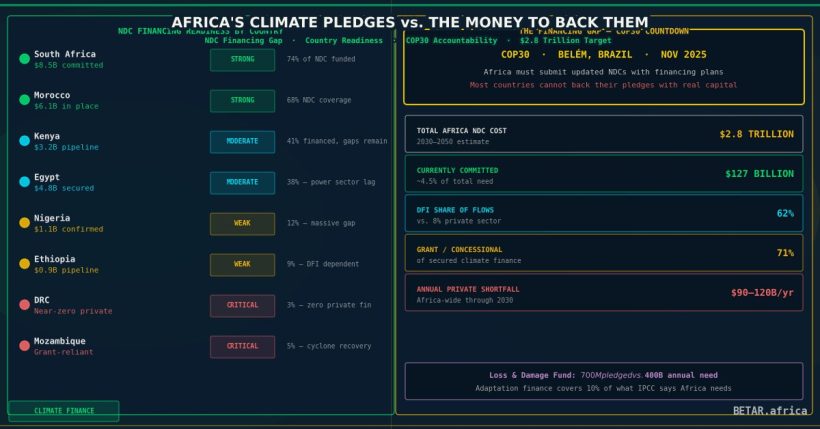

COP30 opens in Belém, Brazil on 10 November 2026. Eight months from now, African heads of state and climate negotiators will walk into the same arena they have entered since Paris in 2015 — carrying nationally determined contributions that promise ambitious emissions reductions, and depending on international climate finance to make those reductions real.
The financing picture has changed more since COP28 in Dubai than in any comparable two-year period since the Paris Agreement was signed. The United States has exited the Just Energy Transition Partnership, effectively withdrawing approximately $1.5 billion in committed and anticipated concessional finance. USAID’s Power Africa programme — which provided grant co-financing and technical assistance for sub-commercial energy access projects across sub-Saharan Africa — has been gutted. The Trump administration has framed its residual Africa energy engagement around critical minerals extraction and LPG exports rather than climate transition finance.
That shift matters because African countries made their NDC commitments — nearly all of them conditionally — on the assumption that substantial international climate finance would flow. The African Group of Negotiators has put the continent’s financing need at $2.8 trillion through 2030. Q1 2026’s record $8 billion in committed clean energy capital, while structurally significant, annualises to roughly $32 billion against that need.
“Africa contributes less than four percent of global cumulative greenhouse gas emissions and yet faces the most severe consequences of climate change, with the least resources to adapt,” AfDB President Akinwumi Adesina said at the World Economic Forum in January 2026. “The finance promised at Paris has not materialised at the scale or on the terms that African countries were promised.”
With the UNFCCC’s NDC synthesis report due in June 2026 — requiring countries to submit updated pledges — and the EU Carbon Border Adjustment Mechanism now fully operative, BETAR has rated five Tier-1 African markets across three dimensions: NDC ambition versus financing reality, concessional finance exposure to Western bilateral cuts, and private capital readiness.
South Africa: Most Finance, Most Complexity
South Africa has the most sophisticated clean energy finance architecture on the continent and, simultaneously, the most concentrated exposure to the US JETP withdrawal. The Just Energy Transition Partnership pledged $10 billion against South Africa’s coal transition — and as of early 2026, less than $2 billion has been disbursed against that headline. The disbursement gap is real. The coal retirement timeline has slipped. The Eskom restructuring — on which significant JETP tranches are conditioned — is incomplete.
What South Africa has that no other sub-Saharan African market can match is a functioning commercial energy finance market. Standard Bank’s sole underwriting of the 255MW Lyra Energy Thakadu solar project at $240 million without a DFI backstop is the clearest evidence that utility-scale renewable energy in South Africa has crossed the commercial bankability threshold. Germany’s doubling of its JETP commitment and the EIB’s EUR 1 billion Mission 300 contribution have partially filled the US gap.
Verdict: Moderate. South Africa can finance its conditional NDC — but later than planned, on harder terms, and with more commercial debt and less grant funding than originally envisaged. COP30 will likely see South Africa reframe its NDC timeline rather than retract its ambition.
Nigeria: Big Pledge, Fragile Pipeline
Nigeria’s NDC commits to a 20 percent unconditional emissions reduction and 47 percent conditional reduction by 2030 — numbers that require massive investment in renewable generation, grid infrastructure, and fuel switching. The financing picture is dominated by one deal: the World Bank’s $750 million DARES (Distributed Access through Renewable Energy Scale-up) programme, targeting 750,000 solar connections across underserved communities.
DARES is critical — but it is a single DFI programme targeting off-grid access, not a broad-based energy transition finance stack. Nigeria’s grid infrastructure deficit, gas sector dysfunction, and regulatory instability have kept commercial capital largely at bay. USAID’s Power Africa was a significant presence in Nigeria, providing the grant co-financing and transaction advisory services that made sub-commercial projects viable. That layer is now gone. Nigeria’s Climate Change Act, enacted in 2021, established the National Council on Climate Change but has not yet produced the regulatory certainty that commercial clean energy investors require.
The country’s dependence on oil revenues — which still account for the majority of government income — creates a structural tension: the fiscal case for oil production competes directly with the transition case for curtailing it. That tension will not resolve before Belém.
Verdict: Weak. Nigeria’s conditional NDC financing pathway is almost entirely DFI-dependent, at significant scale, with limited private capital readiness outside the off-grid solar segment. The conditional 47 percent reduction is unlikely to have credible committed finance behind it heading into COP30.
Kenya: The Renewable Paradox
Kenya presents the most paradoxical NDC picture on the continent. Its electricity sector is already over 90 percent renewable — geothermal, hydro, and wind — making it one of the cleanest power grids in the world. Kenya’s 32 percent emissions reduction NDC for 2030 is, in the electricity dimension, essentially already met.
The problem is that electricity is not Kenya’s dominant emissions source. Transport, agriculture, and cooking fuel — where three-quarters of Kenya’s population still relies on charcoal and biomass — account for the bulk of the country’s emissions trajectory. Decarbonising those sectors requires different finance instruments: EV infrastructure investment, agricultural methane reduction programmes, and the kind of household clean cooking subsidy that USAID’s bilateral programmes partially funded.
Kenya’s private capital readiness for the electricity sector is real — IM Bank’s $30 million green finance facility with Swedfund this quarter is evidence of commercial bank appetite — but the decarbonisation financing gap that matters for Kenya’s NDC is not in power generation. It is in sectors where commercial finance structures are thin and where bilateral grant programmes have historically done the most work.
Verdict: Moderate-strong. Kenya’s electricity NDC financing is credible. Its wider economy NDC — transport, agriculture, cooking — is more exposed to the withdrawal of Western bilateral grant programmes. Unlikely to retract its NDC but will arrive at Belém arguing for stronger transport and agriculture finance mechanisms.
Morocco: The CBAM Beneficiary
Morocco’s NDC — 45.5 percent renewable electricity by 2030 from its own resources, rising to 52 percent conditional on international finance — is the most institutionally advanced in the Maghreb. MASEN, the Moroccan Agency for Sustainable Energy, has a decade of project development experience, an established track record with European and multilateral lenders, and direct pipeline access to European electricity grids via undersea cable projects.
Morocco’s positioning as the EU’s preferred energy transition partner in North Africa has strengthened materially since CBAM took full effect in 2026. Moroccan industrial exporters — phosphate processing, automotive manufacturing, cement — face direct carbon pricing pressure on European goods flows, creating a domestic economic incentive for decarbonisation that goes beyond climate commitment. The Gotion battery gigafactory at Kenitra, with $5.6 billion in committed investment, is partly a CBAM-driven industrial bet: positioning Morocco as a low-carbon battery manufacturer for European EV supply chains.
Morocco’s conditional NDC financing exposure to US withdrawal is limited. European DFIs — EIB, AFD, KfW — are the primary bilateral partners, and those commitments have been reinforced rather than retracted in 2025–26.
Verdict: Strong. Morocco has the most credible NDC financing pathway of the five markets rated. CBAM creates a self-reinforcing commercial incentive for its industrial transition. COP30 will likely feature Morocco as one of the few African countries able to demonstrate that NDC ambition and financing are in meaningful alignment.
Senegal: The LNG Complication
Senegal’s NDC — a 30 percent unconditional emissions reduction by 2030 — was drafted before the country became a gas producer. Sangomar oilfield began production in 2024. The Grand Tortue Ahmeyim LNG project, jointly developed with Mauritania and BP, started exports in late 2024. Senegal is now navigating the political economy of a newly resource-rich country trying to simultaneously finance a clean energy transition and capture the fiscal benefits of fossil fuel production.
The tension is sharpest on electricity generation. Senegal’s electricity access rate remains below 60 percent in rural areas; the government has made clear that LNG-to-power projects will play a role in closing that gap. That is a defensible position for a low-income country with a new gas resource — but it complicates the NDC emissions pathway in ways that will require explanation at Belém.
Climate finance for Senegal’s NDC is nascent. FarmCarbon’s $53 million biogas-carbon credit vehicle has reach in West Africa, and the AfDB’s BEEP programme is active across the region. But the financing stack for the transition components of Senegal’s NDC is thin relative to the ambition of the pledge — and the political pressure to use domestic gas revenues for electricity access rather than for clean transition investment is structural.
Verdict: Weak. Senegal’s NDC financing pathway is underdeveloped and complicated by the LNG revenue dynamic. It will arrive at Belém more likely to seek flexibility on NDC scope than to demonstrate credible transition finance.
The CBAM Factor and the June Deadline
The EU’s Carbon Border Adjustment Mechanism, now fully operative across steel, aluminium, cement, fertilisers, electricity, and hydrogen, introduces a structural incentive for African industrial decarbonisation that did not exist at previous COP cycles. For Morocco, South Africa, and Egypt — all major EU goods exporters — the CBAM creates a commercial case for accelerating NDC implementation that bypasses the availability of Western bilateral climate finance. Industrial companies paying a carbon price at the EU border have a direct financial incentive to decarbonise, independent of whether the US JETP is operative.
The UNFCCC’s June 2026 deadline for updated NDC submissions will reveal whether African governments treat CBAM as a reason to strengthen their pledges or as a reason to flag that industrial decarbonisation requires infrastructure investment — and therefore more international finance, not less. The most likely outcome is both, simultaneously, from different countries.
What is clear is that the conventional framing of African NDCs as aspirational targets conditional on rich-country finance is under stress from two directions at once: the finance is less than promised, and the commercial case for decarbonisation is growing stronger in industrial sectors than the original NDC framework anticipated. Belém will have to accommodate both of those realities.
What African Negotiators Need Before November
African climate negotiators heading into COP30 are not starting from zero. The pan-African NDC financing architecture has real building blocks: AfDB’s Mission 300 (EUR 1B), the AIIM-ATAF $200 million Africa Energy Transition Fund first close, Persistent Energy Capital’s $52 million Africa Climate Ventures fund, and the growing commercial bank appetite visible in South Africa. The EIB has deepened its Africa commitment. European bilateral programmes have stepped in to fill some of the US gap.
But building blocks are not a credible financing pathway. The gap between Africa’s aggregate NDC finance need and committed capital remains enormous — and the US exit from JETP and Power Africa has removed instruments that were specifically designed for the part of the market (sub-commercial, grant-dependent, access-focused) that commercial and multilateral DFI finance does not reach.
Before Belém, the most useful work African climate negotiators can do is the quantification work the UNFCCC NDC synthesis has already mandated: how much committed finance exists, for which sectors, on what terms, and what remains conditional on international pledges that may not materialise. Getting those numbers right — country by country, sector by sector — is the only way to walk into COP30 negotiations with leverage rather than aspiration.
Related Coverage

 UphivaBETAR


