
Lyra Energy Closes 255MW Thakadu Solar Project with Standard Bank — South Africa Commercial Bank Solo
Utility-scale renewable energy in Africa has been bankrolled largely by development finance institutions and multilateral lenders. Lyra Energy’s Thakadu project — 255 megawatts financed by Standard Bank alone — is a test of whether South Africa’s commercial banking sector can carry this load without DFI participation, and what it means for the country’s energy transition if it can.
South Africa’s Renewable Energy Independent Power Producer Procurement Programme — REIPPPP — has brought more than 6,000 megawatts of contracted private renewable energy capacity to the country since its launch in 2011. The projects it has enabled have collectively attracted billions of dollars in project finance from a roster of lenders that reads like a development finance institution directory: the International Finance Corporation, the Development Finance Institution (DFI) of the European Union, the African Development Bank, the Development Bank of Southern Africa, the French Agency for Development, KfW, and a range of bilateral export credit agencies.
This lender composition reflects the reality of African utility-scale project finance. Commercial banks — domestic or international — have typically participated in REIPPPP deals as part of club structures where DFIs provide first-loss protection, concessional tranches, or political risk guarantees that make the project acceptable to commercial lenders who would otherwise price the risk at rates that undermine project economics.
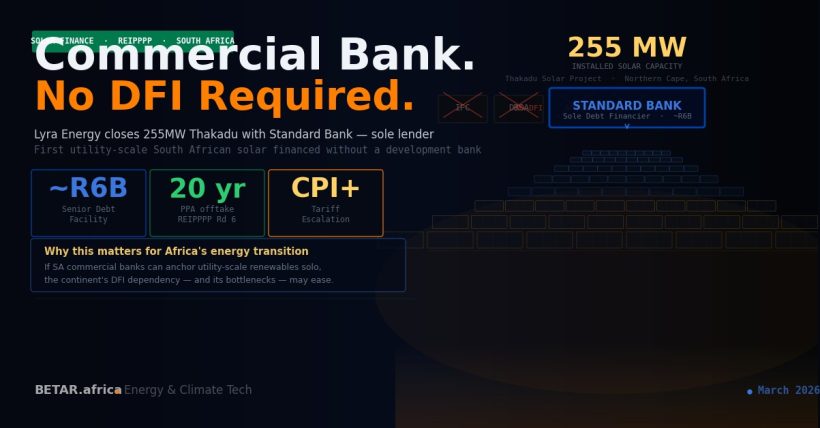
Lyra Energy’s Thakadu solar project, which reached financial close in early 2026, is notable for a different structure. Standard Bank arranged and provided the senior debt facility — approximately R6 billion ($330 million at prevailing rates) — as sole debt financier. No DFI participation. No bilateral lender. A South African commercial bank, carrying a 255-megawatt utility-scale solar project on its own balance sheet.
What Makes Thakadu Bankable Without a DFI
The REIPPPP framework is the foundational bankability element. Projects contracted under REIPPPP Round 6 — which Thakadu entered through the bid process — benefit from a power purchase agreement with the state buyer, backed by the government’s Implementation Agreement which provides sovereign support for Eskom’s offtake obligations. The PPA converts revenue risk from a question about market conditions into a question about sovereign credit — and South Africa’s investment-grade sovereign rating (maintained by Moody’s and Fitch through the country’s 2024 fiscal consolidation), while downgraded from its peak, remains above the threshold at which commercial bank project finance becomes structurally viable.
The specific risk mitigation embedded in the REIPPPP PPA — 20-year fixed-price offtake with annual escalation tied to CPI, Implementation Agreement government guarantee, rand-denominated revenue matching rand-denominated debt service — reduces the complexity of risk that Standard Bank’s project finance team needs to price. A solar project in a country without REIPPPP-equivalent contractual protections would present Standard Bank with technology risk, revenue risk, offtake risk, and currency risk simultaneously. Thakadu presents primarily credit risk on the South African sovereign.
Lyra Energy, the project developer, is majority owned by Mainstream Renewable Power — the Irish developer with an established South African track record through its Oya Energy portfolio, which includes the Loeriesfontein 2 and Khobab wind farms developed under REIPPPP Round 3. Sponsor track record matters in project finance: Standard Bank has watched Mainstream operate South African assets through Eskom payment delays, grid curtailment episodes, and the COVID-era construction disruptions that stressed multiple REIPPPP projects. The developer’s demonstrated ability to manage those events reduces the operational risk component of the lender’s assessment.
The Solar Resource and Site
Thakadu is located in the Northern Cape — the same high-irradiance region that has hosted a significant proportion of South Africa’s solar PV build-out since REIPPPP Round 1. The Northern Cape offers the highest average direct normal irradiance in South Africa, with annual averages exceeding 2,900 kWh per square metre in the Upington, Loeriesfontein, and Prieska corridors. Thakadu’s 255 megawatts of installed capacity, at this irradiance level and with modern bifacial panel technology, is expected to generate approximately 550 to 580 gigawatt-hours annually.
Grid connection — historically a significant risk factor in South African renewable energy development — is addressed through Eskom’s transmission infrastructure in the Northern Cape, which has been progressively upgraded to accommodate the region’s growing renewable capacity. Eskom’s grid integration challenges of the 2019 to 2022 period, when curtailment of wind and solar generation was significant, have been partially addressed through the Transmission Development Plan investments prioritised under the Electricity Regulation Amendment Act 2022.
Construction is contracted under a fixed-price EPC arrangement with a Chinese solar contractor — a structure consistent with recent REIPPPP projects where Chinese EPC firms have been competitive on both price and delivery schedule. The fixed-price structure further insulates Standard Bank’s loan from cost overrun risk during the construction phase.
What a Commercial Bank Solo Means for South Africa’s Energy Transition
South Africa’s energy transition has a financing capacity problem that is distinct from its generation capacity problem. The country’s Integrated Resource Plan projects 14,400 megawatts of new solar PV capacity by 2030 — a target that has already been partially revised upward to accommodate the faster-than-expected deterioration of Eskom’s coal fleet. Delivering that capacity requires a flow of project finance that is large enough to fund dozens of projects simultaneously across a multi-year procurement window.
DFIs — the African Development Bank, IFC, DBSA, and their bilateral counterparts — have finite capital allocation capacity and deployment bandwidth. They cannot finance every project in the South African pipeline, nor is it their mandate to do so. The DFI model is explicitly catalytic: use concessional capital to enable commercial capital to flow. For the catalytic model to achieve the volume of financing the transition requires, commercial banks must eventually become the primary lenders, with DFIs moving to credit enhancement, first-loss provision, and capacity building roles rather than direct project lending.
Thakadu is evidence that this transition is occurring — at least for REIPPPP-contracted projects in South Africa’s most favourable project development conditions. Standard Bank’s ability to carry a R6 billion solar project on its balance sheet without DFI participation reflects the maturation of the South African renewable energy market: enough projects have been built and have operated through stress events that the lender has a body of evidence to support its risk assessment without requiring a DFI guarantee.
The limitation is that this maturation is specific to REIPPPP’s contractual framework and South Africa’s sovereign credit. It does not automatically generalise to smaller markets, developers without established track records, or projects outside the REIPPPP procurement structure — including the growing market for corporate power purchase agreements and embedded generation that is developing alongside REIPPPP as South Africa’s energy market liberalises.
Standard Bank’s Strategic Position
For Standard Bank, the Thakadu mandate is a statement about its infrastructure and project finance ambitions in South Africa’s energy transition more broadly. The bank has been building its renewable energy project finance team since the early REIPPPP rounds and has been involved in multiple South African and pan-African clean energy transactions. But a sole-lender position on a 255-megawatt project is a balance sheet commitment of a different order than participation in a club deal.
The transaction positions Standard Bank as the leading domestic commercial lender in South Africa’s REIPPPP Round 6 cycle — a credential that has commercial value in subsequent mandates as developers, both domestic and international, evaluate which banks have demonstrated willingness to take large single-project exposures to South African renewable energy. In a financing market where REIPPPP will produce dozens of projects over the next five years, that credential is worth considerable future deal flow.
It also positions Standard Bank in the emerging market for environmental, social and governance-labelled financing. A large, verified solar project with a sovereign-backed PPA is among the most straightforward assets to label as a green loan under the Loan Market Association Green Loan Principles. Standard Bank’s ability to point to Thakadu as collateral-level evidence of its green lending portfolio will be relevant as it develops its own ESG-aligned funding base and investor relations positioning.
The Broader Signal
The renewable energy financing story in Africa has been dominated by headlines about DFI commitments and multilateral climate pledges. Thakadu is a different kind of signal: that in at least one African market, at least for utility-scale projects with sovereign-backed revenue certainty, commercial bank financing is no longer contingent on DFI participation.
That shift — from DFI-led to commercially-led project finance — is the transition that development finance theory has always projected as the endpoint of the catalytic investment model. Thakadu does not prove that the transition is complete or systemic. But it demonstrates that the direction of travel is real, and that South Africa’s renewable energy market has reached a depth where the most sophisticated domestic commercial lender is comfortable carrying the risk that DFIs were previously required to absorb.
For countries watching South Africa’s energy transition — Nigeria, Ghana, Kenya, and others developing their own procurement frameworks — the Thakadu closing offers a specific data point: programme credibility, contractual structure, and track record are the inputs that convert DFI-dependent project finance into commercially self-sustaining deal flow. The DFI model works. The question is whether other African energy markets are building the conditions for it to work itself out of a job.


 UphivaBETAR
 Joseph Busari