
South Africa JETP: America Exited, Germany Doubled Down, and the Money Is Still Not Moving
The Just Energy Transition Partnership was the marquee climate finance commitment of COP26 — a $8.5 billion package meant to demonstrate that rich nations would fund Africa’s coal exit. Four years on, grant disbursement is slow, the US has pulled out, and South Africa’s experience is shaping how African negotiators will approach Belem.
When COP26 concluded in Glasgow in November 2021, the headline that carried furthest was the South Africa Just Energy Transition Partnership. The United States, United Kingdom, France, Germany, and the European Union announced a collective commitment of $8.5 billion to help South Africa accelerate its exit from coal — the most carbon-intensive power sector in Africa, and the sixth-largest source of coal-fired power globally. Climate negotiators described it as a new model for climate finance: bilateral donors pooling around a single recipient with a credible transition plan, delivering concessional finance and grants rather than commercial debt.
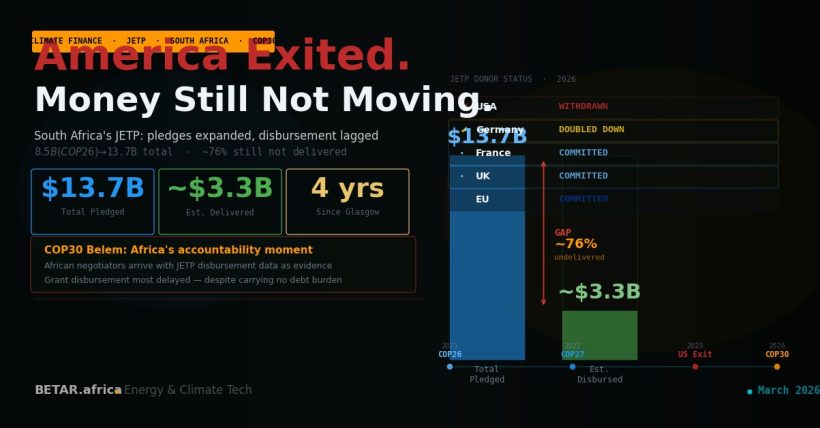
Four years later, the JETP has produced a detailed investment plan, a governance structure, and a series of further pledges that have expanded the total headline figure to approximately $13.7 billion including multilateral development bank commitments. What it has not produced is a disbursement rate that corresponds to the scale of the challenge. The gap between what has been pledged and what has actually flowed to South Africa’s energy transition is the central accountability question that will define how African negotiators approach COP30 in Belem this November.
What Was Actually Pledged — and What It Means in Practice
The $8.5 billion COP26 figure was a headline pledge, not a disbursement commitment with a fixed timeline. The financing was structured as a mix of grants, concessional loans, and guarantees from bilateral donors, channelled through a combination of direct budget support and project-level instruments. France, Germany, the UK, the US, and the EU contributed at different levels and through different financial vehicles — meaning the aggregate figure masked significant variation in the terms, conditionality, and delivery mechanisms attached to each bilateral contribution.
The subsequent expansion to $13.7 billion — announced through 2022 and 2023 as the JETP Investment Plan was developed — incorporated commitments from the New Development Bank, the International Finance Corporation, and the African Development Bank, alongside additional bilateral pledges. The MDB portion is largely structured as concessional lending rather than grants. The practical consequence is that South Africa must service a substantial fraction of the climate finance package as debt, at a time when its sovereign debt-to-GDP ratio already exceeds 70 per cent and its fiscal position is under sustained pressure.
Climate Action Tracker and the African Climate Foundation’s 2025 analysis of JETP disbursement — drawing on publicly available data from bilateral donor reports and South Africa’s National Treasury disclosures — found that actual disbursements as of end-2025 represented a fraction of the total committed envelope. Grant disbursements, which carry no debt burden and were supposed to demonstrate the concessional character of the package, were particularly slow. The opacity of the reporting structure — different donors use different definitions of “disbursed” versus “committed” versus “approved” — makes precise tracking structurally difficult.
The US Withdrawal: What Was Actually Lost
In February 2025, the United States formally withdrew from its JETP commitments following the return of the Trump administration and its associated executive actions rolling back US international climate finance programmes. The US contribution to the JETP had been structured through the US International Development Finance Corporation and the State Department’s climate diplomacy budget — both of which were substantially constrained under the new administration’s foreign policy priorities.
The direct financial loss was more limited than the headline JETP withdrawal implied. The US had not disbursed a substantial proportion of its JETP commitment by the time of withdrawal. Approximately $56 million in committed grants were cancelled. Additional potential commercial investment facilitated through DFC guarantees — estimated at up to $1 billion in prospective leverage — became uncertain. The headline withdrawal figure was the symbolic loss as much as the financial one: the JETP had been designed as a demonstration of G7 commitment to climate finance, and the departure of the largest G7 economy within four years of the initial pledge sent a signal that commitment durability was not guaranteed.
For South African negotiators and the African Group of Negotiators more broadly, the US withdrawal confirmed a risk that had been articulated but not resolved in the Glasgow architecture: bilateral climate finance pledges contain no enforcement mechanism. There is no international legal obligation binding the US, or any other donor, to disburse committed climate finance. The political will that created the commitment in 2021 proved insufficient to survive a domestic political transition in 2025.
Germany’s Doubling Down
Against the US withdrawal, Germany’s response has been the most significant bilateral development in the JETP’s second phase. Germany’s contribution — channelled primarily through KfW Development Bank and the German Federal Ministry for Economic Cooperation and Development (BMZ) — expanded to approximately €1.6 billion ($1.8 billion at current exchange rates), making it the largest single bilateral donor in the JETP package following the US departure.
Germany’s climate finance engagement with South Africa predates the JETP. The South Africa-Germany Energy Partnership, established in 2012, had built institutional relationships between Eskom, the South African Department of Mineral Resources and Energy, and German energy agencies that provided a foundation for more structured JETP engagement. KfW’s project finance capabilities in renewable energy and grid infrastructure gave Germany a delivery mechanism that bilateral donors without development bank capacity struggled to replicate.
The German scaling-up has been accompanied by specific project announcements — including concessional finance for the Renewable Energy Independent Power Producer Procurement Programme (REIPPPP) rounds and technical assistance for Eskom’s transmission unbundling — that are more tractable to disbursement than the broader programmatic pledges that characterised the initial JETP structure.
Germany’s willingness to increase its exposure as the US withdrew reflects both its climate foreign policy priorities — the German government remains committed to its international climate finance targets under domestic law — and its specific interest in South Africa as a supplier of green hydrogen and green ammonia for German industrial decarbonisation. The bilateral climate finance relationship is not purely altruistic; it is also a strategic industrial procurement partnership.
The Structural Problem: Grants vs. Loans
The composition of climate finance — the balance between grants, concessional loans, guarantees, and market-rate instruments — is the central technical dispute in African climate negotiations, and the JETP has become a case study in why it matters.
The vast majority of the JETP’s $13.7 billion envelope is debt. Grant-equivalent financing — which carries no repayment obligation and is the form of climate finance that African governments have consistently argued should dominate a “just” transition package — represents a small fraction of the total. The African Group of Negotiators, in their submissions to the UNFCCC, has argued that debt-financed climate transition support is not equivalent to grant-financed support: it adds to sovereign debt burdens that are already constraining development spending, and it effectively charges vulnerable countries for the cost of an energy transition that high-income economies — the primary historical emitters — have an obligation to fund.
South Africa’s case is particularly pointed because its coal-dependent grid was built under apartheid with multilateral and bilateral financing from the same nations now offering transition support. The structural argument — that South Africa’s carbon legacy reflects historical development finance choices made by donor countries — is not resolved by offering replacement debt. It requires grant financing that acknowledges the historical liability.
COP30 Implications
The JETP’s performance through 2026 will be a primary exhibit in the African Group of Negotiators’ case at Belem. The arguments likely to be advanced are threefold.
First, commitment durability: the US withdrawal demonstrates that bilateral pledges are not legally binding and can be reversed through domestic political processes. African negotiators will push for treaty-level climate finance commitments, or at minimum, escrow and pre-disbursement mechanisms that make pledged capital more resistant to political reversal.
Second, grant composition: the African climate finance position — articulated through the African Ministerial Conference on the Environment and the AGN — calls for the New Collective Quantified Goal (NCQG) on climate finance to include a binding grant floor. The JETP experience, where grants represent a small fraction of a large headline number, provides empirical support for why a headline figure without grant floor requirements can misrepresent the actual terms of the financial relationship.
Third, disbursement accountability: the opacity of JETP disbursement tracking has made it difficult for South African civil society and government to hold donor countries accountable for delivery. African negotiators will argue for standardised disbursement reporting, independent verification, and consequence mechanisms for non-delivery. The JETP’s own governance structure — a Coordinating Body that produces implementation plans but lacks enforcement authority over donor disbursements — has not resolved this accountability gap.
South Africa’s JETP was meant to be the proof of concept for a new era of climate finance. Four years on, it is instead the most detailed evidence available for exactly how the current system fails — and why the $300 billion NCQG commitment reached at COP29 in Baku requires an implementation architecture that the JETP was never given.


 UphivaBETAR
 Joseph Busari