
On a Saturday night in Victoria Island, Lagos, the queue outside Quilox stretches to the end of the block. Inside, forty VIP tables are occupied at minimum spends of ₦500,000 each. The DJ — a mid-tier Afrobeats name — is being paid ₦400,000 for a two-hour set. The bar is selling bottles of Hennessy at four times retail price. By 4 a.m., the venue has turned over more than ₦30 million in a single night. Almost none of this has ever been reported as a business story.
Africa’s nightlife sector — clubs, DJ ecosystems, and live entertainment spaces across Lagos, Nairobi, Accra, and Johannesburg — is a multi-billion dollar creative economy operating without economic scrutiny. What follows is the first systematic analysis: who captures the revenue, what DJs actually earn, and how promoters structure deals that carry more financial risk than most people assume.
The Revenue Architecture of a Tier-1 Club
In Western markets, the standard club revenue split runs roughly 20 to 30 percent from door receipts, 50 to 60 percent from bar sales, and 15 to 25 percent from VIP or bottle service. Africa’s premium clubs are structurally different — and the divergence tells you something important about the continent’s consumer economy.
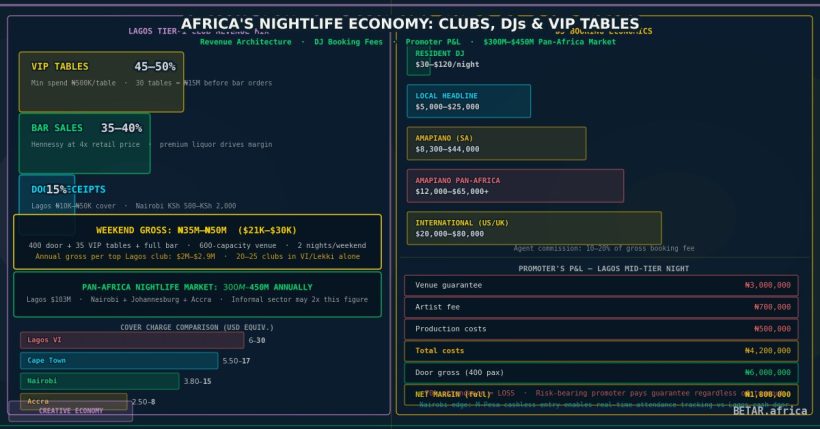
In Lagos tier-1 venues — Quilox, Revel, Bungalow — VIP table revenue has displaced bar sales as the primary income driver. The mix at a Lagos premium club runs approximately 15 percent door, 35 to 40 percent bar, and 45 to 50 percent VIP tables. The reason is simple arithmetic: a 500-capacity club at ₦15,000 average cover generates ₦7.5 million at the door. Thirty VIP tables at ₦500,000 minimum spend each generate ₦15 million before a single cocktail is poured.
“Young people are moving their networking to clubs now,” said Bukola Olajide, a Lagos nightclub owner. “It is no longer a venue to only drink and dance, but a meeting and networking venue too.” The shift in venue positioning has reinforced the VIP table model: by guaranteeing a minimum spend at the point of reservation, venues convert the night’s profitability from a variable outcome into a partially fixed one. Thirty tables sold by 11 p.m. means the night is profitable regardless of what the bar does after midnight.
Cover charge economics vary sharply by market. Lagos tier-1 clubs charge ₦10,000 to ₦50,000 for entry depending on the act. Nairobi’s premium venues — Trademark Hotel, B-Club — run KSh 500 to KSh 2,000 at the door. Cape Town’s high-end clubs (Origin, Taboo) charge R100 to R300. Accra venues GH₵50 to GH₵200.
A fully operational weekend at a 600-capacity Lagos club — 400 paying entry, 35 VIP tables, full bar — grosses ₦35 million to ₦50 million per night. A top-performing venue generates annual gross revenue of roughly $2 million to $2.9 million before costs.
DJ Booking Economics: The Amapiano Premium
DJ fees in African markets operate across a three-tier hierarchy: resident DJs, local headline acts, and international bookings.
Resident DJs — in-house acts playing four nights a week — earn ₦50,000 to ₦200,000 per night in Lagos, KSh 5,000 to KSh 15,000 in Nairobi, R500 to R2,000 in South African secondary markets. Working wages, not fortunes — and resident fees have not kept pace with venue revenue growth.
Headline bookings tell a different story. The amapiano wave has transformed South African DJ economics at the top end of the market. Leaked booking fee disclosures reported by The South African and Briefly.co.za show the Scorpion Kings duo (DJ Maphorisa and Kabza De Small) charging R200,000 for indoor events and R300,000 for outdoor performances in South Africa, with a hospitality rider that adds hotel suites, transport, and per diems on top. Across the broader amapiano headliner tier — which includes acts such as Kamo Mphela and DBN Gogo — fees range from R50,000 to R200,000 per show, according to Adias Moyo. Pan-African bookings for these acts carry a 30 to 50 percent premium above domestic rates to account for travel, rider requirements, and cross-border demand scarcity.
“An average amapiano artist commands a crowd of at least 2,000 revellers,” said Adias Moyo, a music promoter who has worked with amapiano acts touring across Africa. “People pay top dollar outside South Africa for a good time.” The cross-border premium is structural: the pool of amapiano acts with genuine pan-African ticket-moving power is narrow, and demand from Lagos, Nairobi, and Accra promoters for those specific names compresses into a price premium.
Nigerian Afrobeats DJs headline Lagos clubs at $5,000 to $25,000 per booking. International DJs from the UK or US command $20,000 to $80,000 for a single-night set in Lagos or Nairobi. DJ agent economics mirror the global standard: 10 to 20 percent commission on the gross booking fee.
The Promoter’s P&L: Breaking Down a Lagos Club Night
The promoter is the risk-bearing intermediary. A typical Lagos deal: the promoter pays the venue ₦2 million to ₦5 million for exclusive Friday use, plus the artist fee. In return, the promoter takes door revenue and sometimes a bar percentage above a threshold.
“Nightlife business is the crude oil,” said Stanley Ojumu, a Lagos nightclub promoter. “Whether open or rooftop bars, nightclubs or lounges, as long as the doors are open, music plays on and drinks flow, the owners will always smile to the bank.” But the independent promoter model sits on a narrower margin than venue ownership: the promoter commits venue guarantee, artist fee, and production costs before a single ticket is sold, converting every event into a leveraged bet on door turnout.
On a ₦3 million venue guarantee, a ₦700,000 artist fee, and ₦500,000 in production (sound, lighting, security), the promoter’s total commitment is ₦4.2 million. Door gross of ₦6 million at a full 400-person house at ₦15,000 leaves ₦1.8 million margin. Break-even requires filling at least 280 of 400 spots. A 70 percent attendance night turns a loss.
The Lagos and Nairobi promoter markets differ structurally. Lagos is walk-up dominant with limited presale culture. Nairobi’s advance ticket infrastructure, built on M-Pesa mobile money adoption, gives operators cashless entry tracking and attendance data that Lagos cash-door operations cannot replicate.
Operating Costs: The Invisible Constraint
Venue operating economics are less visible than revenue — but they explain why African nightlife is a business of high gross margins and volatile net margins.
Commercial property in Victoria Island, Lagos runs $70 to $120 per square metre per month for entertainment-zoned space. A 1,000-square-metre club carries a property cost of $70,000 to $120,000 per month, before fit-out amortisation. Equivalent space in Westlands, Nairobi costs $25 to $60 per square metre monthly. Sandton, Johannesburg runs R80 to R200 per square metre ($4.50 to $11).
A 500-capacity club requires 40 to 60 staff on an operating night. In Lagos, that staffing cost runs ₦2 million to ₦4 million per night inclusive of casual labour; in Nairobi, KSh 250,000 to KSh 500,000.
Liquor licensing costs vary substantially. In Nigeria, state licensing bodies impose annual fees and irregular compliance costs estimated at ₦3 million to ₦8 million for a premium Lagos venue. Kenya’s Alcoholic Drinks Control Act licensing is administered at county level — Nairobi County fees run KSh 200,000 to KSh 800,000 annually. South Africa’s regime is more formalised but carries BBBEE compliance complexity for new entrants.
Sizing the Market
Estimating the African nightlife economy requires a city-by-city reconstruction. Lagos is the best-documented market. Oui Capital, a Lagos-based venture fund, estimates the city’s nightlife economy at nearly ₦1.5 trillion annually. Granular data from the December 2024 peak period corroborates the scale: MO Africa Company Limited, which surveyed 15 of Lagos’s top lounges and nightclubs during the “Detty December” season, recorded ₦4.32 billion ($2.7 million) in revenue across those venues — an average of ₦360 million per club, with premium table pricing reaching ₦1.2 million per night at the top end. Lagos State Bureau of Statistics registers approximately 1,800 nightclub and entertainment facilities across the metropolitan area. Add Nairobi (800 active clubs), Johannesburg (600 premium venues), and Accra (400 registered venues), and a conservative pan-African estimate reaches $300 million to $450 million annually before the informal sector.
The Economics Nobody Reports
Africa’s nightlife industry generates real revenue, employs real people — DJ agents, promoters, security companies, logistics operators — and produces substantial tax-eligible turnover that mostly operates outside formal reporting. The VIP model has restructured how tier-1 clubs operate, concentrating revenue in a small number of high-spend customers. The DJ market has professionalised rapidly on the back of amapiano’s cross-border momentum. And promoters are navigating event risk with financial sophistication that exceeds most small business benchmarks.
The nightlife economy will not appear in Africa’s official creative industry statistics until governments start measuring it. The economics are there. The data collection is not.


 UphivaBETAR



 Joseph Busari