
Africa Teacher Pay & Migration Crisis: Why the Continent Is Losing Its Educators to the UK and Gulf
The continent trains teachers at public expense. Richer countries hire them for free. The numbers behind Africa’s slow-motion education labour collapse.
By the Education Reporter, BETAR.africa
On the morning of March 24, 2025, teachers at more than 400 schools in Abuja closed their gates and did not return for three months. The Federal Capital Territory teachers’ strike — over the implementation of Nigeria’s new ₦70,000 monthly minimum wage — kept more than 50,000 children out of classrooms through June and into July, resolved only when six area councils released ₦16 billion in arrears. It was the most disruptive teacher action in Nigeria’s recent history. It was also a precise illustration of why, across the continent, trained African teachers are choosing to teach somewhere else.
Adaeze Nwosu trained as a secondary school mathematics teacher at the University of Nigeria, Nsukka, graduating in 2019. She taught for four years in a public school in Enugu State, earning ₦48,000 a month — approximately $30 at the exchange rate prevailing in late 2023. In early 2024, she applied through a UK-registered international recruitment agency for a position at a secondary school in Wolverhampton teaching mathematics to 11-to-16-year-olds. Her salary in Wolverhampton is £31,650 per year. “I did not want to leave,” she said. “But I was earning $30 a month. You cannot build a life on $30 a month. I had a degree, I had four years of experience, and I had no real choice.”
Nwosu’s story is becoming increasingly common — and increasingly easy to execute, since the UK’s Teaching Regulation Agency introduced automatic Qualified Teacher Status recognition for teachers from Nigeria, Ghana, South Africa, and Zimbabwe in February 2023.
Fifteen Million Teachers Short — and Falling Further Behind
The scale of the structural problem predates the migration surge. UNESCO’s Global Report on Teachers, published in February 2024, found that sub-Saharan Africa needs 15 million additional teachers by 2030 — 10.7 million at secondary level and 4.4 million at primary. Africa accounts for one in three of the global teacher shortfall. Of 46 surveyed countries in the region, only nine are on track to meet universal primary teacher targets by 2030; only four of 44 are on track for secondary. The proportion of sub-Saharan African primary teachers holding minimum qualifications has fallen from 75 per cent in 2010 to 69 per cent — in a decade of supposed educational expansion. The global average is 86 per cent.
Against this backdrop, Africa is losing the teachers it has already trained. The mechanism is not invisible or unintended. It is a predictable consequence of a specific policy decision the UK made in 2023, combined with salary structures in African education systems that have not changed materially in real terms in a decade.
The Pay Gap That Explains Everything
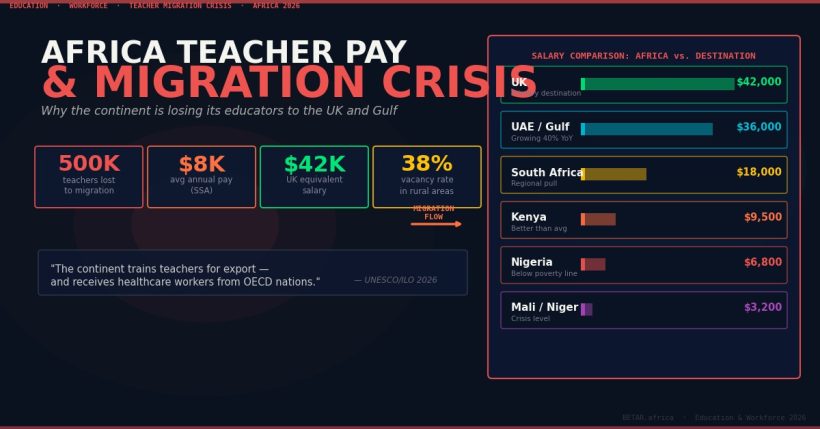
The numbers are not complicated. A Nigerian state school teacher at entry level earns between ₦35,000 and ₦75,000 per month — between $22 and $47 at current exchange rates. A newly qualified teacher in England earns a minimum of £31,650 per year, which is approximately $3,333 per month. That is a pay differential of between 70 and 150 times, depending on which Nigerian state and exchange rate you use. The differential is not a marginal preference. It is a structural imperative for any teacher capable of navigating the immigration pathway.
Ghana, Kenya, and South Africa offer more competitive rates. A Ghanaian degree-educated teacher earns approximately $235 per month. A Kenyan secondary teacher earns $220 to $290 per month. South Africa’s entry-level teaching salary of R163,179 per year — approximately $740 per month — is the highest in sub-Saharan Africa by a significant margin. Yet South Africa records among the highest rates of teacher emigration to the UK, Australia, and New Zealand of any African system, precisely because its teachers are educated to a level that receiving country systems readily accept. The better the training system, the more attractive the teacher — and the more acute the export risk.
The Pathway That Opened in 2023
The UK’s Teaching Regulation Agency created an automatic recognition route for teachers from a defined list of countries in February 2023. For teachers from Nigeria, Ghana, South Africa, and Zimbabwe, the route grants Qualified Teacher Status without an assessment period, provided the applicant specialises in mathematics, science, or modern foreign languages; teaches the 11-to-16 age range; has at least one year’s teaching experience; and secures a Skilled Worker visa sponsor. The academic restriction — mathematics and science only — narrows the pool. But mathematics and science teachers are precisely the cohort most in demand in African systems, and most urgently needed: the same teachers African secondary schools can least afford to lose.
Active international teacher recruitment agencies — including ASQ International, Teach Now, and Prospero Teaching — operate explicit African recruitment pipelines, advertising UK teaching vacancies in Nigerian, Ghanaian, and South African markets. A UK school that hires through this mechanism bears zero training cost. The Nigerian or Ghanaian taxpayer bore the cost of a three-year National Certificate in Education programme or a four-year bachelor of education. The UK school pays a recruitment fee and issues a visa sponsorship letter.
A Public Subsidy to British Schools
The structural economics are rarely named directly in policy discussions, but they are straightforward. Nigeria spends an estimated $3,000 to $5,000 per teacher in state-funded teacher college or university education over a three-to-four year programme. The UK government has calculated that training a new teacher domestically costs approximately £27,000 per candidate, including bursaries and training providers. An African-trained teacher who migrates to the UK represents a direct fiscal transfer: a receiving-country employer captures the full labour market value of a publicly funded training investment made by a sending-country government. No accounting mechanism tracks this transfer. No bilateral agreement compensates the sending system. It is, in effect, an unreported subsidy flowing from African education budgets to UK schools.
At the classroom level, the consequences are already visible. Nigeria’s North-East region recorded a pupil-to-teacher ratio of 124:1 as of 2023 data compiled by UNICEF — three times the national average, and more than three times the UNESCO benchmark of 40:1 for primary education. In the 90 per cent of sub-Saharan African secondary schools that UNESCO identifies as facing serious teacher shortages, the constraint is not funding for buildings or textbooks. It is the absence of qualified adults to stand at the front of the classroom.
What Governments Are Doing — and Not Doing
Some governments are responding with targeted retention programmes. Ghana’s newly announced Teacher Dabre Programme, launched by the Mahama administration in February 2026, offers teachers posted to hard-to-reach rural areas a 20 per cent salary top-up and free accommodation. It follows a 23 per cent base salary increase in January 2024 and a 15 per cent retention premium added to that settlement. The measures are meaningful at the margins. They do not address the structural gap with receiving-country salaries.
Kenya concluded a new Collective Bargaining Agreement for 2025 to 2029 in July 2025, following KNUT demands for a 60 per cent basic salary increase. The TSC-negotiated outcome fell short of that demand, but included salary increments and restructured allowances. In Nigeria, a dedicated teacher salary structure has been promised for five years and not delivered. The July 2024 national minimum wage increase to ₦70,000 per month — which triggered the Abuja strike when states failed to implement it — has still not been uniformly applied across all Nigerian states as of early 2026.
A Continental Strategy With No Pay Commitments
CESA 2026-2035 — the African Union’s Continental Education Strategy for Africa adopted in February 2025 — explicitly identifies teachers as the centrepiece of its second strategic area. It calls on member states to “increase the attractiveness of the teaching profession,” covering salaries, benefits, career progression, and working conditions. The strategy was adopted by AU heads of state with ministerial endorsement across 40 member states. It contains no numerical pay benchmarks, no minimum salary commitments, and no financing mechanism to bridge the gap between stated ambition and current wage levels.
“CESA correctly identifies the problem,” said Dr. Beatrice Awuor, a Kenyan education economist who has advised the Teacher Task Force. “But naming the problem is not the same as solving it. If you want teachers to stay in African classrooms, you have to pay them enough to make staying a rational decision. The strategy doesn’t get you there.”
The Arithmetic of the Crisis
Africa needs 15 million more teachers by 2030. It is losing the ones it has trained. The mechanism connecting those two facts is not policy failure in the abstract — it is the daily calculation made by a trained mathematics teacher in Lagos, Accra, or Nairobi who has received an email from a Wolverhampton school offering £31,650 per year and a Skilled Worker visa sponsorship. She is not making a values decision. She is making an arithmetic decision. The arithmetic is not difficult.
CESA 2026-2035 launched with a teacher retention objective and no mechanism to fund it. The UK’s Teaching Regulation Agency has a functioning automatic QTS route for African teachers and every intention of keeping it. Ghana’s Teacher Dabre programme is a start. Nigeria’s salary arrears remain unresolved in several states. Kenya’s new CBA did not deliver the 60 per cent increase its unions requested. Until the pay gap closes to the point where it stops being a structurally irrational decision for an African teacher to remain in an African classroom, the export of trained educators to richer countries will continue — quietly, at scale, and largely without the political attention the numbers suggest it deserves.
This article is part of BETAR.africa’s series on Africa’s education quality crisis. Related coverage: Africa’s Teacher Training Pipeline Is Breaking Down (BETA-969) and Africa’s Brain Drain Problem Has a New Face (BETA-690).


 UphivaBETAR
 Joseph Busari