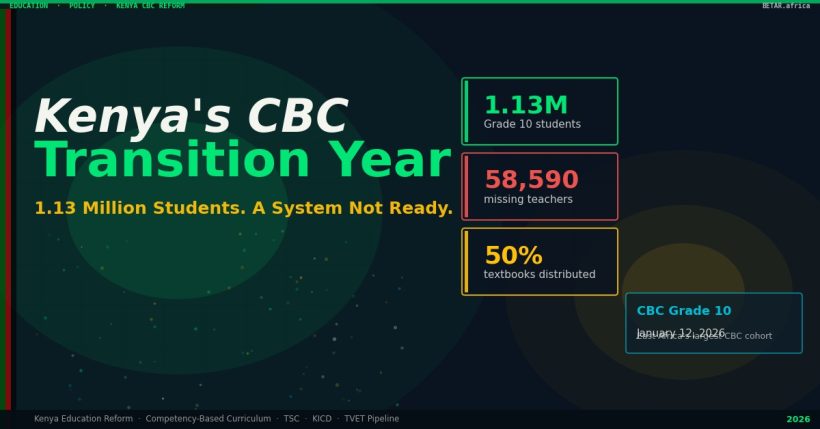

Kenya’s CBC Transition Year: 1.13 Million Students, 58,590 Missing Teachers, Half the Textbooks
On January 12, 2026, Kenya launched one of the most ambitious education reforms in East African history. The first cohort of Competency-Based Curriculum learners entered Grade 10 — senior secondary school — in a country that was not fully ready to receive them.
April 2026
The first morning of senior school for Kenya’s CBC pioneer cohort arrived on January 12, 2026. More than 1.13 million Grade 9 graduates — the first cohort to have completed the full nine-year basic education pathway under the Competency-Based Curriculum — reported to secondary schools across 47 counties. For millions of Kenyan families, it was a moment of genuine milestone: a generation educated under a system designed to replace rote learning with skills, pathways, and practical capability was finally moving into the tier of education it had been built for.
The system waiting to receive them told a different story.
Printing firms had withheld Grade 10 textbooks in protest of an outstanding government debt of Sh11.4 billion for books supplied in Grades 8 and 9 since 2022. By mid-January, just 50 percent of the 11.8 million required Grade 10 textbooks had been distributed nationwide. The government released Sh5.64 billion to publishers in a last-minute bid to accelerate printing — but weeks into the term, teachers in many schools were managing without the materials their curriculum required. Rural schools, which form the backbone of Kenya’s public education system, were the worst supplied.
The teacher gap was more structural. Kenya faces a shortage of 58,590 teachers for the CBC senior school rollout — educators trained and credentialled specifically for the new pathway-based curriculum. Existing teachers, most of whom trained and built their careers under the 8-4-4 system, describe preparation for the new Grade 10 subjects as “grossly insufficient.” In many counties, teachers tasked with delivering STEM and Arts pathway lessons had received no subject-specific training before the term began.
Willy Kuria, National Chairman of the Kenya Secondary Schools Heads Association (KESSHA), put the problem in plain terms at the association’s 47th Annual Conference Meeting in Mombasa in March 2026. “With the CBE, we need qualified teachers who can handle the new subjects in our schools, such as electricity, aviation, marine technology and building and construction,” Kuria told journalists. “I don’t think there is a school that has all of these teachers.”
The Pathway Architecture: What CBC Senior School Actually Is
Kenya’s senior secondary school, as designed under CBC, is not simply a renamed Form 1. It is a structural break with forty years of 8-4-4 convention.
Under the new system, learners are placed into one of three pathways — Science, Technology, Engineering and Mathematics (STEM); Social Sciences; and Arts and Sports Science — based on their Kenya Junior Secondary Education Assessment (KJSEA) results and continuous assessment scores. Pathway placement is not optional. It determines the subjects students take, the institutions they target at the tertiary level, and the type of professional or vocational preparation they receive in the two years before sitting the Kenya Certificate of Basic Education (KCBE) examination in 2028.
The 2025 KJSEA results, released in December by the Kenya National Examinations Council (KNEC) for 1,130,459 candidates, showed that 59.09 percent demonstrated readiness for the STEM pathway. Approximately 46.52 percent qualified for Social Sciences and 48.73 percent for Arts and Sports — with significant overlap across pathways, reflecting the multi-pathway eligibility architecture.
That 59 percent STEM qualification rate is the policy signal CBC’s architects wanted. The curriculum was explicitly designed to increase the proportion of Kenyan students pursuing science and technical subjects, reversing the concentration of secondary school cohorts into humanities and social sciences that the 8-4-4 system inadvertently produced. If the data holds at scale — and if the schools can actually deliver STEM instruction — Kenya’s graduate pipeline into technology, medicine, and engineering will look materially different by the early 2030s.
That conditional is the weight-bearing problem.
The Infrastructure Gap
The government’s preparation plan for the Grade 10 transition included constructing 2,600 new laboratories — 1,600 physical and 2,000 virtual — to ensure every senior secondary school had at least one functional science facility by January 2026. The ambition was appropriate. The execution was partial.
As of the January rollout, reports from educators across multiple counties described science labs under construction, ICT rooms without computers, and virtual lab infrastructure installed but not yet operable. Rural schools — which absorbed the majority of the 1.13 million cohort — remain structurally disadvantaged relative to urban national schools where infrastructure investment is historically concentrated.
The gap is not merely inconvenient. For a curriculum explicitly structured around practical, competency-based learning, the absence of functioning labs is not a minor logistical shortfall. A STEM pathway student who cannot conduct chemistry experiments, access internet-connected computing, or engage with the engineering design process that CBC’s curriculum mandates is receiving a paper qualification in a competency they have not developed.
The government has framed these as transitional problems — implementation friction that will resolve as the investment pipeline catches up. That framing is partly true. It is also a structural pattern in Kenyan education reform history: the policy architecture tends to be sound; the execution infrastructure tends to lag by a generation of learners.
The TVET Absorption Question
CBC’s most consequential structural claim is that it will redirect a significant proportion of Kenya’s secondary school leavers into Technical and Vocational Education and Training pathways. The 8-4-4 system, in practice, treated TVET as a consolation prize for those who failed university entry — socially stigmatised and structurally under-resourced. CBC is designed to invert this hierarchy, positioning TVET as a deliberate pathway with career endpoints rather than an alternative for academic underperformers.
The government has set a target of two million TVET learners by end of 2026. Against the 1.13 million entering Grade 10 this year — with another 1.2 million expected in the following cohort — the TVET absorption question is genuinely consequential. If 30-40 percent of senior secondary leavers pursue TVET pathways as designed, Kenya’s TVET sector will need to more than double its current capacity within two years.
The current infrastructure cannot accommodate that volume. All TVET institutions formally transitioned to Competency-Based Education and Training frameworks in January 2026 — a regulatory milestone. The physical capacity, faculty numbers, and employer partnerships required to absorb a CBC-scale TVET intake are not yet in place.
The University Pipeline: A 2029 Problem
For universities, the CBC cohort arrives later than the senior secondary crisis would suggest. Kenya’s first CBC students will sit their KCBE examination in 2028 and enter university from 2029 onwards. The Commission for University Education (CUE) and the Ministry of Education have until December 2026 to finalise the new university admission framework — transitioning from the C+ minimum entry grade that has defined access for decades to a CBC-compatible pathway-based placement system.
Kenya Universities and Colleges Central Placement Service (KUCCPS) has signalled the phasing out of the C+ minimum in favour of pathway-based admissions. For the 2026/27 cycle — still a transitional year serving 8-4-4 leavers — 42 public universities and the Open University of Kenya qualify for government scholarships and HELB loans, with HELB’s annual budget raised to Ksh41 billion.
The 2029 entry of the first CBC university cohort will stress-test whether the frameworks developed through 2028 are coherent — and whether the loan architecture has been capitalised at CBC scale. As BETAR reported in March 2026, the HELB system already faces a KSh43.6 billion deficit serving existing students. Building KALF to handle a larger, more technically-tracked cohort without structural capitalisation will replicate the deficit problem at the next tier.
What the Reform Actually Tests
Kenya’s CBC transition is not primarily a curriculum question. It is an institutional capacity question. The policy design — pathway-based learning, competency assessment, TVET parity, practical skills instruction — is among the most sophisticated education reform frameworks produced in Sub-Saharan Africa in the past decade. The Kenya Institute of Curriculum Development (KICD) and the Ministry of Education have built a coherent architecture.
What the reform tests is whether Kenya’s public institutions — the Teachers Service Commission (TSC), county governments, publishers, TVET councils, and the university sector — can execute a coordinated multi-sector transition at the pace the curriculum reform demands. The TSC, for its part, has acknowledged the staffing challenge. Acting CEO Evaleen Mitei said in early 2026 that the commission is “currently in discussions with technical and vocational training institutions to explore ways of tapping into their trainers to help handle some of the specialised subjects.” It is a pragmatic workaround. It is also a signal that the formal teacher pipeline will not close the gap on its own timeline.
The January 2026 rollout, with its missing teachers, unpacked textbooks, and half-built laboratories, suggests the answer is: not simultaneously, and not without sustained public investment that the current funding environment does not yet guarantee.
For the 1.13 million students now in Grade 10, that abstraction is not policy theory. It is the classroom they are sitting in.

 UphivaBETAR
 Joseph Busari