
AI-Industrialised Identity Fraud: Africa Fintech’s 160,000-Attacks-a-Month Problem
A fraud syndicate launched over 160,000 identity verification attacks using just 100 stolen faces. This is not a cybercrime story — it is an infrastructure story. And African fintechs are being forced to rebuild from scratch.
A fraud syndicate launched over 160,000 identity verification attacks in a single month last year using just 100 stolen faces. This is not a cybercrime story. It is an infrastructure story — and African fintechs are being forced to rebuild their identity stack from scratch.
The scale of AI-driven identity fraud in Africa’s fintech sector has reached what security engineers are calling an inflection point. According to Smile ID’s 2026 Digital Identity Fraud Report — compiled from more than 200 million identity checks across 35 countries — 69% of biometric fraud attempts in Africa are now AI-generated. In Southern Africa, that figure rises to 87%. Injection attacks, in which fraudsters bypass device cameras entirely by injecting synthetic video streams, exceeded 100,000 attempts per month in 2025. High-fidelity document forgeries are up 250% year-on-year.
The economics of fraud have been permanently disrupted. “Generative AI has collapsed the cost structure of identity fraud,” said one Lagos-based fintech CTO who requested anonymity because the firm’s fraud systems are under active attack. “A skilled deepfake operation that would have cost tens of thousands of dollars two years ago now costs someone with a laptop a few hours of compute time.”
Not onboarding. Authentication.
The Smile ID data reveals a structural shift that has significant implications for how fintechs architect their security layers: authentication fraud attempts are now five times more common than fraud at account registration. Fraudsters are no longer primarily trying to create fake accounts — they are targeting the ongoing authentication of real ones. Account takeover has become the preferred vector.
This matters because most African fintech security stacks were built around onboarding. KYC pipelines, document verification, and liveness checks at account creation were designed to be the primary line of defence. That design assumption is now obsolete.
The data breaks down regionally. In West Africa, potential fraud incidents grew 50% year-on-year, with 65% of digital fraud attempts linked to biometric spoofing. East Africa saw sharper spikes: deepfake-driven fraud in Tanzania surged 317%, while Kenya recorded an 87% increase in mobile banking fraud. In one particularly stark finding, the same 100 facial identities were used to power 160,000 fraudulent verification attempts — with some faces appearing over 12,000 times across multiple platforms in a single month.
The compliance mandate arrives simultaneously
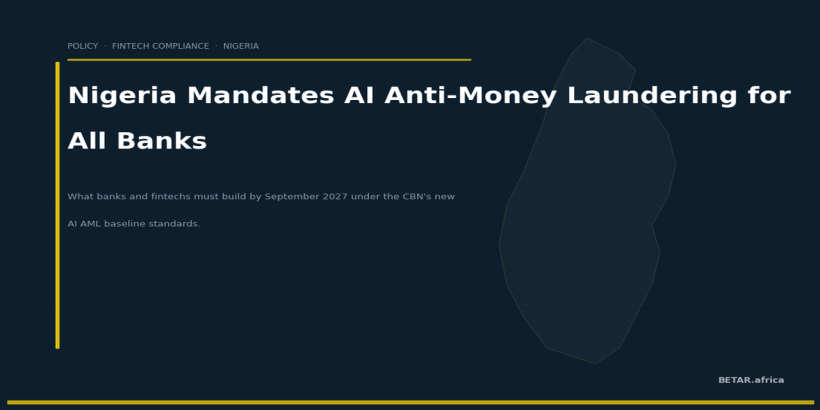
African fintechs are being squeezed from two directions at once. On March 10, 2026, the Central Bank of Nigeria issued Circular BSD/DIR/PUB/LAB/019/002, establishing mandatory baseline standards for automated AML solutions across the Nigerian financial sector. Institutions must submit implementation roadmaps by June 10 and have compliant systems deployed within 18 to 24 months.
The circular does not mention the Smile ID report. It does not need to. The regulatory logic is the same: AI-powered fraud detection is no longer optional infrastructure. CBN now requires real-time transaction monitoring, automated suspicious activity reporting, and independent annual validation of all AI and machine-learning models used for AML — including accuracy audits, bias testing, and human oversight documentation.
For a mid-sized Nigerian fintech already running thin margins, the simultaneous arrival of industrialised AI fraud and a mandatory compliance upgrade creates what one financial crime specialist called “a perfect compression event.”
What the new stack looks like
The technical response is converging around a set of architectural principles that represent a significant departure from first-generation African fintech identity infrastructure.
The first is liveness detection hardening. ISO 30107-3 — the international standard for presentation attack detection — is becoming the baseline requirement for any identity verification provider operating at scale in Africa. Passive liveness (which detects spoofing without requiring user action) is being layered with active challenges in high-risk transaction flows. Several Nigerian fintechs have moved to multi-factor biometric architectures that cross-reference facial recognition against voice, device telemetry, and behavioural pattern analysis.
The second is continuous authentication. Rather than verifying identity once at login, more sophisticated fraud stacks now assess trust continuously across a session — monitoring mouse behaviour, typing cadence, transaction velocity, and device characteristics in real time. Trust decays and regenerates with each interaction rather than being treated as a binary gate.
The third is ecosystem-level intelligence. The same face appearing 12,000 times across multiple platforms cannot be stopped if each platform is running its own isolated fraud database. Smile ID and competitors including Dojah and Appruve are building cross-platform fraud signals that allow fintechs to benefit from attacks detected on other platforms — essentially a shared threat intelligence layer for the African identity ecosystem.
The cost of this upgrade is not trivial. Identity verification contracts for mid-tier fintechs running 1–5 million monthly verifications have increased 30–60% over the past 18 months as providers invest in AI detection infrastructure. When combined with the CBN’s AML automation requirements, the compliance technology bill for a regulated Nigerian fintech in 2026 looks materially different from 2024.
The gap between knowing and doing
The Smile ID report identifies what it calls an “execution gap” — the distance between fintechs that understand the fraud landscape and those that have rebuilt their identity infrastructure to respond to it. Across East Africa in particular, the report finds a concentration of small and mid-sized fintechs operating liveness and document verification systems that remain vulnerable to injection attacks.
The report’s framing is direct: “Successful firms treat identity as a security surface, not an onboarding step.” That distinction — between identity as a gate you pass through once and identity as a dynamic, continuously monitored surface — is the central architectural decision every African fintech must now confront.
For the largest players — Moniepoint, Flutterwave, OPay, Wave — the investment is happening. For the hundreds of Series A and earlier fintechs that built their infrastructure during the verification-light years of 2019–2022, the compliance clock is now running.
BETAR.africa covers African fintech, AI, and technology markets. Sources: Smile ID 2026 Digital Identity Fraud Report; CBN Circular BSD/DIR/PUB/LAB/019/002 (March 10, 2026); company product documentation. BETAR reached out to Smile ID for comment on data methodology; no response had been received by publication. Related: CBN AI/AML Gold Rush — Which African AI Startups Win the Compliance Market (BETA-1074) — the market opportunity the mandate creates.

 UphivaBETAR