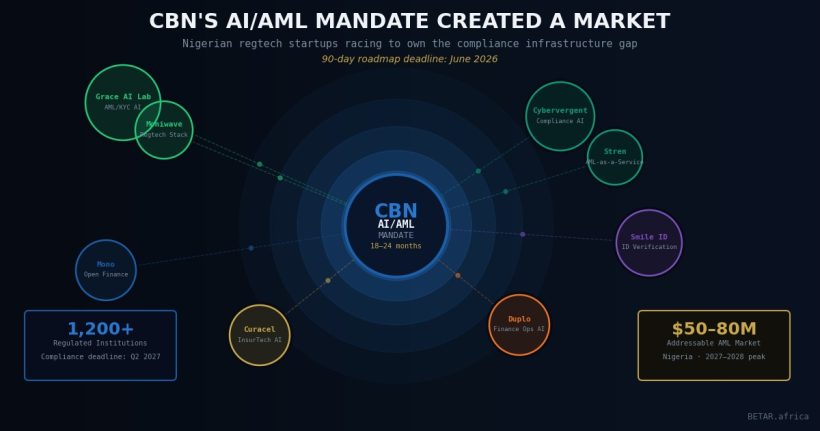

Nigeria’s Central Bank did not intend to write a startup pitch deck when it published its AI/AML baseline standards on March 10. But that is effectively what it did. With a stroke of regulatory authority, the CBN created a compliance infrastructure gap across hundreds of Nigerian financial institutions — and a market for whoever can fill it fastest.
The mandate requires banks, fintechs, mobile money operators, and payment service providers to deploy AI-validated, independently auditable anti-money laundering systems within 18 to 24 months. A 90-day roadmap obligation — due in the first week of June 2026 — means the procurement clock is already running. The question is no longer whether Nigerian fintechs will buy compliance AI. It is which companies they will buy it from.
The Numbers Behind the Opportunity
Nigeria’s CBN-licensed financial ecosystem is large. At last count: 30 deposit money banks, approximately 900 microfinance banks, five mobile money operators, 45 international money transfer operators, and more than 200 payment service providers and fintechs operating under various licences. Not all of these institutions have AML infrastructure that meets the CBN’s new six-domain standard.
For most smaller institutions — especially the payment fintechs that scaled fast on mobile money rails during the 2020–2024 growth cycle — compliance infrastructure was a background cost, not a product investment. Many operate on rule-based transaction filters and manual review queues. The CBN’s new standards require something structurally different: AI-driven anomaly detection, dynamic customer risk profiling, documented audit trails, and annual independent model validation.
Conservative estimates put the addressable market for compliant AML-as-a-service in Nigeria at $50 million to $80 million annually once the compliance wave peaks in 2027–2028. That figure is based on licensing and validation costs across the institution base — not the broader professional services and systems integration work that will accompany deployment. Add that layer and the market could comfortably double.
The Local Contenders
The most prominent Nigerian name in AI/AML circles is Grace AI Lab, a Lagos-based compliance technology firm that has been quietly building automated AML and KYC infrastructure for Nigerian financial institutions since 2023. Grace AI Lab was among the first local firms to publicly signal alignment with the CBN’s expected standards ahead of the March circular — a positioning move that suggests its product was architected for exactly this regulatory moment.
Cybervergent, which raised a seed round in 2025, offers AI-driven cybersecurity and compliance tooling with specific modules for financial services clients. Its positioning as a “compliance AI” provider — rather than a pure cybersecurity company — gives it a natural wedge into the AML procurement conversation, particularly with mid-tier fintechs that want a single vendor covering both threat detection and regulatory compliance.
Mono.co operates at a different layer of the stack — financial data infrastructure rather than compliance tooling — but its transaction data enrichment capabilities are increasingly relevant to the CBN’s KYC/KYB and dynamic risk profiling requirements. Mono has not publicly announced an AML product pivot, but its data infrastructure sits directly underneath the kind of real-time transaction monitoring the CBN mandates.
Appzone (now Zone), the West African banking infrastructure company, has deeper roots in the legacy tier-one bank stack than most fintechs. Its core banking and payment switching infrastructure gives it integration leverage with DMBs — the institutions facing the tightest 18-month deadline — that purely regtech-focused startups cannot easily match.
Build vs. Buy: How Nigerian Fintechs Are Deciding
Conversations with compliance officers at three CBN-licensed fintechs — none of whom would speak on record ahead of their roadmap submissions — suggest the predominant posture is vendor procurement rather than in-house build. The reasons are structural.
Building a compliant AI/AML system from scratch requires machine learning engineering, a proprietary transaction dataset large enough to train on, a compliance legal function to interpret the CBN’s standards, and the internal capacity to manage annual independent model validation. For a fintech with 50 to 200 employees and a primary business that is not compliance tooling, that is a multi-year, multi-million dollar investment.
“The CBN has essentially told us what we need to build,” one compliance lead at a Lagos PSP said. “We don’t have the team to build it ourselves. We’re going to buy it.” Their criteria: CBN-audit-ready documentation, NIBSS integration, and a vendor that can own the annual validation process.
The 90-day roadmap requirement is accelerating vendor conversations that would otherwise take 12 months. Fintechs that had been in exploratory discussions are now in procurement mode.
The Global Vendor Problem
Temenos, Oracle FSS, and NICE Actimize all offer enterprise-grade AML platforms that can technically meet the CBN’s standards. For tier-one Nigerian DMBs with existing relationships, global vendors will win a significant portion of the large-institution market.
But for the mass of smaller CBN-regulated institutions, global platforms present three friction points.
First, price. Enterprise AML platforms from Temenos or NICE Actimize are priced for institutions with compliance budgets to match — typically $200,000 to $1 million annually for licensing alone. That is prohibitive for an institution generating $5 million to $20 million in annual revenue.
Second, localisation. NIBSS integration, Nigerian PEP list management, and the CBN’s specific documentation requirements for the six-domain standard require customisation that global vendors provide slowly and at high cost.
Third, support. The CBN’s enforcement calendar runs on Nigeria time. Institutions that encounter regulatory queries need vendors who can respond in hours, not across time zones.
Local African AI vendors — if they can demonstrate audit readiness and model validation capability — have a structural advantage with mid-market and lower-tier institutions. The TAM may be smaller per contract, but the addressable institution count is far larger.
What Investors Are Watching
Regtech-focused VCs in Nigeria are paying attention. Ventures Platform and TLcom Capital — both active in the Nigerian compliance and fintech infrastructure space — have publicly indicated interest in compliance tooling plays in recent months. GreenHouse Capital, which has a portfolio weighted toward financial infrastructure, is understood to be evaluating at least one AML-adjacent investment.
The appeal is straightforward: mandate-driven demand, a time-pressured customer base, and a compliance requirement that does not disappear after the first deployment cycle. Annual validation requirements create recurring revenue. The CBN’s enforcement mechanisms — thematic reviews, on-site examinations, sanctions — give the compliance obligation teeth that purely advisory software markets lack.
“This is not discretionary spend,” one Lagos-based investor said. “The CBN has effectively created a floor.”
The Competitive Window
The first-mover advantage in compliance markets runs roughly 24 to 36 months — the period between mandate publication and widespread enforcement. Companies that establish CBN audit track records during that window, build integrations with NIBSS and the major core banking systems, and accumulate independently validated model accuracy data are structurally difficult to displace.
Grace AI Lab, Cybervergent, and the handful of other Nigerian regtech firms now racing toward the June 2026 roadmap deadline know this. So do their investors. The CBN’s AI/AML mandate was framed as a burden on the financial sector. For a small number of African AI companies, it is something else entirely: a government-issued starting gun.
*Sources: CBN circular (March 10, 2026); industry interviews (three CBN-licensed fintechs, on background); TechCabal coverage of Grace AI Lab; investor conversations. Related: BETA-624 (CBN AML standards), BETA-555 (initial CBN AI/AML assessment), BETA-623 (CBN liveness checks).*


 UphivaBETAR
 Joseph Busari