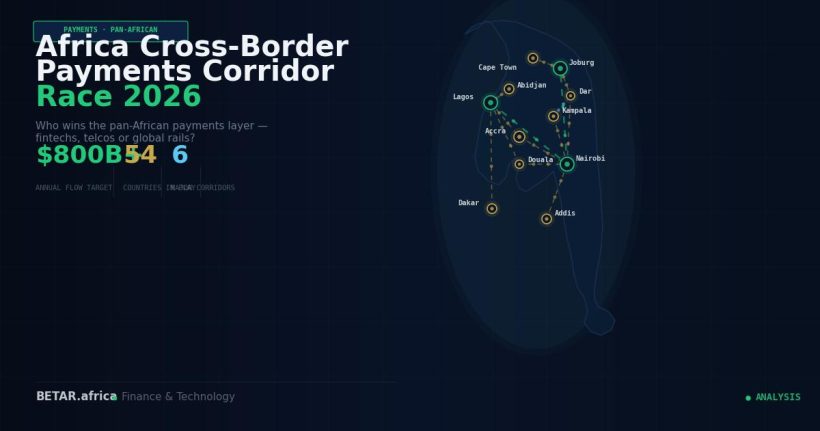

Africa Cross-Border Payments Corridor Race 2026: Who Wins the Pan-African Payments Layer?
In 60 days in early 2026, three structurally significant events reshaped Africa’s cross-border payments landscape. The Kenya-Rwanda EAC PSP licence passporting MOU created a regulatory precedent for corridor harmonisation. Moniepoint completed its acquisition of Sumac Microfinance Bank in Nairobi, giving a Nigerian fintech its first East Africa banking footprint. And Wise secured a Nigerian IMTO licence, bringing global direct-to-consumer competition into the corridor. Three moves. Five categories of player. One battlefield.
The prize is significant. Sub-Saharan Africa cross-border payment flows — formal and informal — are estimated at over $50 billion annually, with average send costs still sitting at 7.8% according to World Bank Q4 2025 data. Within the East Africa Community, intra-regional costs run lower at 4–5%, but the Nigeria-to-EAC business payments corridor stacks above 5% once FX conversion is layered in. The economics of this market reward whoever owns both ends of the rail.
What EAC Passporting Actually Unlocks
The Kenya-Rwanda PSP licence passporting MOU, signed in early 2026, is the most consequential regulatory development in African payments infrastructure in years — but it is important to understand its precise scope. The agreement enables a payment service provider licensed in Kenya to obtain recognition in Rwanda without a full local licensing process, and vice versa, under Stage 2 of the EAC Cross-Border Payment System Masterplan. Tanzania is the next natural signatory.
What it unlocks in practice: a fintech with a CBK licence can now enter Rwanda with significantly reduced regulatory friction, timelines, and capital cost. What it does not unlock: automatic passporting across all EAC members; Uganda, Tanzania, Burundi, and South Sudan are not yet party to this bilateral instrument. The legal architecture creates a corridor, not a corridor network. For a player like Moniepoint, which acquired a CBK banking licence via the Sumac MFB deal, the passporting framework is immediately actionable for Rwanda entry — the bottleneck is distribution buildout, not licensing.
Moniepoint’s East Africa Play: Banking Licence First, Corridor Second
Moniepoint’s acquisition of Sumac Microfinance Bank was widely reported as a “Kenya entry,” but its strategic logic runs deeper. The acquisition secures a CBK deposit-taking licence — a category of approval that would take 18–24 months to obtain organically. The initial Nairobi play is merchant acquiring and SME working capital financing, not personal remittance. Moniepoint is replicating the model that drove its Nigeria growth: point-of-sale terminal penetration, merchant lending, and current account products bundled to a business banking stack.
According to CBK regulatory filings at the time of acquisition, Sumac had approximately 12,000 active borrowers and a loan book concentrated in micro-enterprise. For Moniepoint’s purposes, the asset quality is secondary to the licence and the network bridgehead. The West-to-East business payments corridor — Nigerian manufacturers, logistics firms, and service exporters transacting with East African counterparts — is the medium-term revenue thesis. No single player currently owns both ends of that corridor with owned rails. Moniepoint, with its Nigeria licensing depth and new Kenya banking licence, is the closest to doing so.
Wise, NALA, and the Direct-Licence Race
Wise’s Nigerian IMTO licence changes the competitive geometry on the consumer remittance side. Prior to the licence, Wise processed Nigeria-bound transfers via partner IMTOs, paying intermediation costs that constrained its ability to price aggressively. On its own IMTO rails, Wise eliminates that cost layer and can push rates closer to its UK-Nigeria corridor transfer data — a figure disclosed in Wise’s published transfer data for the UK-Nigeria corridor, where Wise consistently prices below the 7% industry average.
NALA, the Tanzanian-founded remittance fintech, has followed a parallel track: acquiring licences at the source market rather than relying on aggregators. The pattern is clear — serious corridor players are moving from partnerships to ownership. The implication for incumbent IMTOs, Flutterwave, and the banks that intermediated corridor transfers is pricing pressure at the consumer end. Where Wise and NALA are competing, take rates compress.
The gap neither is filling: the business payments corridor. Consumer remittance (diaspora to family) is a volume game with thin margins. The SME cross-border trade corridor — goods, services, professional fees moving between Nigeria and EAC markets — is a higher-margin, lower-frequency business where relationships and working capital financing create switching costs. Wise has no SME financing product in Africa. Moniepoint does.
M-PESA’s Asymmetric Defence
M-PESA’s decision to mask merchant phone numbers in its API ecosystem — separating the M-PESA business number from the operator’s personal SIM — has a KYC implication that is easy to underestimate. For corridor entrants that rely on phone number as the primary identity layer for onboarding, the masking policy creates a friction asymmetry: M-PESA maintains its own identity infrastructure and knows its customers; corridor competitors building on top of M-PESA merchant rails now face a heavier KYC lift to verify business counterparties.
The practical effect is that M-PESA’s East Africa incumbent position is defensible not through price competition but through identity infrastructure depth. Any corridor entrant who wants to reach M-PESA’s 30-million-plus merchant touchpoints must invest in independent identity verification, raising their cost-to-serve. This is a structural moat, not a pricing moat.
MTN MoMo: War Chest, Constrained
MTN Group entered 2026 with what it publicly described as a $2 billion acquisition war chest. Approximately 60% of that capacity has been allocated toward resolving the IHS Towers capital structure, leaving roughly $800 million in free optionality. MTN MoMo’s corridor ambitions — linking West Africa wallet infrastructure to East Africa payment rails via interoperability agreements — are structurally intact, but the execution capital is constrained relative to the original ambition.
MTN MoMo is the only player with a presence in both the Nigeria-anchored West Africa payments corridor and the Kenya-anchored East Africa corridor. Its problem is that interoperability agreements produce lower per-transaction economics than owned rails. Until MTN makes an acquisition in East Africa payments infrastructure — not just a bilateral interoperability deal — it will remain a corridor participant rather than a corridor owner.
The Five Players and the Two Corridors
The five categories of player converging on the pan-African payments layer are: West Africa fintechs expanding East (Moniepoint, Chipper Cash); East Africa incumbents defending the corridor (M-PESA, Equity Bank, NCBA); global remittance players entering on direct licences (Wise, NALA); telecoms infrastructure players (MTN MoMo, Airtel Money); and the regulatory frameworks enabling or fragmenting movement (EAC passporting, CBN IMTO framework, Kenya’s VASP Act).
The structural reality in 2026 is two distinct corridors with different competitive dynamics. The consumer remittance corridor — diaspora transfers, personal payments — is being competed for aggressively by direct-licence fintechs on price. Wise and NALA have the technology and the licensing trajectory. Margins will compress. The business payments corridor — SME trade finance, cross-border invoicing, supply chain payments between Nigeria and EAC markets — remains largely uncontested and carries structurally higher margins because it requires banking licences, FX management, and working capital products on both sides of the transaction.
BETAR Assessment
The consumer remittance corridor is heading toward direct-licence fintechs. Wise’s IMTO licence in Nigeria, NALA’s expansion from Tanzania, and the EAC passporting framework collectively remove the intermediation layers that have kept transfer costs above 7%. That corridor will be won on price, rails ownership, and customer acquisition efficiency. Moniepoint and MTN MoMo are not the primary competitors here.
The business payments corridor is a different race — and it is the more valuable one. Moniepoint, with a CBK banking licence, an active SME lending product, and deep Nigeria regulatory roots, is the player best positioned to own both ends of the West-to-East business rail if it executes on Kenya distribution and applies its EAC passporting option in Rwanda. The window is 18 months before a larger player — Stripe, via Paystack — replicates the same licensing stack. The corridor race is not over. It is, in 2026, just beginning.
BETAR Africa covers Africa’s business, technology, and innovation economy. This analysis synthesises publicly reported data and regulatory filings. The figures cited reflect published sources including World Bank Remittance Prices Worldwide (Q4 2025) and CBK regulatory disclosures.


 UphivaBETAR


 Joseph Busari