
Africa’s Documentary Economy: Who Pays, How Much, and Who Owns the Film
Status: Publication-ready — approved by Creative Economy Desk Editor 27 March 2026
Documentary filmmaking in Africa sits at the intersection of journalism, commerce, and cultural production — yet the economics of who commissions these films, how much they pay, and what a filmmaker actually earns have never been systematically mapped. BETAR.africa analysis of commissioning fee structures at international broadcasters, streaming platform terms for African documentary content, the grant economics of the continent’s major co-production funds, and the income model that connects an African documentary filmmaker from concept to screen reveals a sector structurally reliant on international funders, a commissioning market that prices African content below comparable global rates, and a filmmaker income model built on unfunded development, modest production fees, and the low-probability upside of prize money and distribution advances.
Broadcaster Commissioning Economics
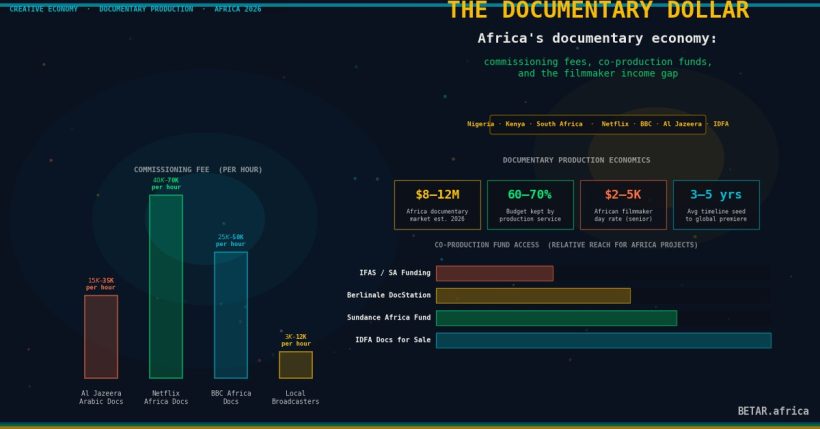
Al Jazeera English is the most active international broadcaster commissioning African documentary content, operating a model that covers co-commissioning deals with independent African production companies. The industry benchmark for Al Jazeera co-commissions — confirmed by multiple producers in the West and East African markets — runs at $500 to $2,000 per finished minute, meaning a 50-minute documentary generates between $25,000 and $100,000 in commissioning revenue depending on negotiation leverage, previous relationship with the channel, and editorial priority.
BBC News Africa operates distinct commissioning structures across its documentary output. BBC Africa Eye, focused on investigative short-form documentaries (25–35 minutes), pays in the £10,000–£30,000 range for co-commissions with African independent production companies, with the BBC retaining global broadcast rights for a defined exclusivity window. Longer feature documentary commissions for BBC News Africa push into the £40,000–£60,000 bracket, with African co-producers required to provide a minimum share of the editorial vision and access. The IP terms in these arrangements — world rights for exclusivity windows that can extend seven to ten years — represent the most consequential negotiating point for African producers, who frequently enter those terms without the institutional support that producers in more mature markets take for granted. “Unfortunately, because there are no unions or guilds or regulations in the same way they are in other markets, creators can really get taken advantage of,” says Mehret Mandefro, co-founder of the Realness Institute, the Cape Town-based programme that has supported African producers navigating international co-production markets since 2015.
SABC’s documentary commissioning fees are considerably lower than international equivalents, constrained by the broadcaster’s well-documented financial pressures. Fees for independently commissioned SABC documentaries range from approximately ZAR 200,000 to ZAR 500,000 per broadcast hour — equivalent to roughly $11,000 to $27,000 at current exchange rates. Kenyan free-to-air broadcasters KTN and NTV commission local documentaries in the KES 500,000–KES 2 million range ($3,800–$15,400). These rates, while providing a distribution platform, are insufficient as the sole funding mechanism for a documentary of any production ambition.
Streaming Platform Documentary Economics
Netflix’s approach to African documentary production distinguishes between a commission and an acquisition — a distinction with material financial implications for African filmmakers.
Under a commission, Netflix finances the production at full budget, paying the production company a fixed fee that covers total production costs plus a negotiated production margin, typically 10–20% of budget. In exchange, Netflix holds the content globally, in perpetuity within the deal window, with no residual rights remaining with the production company. For premium African documentaries — defined here as productions with production budgets above $250,000 — this model delivers certainty of capital but eliminates long-term IP value for the producing company.
Netflix’s acquisition model, applied to completed or near-complete African documentaries, has delivered licence fees in the $80,000 to $350,000 range per title, with the spread driven by production quality, language distribution (English-language content commands a premium), and exclusivity scope. Amazon Prime Video is more active as an acquirer than a commissioner of African documentary content, with acquisition fees for completed works reported in the $30,000 to $120,000 range for SVOD rights across defined territories.
Showmax, which announced a significant restructuring of its African originals slate in early 2026, had been commissioning African documentaries at ZAR 300,000–ZAR 800,000 per title. The transition introduces uncertainty for South African and pan-African producers who had oriented their production pipeline around the platform as a development pathway.
Co-Production Fund Economics
The international co-production fund ecosystem provides grants that are critical for African filmmakers at the development and early production stages, where broadcaster and platform finance is unavailable.
The IDFA Bertha Fund, associated with the International Documentary Film Festival Amsterdam, awards grants of up to €50,000 to filmmakers from Global South countries, including African nations, at development, production, and post-production stages. The fund is selective — of roughly 700 annual applications, approximately 30–40 projects receive grants, with African filmmakers representing a consistent 20–30% of beneficiaries. Selection criteria weight editorial innovation and filmmaker track record; first-time feature documentary directors are eligible but compete against more established practitioners.
The Sundance Documentary Fund (now the Sundance Institute Documentary Program) provides grants in the $10,000–$50,000 range for development and production. African filmmakers including director Joëlle Sambi and Kenyan documentary producers have received Sundance grants. Fund support typically functions as a credentialing mechanism as much as a capital source — a Sundance-supported project is substantially easier to pitch to international broadcasters.
The Doha Film Institute is among the most significant funders of African documentary production by grant volume. Its annual grant cycle covers development ($10,000–$30,000), production ($30,000–$100,000), and post-production ($15,000–$40,000) stages, with a focus on the Arab world but explicit programming for African stories that intersect with Afro-Arab cultural and political geographies. North and East African filmmakers — particularly from Sudan, Ethiopia, and Senegal — have built production pipelines partly on DFI support.
The Hot Docs Forum (Toronto) functions as a pitch market rather than a grant programme. African projects admitted to the Forum present to 30–40 co-production, pre-sale, and acquisition decision-makers from international broadcasters and funds. Successful Hot Docs pitches have unlocked co-production commitments of $50,000–$500,000, though the majority of projects leave without confirmed finance — the Forum is a deal pipeline, not a deal guarantee.
South Africa’s bilateral co-production treaties — with Germany, France, Canada, and Italy, among others — allow qualifying South African documentaries to access national film fund financing in the partner country, creating a structural advantage for South African producers navigating international co-production that is not available to their Nigerian or Kenyan peers operating outside the treaty framework.
Filmmaker Income Model: Development to Delivery
For an independent African documentary filmmaker, the income model from concept to completion typically unfolds across three phases, with only one generating reliable income.
Development — the 12 to 24 months of research, travel, access negotiation, and pitch material creation that precede any broadcast or fund commitment — is almost entirely self-funded. There is no development grant at scale available to an African filmmaker in the pre-pitch phase; the international funds listed above engage at a stage where the project already has structure. African documentary directors routinely absorb $5,000–$25,000 in personal expenditure to reach the point of a credible pitch. “The biggest challenge that we have as documentary filmmakers in Nigeria, or even filmmakers, period, is just that institutional support. My funding comes from outside of Nigeria,” says Joel Kachi Benson, the Emmy Award-winning director of “Daughters of Chibok” and “Mothers of Chibok,” both supported by the Al Jazeera Documentary Channel. Benson’s observation applies across the continent: the self-funded development phase is the defining structural inequity of the African documentary model.
Production fees are paid once a commission or co-production grant is confirmed. Director’s fees in broadcaster co-commission structures run at 5–10% of the total production budget; on a $50,000 Al Jazeera co-commission, a director’s fee in the $2,500–$5,000 range is typical. Producer’s margin — covering overhead, development recoupment, and production management — typically runs 10–15% of total budget, though in grant-funded productions the margin is often squeezed to preserve spend on-screen. For African filmmakers negotiating with broadcasters holding substantially more market power, the practical reality is that fees are often set by the commissioning party rather than negotiated upward from a filmmaker cost structure.
Post-delivery income — festival prizes, theatrical distribution advances, educational licensing, and SVOD sales — represents the long-tail upside that few documentary productions realise. IDFA’s Grand Prize carries €12,000; the Sundance World Cinema Documentary Grand Jury Prize provides $20,000. Educational distribution advances ($5,000–$30,000 for library licensing) offer modest recurring revenue. SVOD acquisition after a festival run — the model through which an independently financed African documentary can reach the acquisition economics described above — requires first that the film be made, which requires the capital that the development phase does not provide.
The Structural Gap
The African documentary economy is caught between two structural problems that international broadcasters and fund administrators acknowledge but do not resolve.
IP ownership in broadcaster-commissioned work remains structurally unfavourable to African producers. When Al Jazeera or the BBC finances a co-commission, the intellectual property resides with the commissioning broadcaster for the contract period. The production company and director are workers-for-hire in economic terms — their negotiating leverage comes from their access and editorial expertise, not from any asset they accumulate. Over a career, this model generates income but not value. South African production companies with established broadcaster relationships have begun inserting secondary rights protections — retaining educational rights, extract rights, and post-window distribution rights — but Nigerian and Kenyan producers operating with less market leverage report that broadcaster draft terms leave these rights with the commissioning party unless actively negotiated out.
Development capital remains the sector’s most significant structural gap. Until an African film institute, development bank, or public fund commits meaningful capital to the pre-pitch phase — not the $10,000–$50,000 post-commissioning grants, but genuine development support for unproven concepts — the pipeline will continue to be shaped by filmmakers who can afford to self-fund 18 months of access work. That constraint selects for certain kinds of documentaries and certain kinds of filmmakers: those with private resources or diaspora income to subsidise a process that in mature documentary markets is funded by the ecosystem itself.
Judy Kibinge, who founded DocuBox — the Nairobi-based East African Documentary Film Fund — in 2013 and ran it for thirteen years, documented the income gap from the distribution side. “There may appear to be all these avenues of distribution, but are they really there?” she said in 2026. Kibinge was direct about the streaming economy’s failure to translate into filmmaker income: “Netflix doesn’t give you money.” DocuBox supported over 100 East African films during its run, including festival-circuit successes such as “Softie” and “Khartoum,” yet Kibinge found that even internationally recognised African documentaries could not generate sustained filmmaker income from the platforms nominally hosting them. The structural gap in African documentary economics runs from development to distribution.
BETAR.africa reporting.

 UphivaBETAR