
Africa’s Film Festival Circuit: The Economics Behind the Red Carpet
Africa hosts more than 30 international film festivals annually, yet the commercial architecture underpinning this circuit has received almost no systematic economic analysis. FESPACO has been running since 1969. The Durban International Film Festival launched in 1978. The Zanzibar International Film Festival has been drawing East African cinema to international attention since 1998. Together, these events form a commercial infrastructure — one that charges filmmaker submission fees, attracts title sponsors paying six-figure sums, and hosts co-production markets where deals worth hundreds of thousands of dollars are negotiated. The question is whether that infrastructure creates genuine commercial value for the filmmakers who feed it.
Festival Operating Economics: Public Money Holds the Circuit Together
The financing model for African film festivals reveals a structural dependency that distinguishes them sharply from their European counterparts.
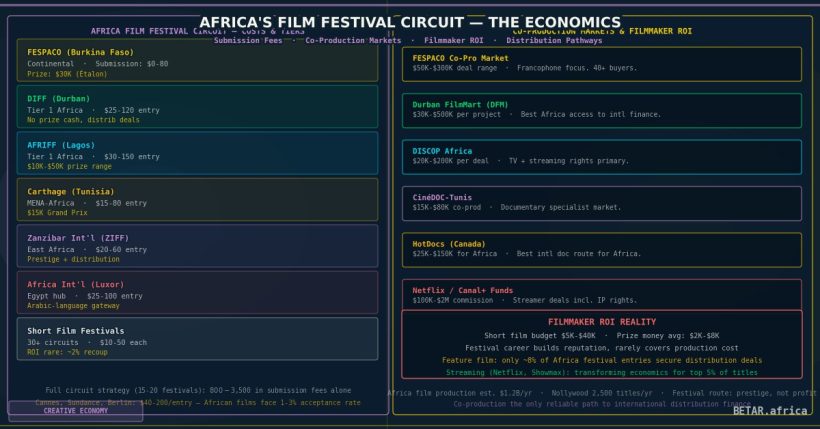
FESPACO — the Pan-African Film and Television Festival held biennially in Ouagadougou, Burkina Faso — is financed primarily through the Burkina Faso government, which accounts for an estimated 60–70% of the festival’s operating budget, supplemented by UNESCO, European cultural institutes, and international co-presenters. Government funding of approximately 500 million CFA francs (roughly $800,000 at current rates) covers core operations. Submission fees charged to filmmakers — approximately €55 per feature film, lower for short films — contribute a relatively minor share of total revenue. The festival attracted 172 films from 36 countries at its 2023 edition; submission fee revenue at that scale generates an estimated €200,000–€350,000, or roughly 25–40% of operating cost depending on the total budget envelope.
The Durban International Film Festival (DIFF), managed by the Centre for Creative Arts at the University of KwaZulu-Natal, operates on a mixed model: public funding from the KwaZulu-Natal Film Commission, the National Film and Video Foundation (NFVF), and the Department of Trade, Industry and Competition, alongside commercial sponsorship from brands including DStv/MultiChoice and Sasol. Industry participants estimate the total DIFF operating budget in the R8 million–R15 million range ($430,000–$800,000), though the festival does not publish audited accounts. Feature film submission fees run approximately $35–$50 per entry.
The Cape Town International Animation Festival (CTIA), a specialist event focused on animation and visual effects, operates at the smaller end of the spectrum — total budget estimated at R2 million–R5 million — with funding from the NFVF and commercial sponsors, and lower submission fees in the €20–€30 range for short animation. The Zanzibar International Film Festival (ZIFF) is more dependent on international development funding, with Tanzanian government support supplemented by European cultural foundations.
Across the major African festivals, public funding covers the majority of operating costs. Commercial sponsorship typically represents 20–35% of total festival budgets. The structural risk is clear: when government arts budgets are cut, festivals have limited ability to absorb the shortfall through earned commercial revenue.
“Submission fees cover less than 10 percent of what it costs to run a festival at the level our filmmakers expect,” said Chioma Ude, founder and executive director of the Africa International Film Festival (AFRIFF) in Lagos. “The government and sponsor dependency is not a choice — it is the structural reality of running a film festival in a market where ticket revenue and commercial co-presenters cannot yet fill the gap. Every year we are negotiating a budget that is largely outside our control.”
Filmmaker Economics: Mounting Costs, Uncertain Returns
For an African filmmaker pursuing a festival strategy, costs accumulate quickly.
Submission fees across a modest five-festival African circuit — FESPACO, Durban IFF, Zanzibar IFF, Africa International Film Festival (AFRIFF) in Lagos, and the South African Film and Television Awards market — total $200–$350. Travel and accommodation to attend even two festivals adds $2,000–$5,000 for a filmmaker based in Lagos or Nairobi, and considerably more for those travelling from outside the continent. Festival marketing materials, film deliverables in multiple technical formats, and representation costs add further overhead. A reasonably active festival season costs a filmmaker $5,000–$15,000, before a single screening has occurred.
“You are not going to FESPACO or Durban to recover your submission fee,” said Akin Omotoso, the South African-Nigerian filmmaker whose credits include “Man on Ground” and “Vaya,” both of which screened at Durban IFF and other African festivals before securing international distribution. “You are going there to have a conversation that might lead somewhere in 18 months. The festival circuit is a development tool, not a revenue source. Every filmmaker who treats it like the latter comes away disappointed.”
Against this, direct prize money returns are available only to winners. FESPACO’s top award — the Étalon d’Or de Yennenga — carries prize money of $20,000 (2023 edition). Silver and bronze Étalons carry $12,000 and $7,000 respectively. The Durban IFF distributes prizes in the range of R150,000–R350,000 ($8,000–$19,000) across categories including best South African feature, best African documentary, and student film. For most festival participants, direct prize return is zero.
The indirect return is harder to quantify but industry evidence indicates it can be substantial. Leila Kilani’s Moroccan co-production “Sur la planche” used festival circuit exposure to build the broadcaster relationships that supported its international sales. South African film “The Wound” (2017) leveraged its festival credentials — including Rotterdam and Toronto screenings — to secure international distribution from Peccadillo Pictures. Several Nigerian features screened at African festivals have subsequently moved into ARTE or Canal+ Afrique licensing agreements through market connections forged at industry sections. The mechanism is real, but the conversion rate is low: most festival screenings do not generate distribution deals, and the timeline from festival screening to distribution agreement routinely extends two to four years.
Co-Production Market Economics: Durban FilmMart as the Circuit’s Commercial Engine
The Durban FilmMart, running annually alongside the Durban IFF, is the continent’s most active co-production market — the commercial engine within the festival’s cultural framework.
The FilmMart operates on a project-entry model (approximately R2,500–R5,000 per project application) and attracts European and North American co-producers, international broadcasters — ARTE, Canal+, ZDF, TV5 Monde — and streaming platform content teams, primarily from Netflix Africa and Amazon Prime Video’s acquisition division. The 2023 edition hosted more than 70 development and co-production projects across feature film, documentary, and series categories.
Average project ask sizes in the FilmMart context range from $200,000–$1.5 million for documentary series co-productions, and $500,000–$5 million for feature film co-productions, based on budget documentation reviewed by BETAR.africa. ARTE’s Africa co-production slate — which has included films from Nigeria, Senegal, Cameroon, and South Africa — consistently traces to relationships initiated at African festival market events. Canal+ Afrique’s documentary acquisitions follow a similar pattern. Netflix has participated as a market observer and has subsequently acquired or co-produced projects that originated in FilmMart pitch sessions, though the streaming platform does not disclose Africa-specific acquisition volumes.
“The FilmMart is where the actual work happens,” said Tendeka Matatu, a South African film producer whose projects have been financed through NFVF, public-private co-production structures, and international broadcaster agreements. “The festival programming is what gets you in the room, but the co-production conversations are separate. ARTE and Canal+ are not commissioning on the basis of which film won an award — they are commissioning on the basis of the relationship, the project package, and whether the filmmaker has a track record of delivery. The market builds those conditions. It takes multiple FilmMart appearances before you get a serious offer.”
FESPACO’s industry section, while less formalised than the Durban FilmMart, serves a parallel function for Francophone African co-productions. The biennial structure limits its frequency, but the concentration of West and Central African filmmakers makes it particularly valuable for French-language projects targeting ARTE, TV5 Monde, and Belgian and Swiss public broadcasters.
Sponsorship Architecture: Brand Value Versus Structural Dependence
Major African festivals attract corporate sponsors seeking arts association, CSI (corporate social investment) compliance, and audience reach among educated urban consumers.
DStv/MultiChoice has historically held title or co-title sponsorship at the Durban IFF, with brand exposure across festival venues, broadcast, and digital channels. Title sponsorship at a major African film festival typically ranges from R1 million–R3 million ($54,000–$163,000) in cash and value-in-kind. Category or section sponsorship — documentary prize, student film, animation — runs R200,000–R600,000 per sponsor. MTN has sponsored FESPACO and regional festivals. Ecobank has provided financial sector sponsorship at pan-African events. The Goethe-Institut and Institut Français remain significant co-presenters across Francophone and Lusophone Africa.
Government funding dependency creates structural risk at the corporate sponsorship tier. When the NFVF budget is constrained — as it has been through multiple South African fiscal cycles — festival organisers face pressure to replace public funds with commercial revenue, often accepting below-market rates on sponsorship packages to close the gap. This compresses margins without improving the programmer quality that justifies sponsor investment in the first place.
The ROI Question: Infrastructure, Not Revenue Source
For African filmmakers, the festival circuit is more accurately characterised as business development infrastructure than as a direct revenue generator. The commercial mechanism is sequential: festival circuit credentialing → co-production market access → broadcaster licensing lead → production financing for the next project. That chain functions — but not quickly, and not for every filmmaker who invests in the circuit.
The strategic calculation differs sharply by career stage. For an early-career filmmaker, festival credentials are disproportionately valuable: they establish credibility with broadcasters and co-producers who require a track record before committing funds. For a filmmaker already at production scale, the FilmMart becomes the primary commercial target — festival programming is the price of market access, not the end in itself.
What is clear across the circuit is that African festivals remain heavily public-subsidy-dependent, with private sponsorship serving as a buffer rather than a primary funding mechanism. The commercial infrastructure — submission fees, market fees, sponsor packages — exists and generates revenue, but has not yet matured to the point where it can substitute for government support. The Étalon d’Or has been awarded for 56 years. The economics that sustain its future remain contingent on budget decisions made in Ouagadougou, Pretoria, and Dar es Salaam.
Note: This story is part of BETAR.africa’s Creative Economy series. Related coverage: BETA-614 (Africa film production economics and financing structures), BETA-488 (Africa cinema exhibition and box office economics).

 UphivaBETAR