
After the CBN Deadline: Which Nigerian Banks Missed the March 31 Bar and What the Regulator Does Next
By BETAR.africa Business Desk | 1 April 2026
Nigeria’s banking sector recapitalisation deadline has passed. For the overwhelming majority of the country’s lenders, the outcome is a story of capital raised, markets tested, and a sector structurally stronger than it was 24 months ago. BETAR.africa reported that picture in full on 29 March.
But deadlines produce two kinds of stories. The first is who made it. The second is what happens to those who didn’t.
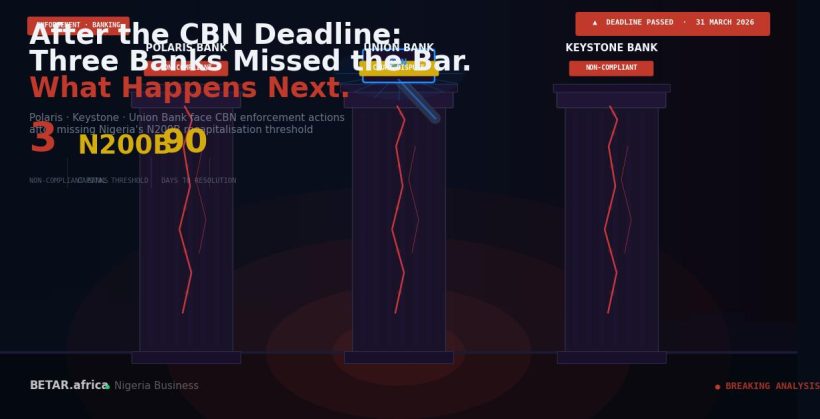
As of 31 March 2026, three institutions remain formally outside full compliance: Polaris Bank, Keystone Bank, and Union Bank of Nigeria. Their situations are distinct — and the Central Bank of Nigeria’s path with each will be different. What plays out over the next 90 days will be watched closely by shareholders, depositors, and analysts tracking the final shape of Nigeria’s post-consolidation banking map.
Polaris Bank and Keystone Bank: Under CBN’s Direct Hand
Polaris Bank and Keystone Bank entered the recapitalisation window already in a position of regulatory dependence. Both institutions have been under CBN supervisory management — in Polaris’s case since 2018, when the regulator intervened in what was then Skye Bank and reconstituted it under a bridge-bank arrangement; in Keystone’s case since a similar intervention in 2017.
Neither bank completed an independent capital raise. Neither announced a merger partner. As the March 31 deadline arrived, both remained under the management of Asset Management Corporation of Nigeria (AMCON)-supported structures, with the CBN holding effective operational oversight.
Banking sector analysts say the CBN’s most likely path for both is directed consolidation — forcing a merger between the two institutions or facilitating their acquisition by a stronger counterpart. “These are not free-standing commercial decisions anymore,” one Lagos-based banking law partner said. “The regulator essentially owns the timeline and the outcome. The question is whether it forces a Polaris-Keystone merger, or finds a third buyer for one or both.”
A Polaris-Keystone combination would create a mid-tier institution with combined assets of approximately ₦3.5 trillion — large enough to survive as a regional or national-licence bank, but not competitive at the international tier. The alternative — sale to an existing Tier-1 player — would accelerate top-five concentration in Nigeria’s banking market.
The CBN has confirmed it will publish a formal enforcement action list. At time of writing, no revocation orders had been issued for either bank. That restraint is deliberate: the regulator does not want a repeat of the Heritage Bank liquidation scenario — depositor disruption, NDIC payouts — if a more orderly resolution is achievable. But patience has limits.
Union Bank: The Court Injunction Complicates Everything
Union Bank’s situation is the most legally complex of the three and the most watched by the broader market.
The background: Union Bank completed a rights issue in 2024 that raised ₦114.2 billion. The issue was insufficient to meet the ₦200 billion national-licence threshold. In late 2025, the CBN moved against the bank’s leadership, culminating in a January 2026 order dissolving Union Bank’s board of directors — a drastic step the regulator has taken only a handful of times in its history.
The board dissolution did not stand unchallenged. On 25 March 2026 — six days before the recapitalisation deadline — the Federal High Court in Lagos issued an injunction nullifying the CBN’s board dissolution order. The court found procedural deficiencies in the regulator’s process. The CBN has filed an appeal and has publicly signalled it will not accept the court’s reasoning as final.
The result is a governance standoff. Union Bank now has a board that was reinstated by court order and a regulator that views that board’s reinstatement as illegitimate pending appeal. The bank’s approximately 4,000 employees and its depositors are caught between two authorities.
“This is uncharted territory for Nigerian banking law,” said a partner at a Lagos firm advising on financial sector regulation who declined to be named due to client sensitivities. “The CBN has supervisory primacy under BOFIA 2020, but courts can and do issue injunctions. The question is whether the appellate court moves quickly enough to give the CBN a clear runway before depositor confidence is affected.”
The CBN’s appeal will likely be heard by the Court of Appeal in Lagos. The regulator will argue that its supervisory authority under Section 33 of the Banks and Other Financial Institutions Act 2020 is paramount and that courts should not second-guess the exercise of that authority in matters of systemic risk. Union Bank’s reinstated board will argue procedural fairness.
In the interim, Union Bank continues to operate. The bank’s core franchise — its retail deposits, SME lending book, and digital banking platform — remains functional. The legal uncertainty is a reputational and governance issue, not yet a liquidity or solvency one. But prolonged ambiguity raises both risks.
The CBN Enforcement Toolkit: What Instruments Are Available
For the CBN, three principal enforcement instruments are available under BOFIA 2020 and precedent:
Licence revocation. The Heritage Bank model. The regulator declares the bank unviable, revokes its operating licence, and appoints the NDIC as liquidator. Depositors are protected up to ₦5 million per customer; shareholders are wiped out. The CBN has shown willingness to use this instrument, but it is a last resort — it triggers depositor anxiety sector-wide and generates political heat. It is most likely for an institution with no credible acquirer and no resolution path.
Licence downgrade. A bank operating at the national-licence tier that cannot meet ₦200 billion can be directed to downgrade to a regional licence requiring only ₦50 billion. This preserves operations in a narrower geographic footprint. None of the three non-compliant banks has announced this path, but it remains available for Union Bank if the governance dispute is resolved.
Conservatorship / directed merger. The instrument most likely for Polaris and Keystone. The CBN appoints a conservator, halts independent management, and drives a structured sale or merger. This is slower and more resource-intensive than revocation but preserves franchise value and depositor continuity. The AMCON framework gives the government a mechanism to absorb residual liabilities.
What the Post-Consolidation Nigerian Banking Map Looks Like
Nigeria entered the recapitalisation window with approximately 26 commercial banks and a handful of non-interest and merchant banks. As the deadline passes, the sector appears to be settling at approximately 30–32 licensed institutions — including those with national, regional, and non-interest licences.
The top tier has hardened. Access Bank, Zenith Bank, GTCO, UBA, and FBN Holdings have collectively raised over ₦1.9 trillion in fresh capital. They are materially better capitalised than they were two years ago and have used the process to access foreign institutional investors who had largely stayed out of Nigerian bank equity since the 2016 currency crisis.
Mid-tier consolidation has reduced competitive fragmentation. The Providus-Unity merger, which closed in 2025, created the entity now operating as PremiumTrust Bank. The SunTrust-Signature Bank combination added another. These mergers have quietly reduced the number of undercapitalised mid-tier players competing for the same SME and retail deposit base.
If Polaris and Keystone are merged or absorbed — the most probable outcome over the next quarter — the post-consolidation map will show the top-five international-licence banks controlling an estimated 65–68% of sector assets, up from approximately 60% in early 2024. The concentration arithmetic favours the large incumbents: they are the natural buyers for any assets the CBN needs to place.
The Union Bank outcome is the remaining variable. If the court appeal resolves in the CBN’s favour before mid-year, the regulator will have a clear run at a structured resolution. If the litigation drags into the second half of 2026, it introduces a prolonged period of governance ambiguity at Nigeria’s sixth-largest bank by deposit base — a drag on the sector’s credibility that the CBN will be keen to remove.
The Verdict
Nigeria’s banking recapitalisation has, on its headline metrics, succeeded. More than ₦4.61 trillion raised. A sector that is now more deeply capitalised, more internationally visible, and more concentrated at the top than at any point in the post-2004 era.
Three institutions did not make the bar. For two of them, Polaris and Keystone, the resolution path is within the CBN’s direct control and involves no new legal obstacles. The timeline is a question of process, not principle. For Union Bank, a court has complicated the picture in ways that will take months, not weeks, to resolve.
The enforcement chapter of Nigeria’s banking recapitalisation story has begun. The outcome will determine whether the CBN’s two-year exercise ends as a textbook consolidation — or whether the final 10% leaves a legacy of contested regulatory authority that complicates the next reform cycle.
BETAR.africa has requested comment from the CBN, Union Bank, Polaris Bank, and Keystone Bank. This article will be updated when responses are received. Related coverage: Nigeria’s Bank Recapitalisation: Who Made the Deadline (29 March 2026).

 UphivaBETAR
 Joseph Busari