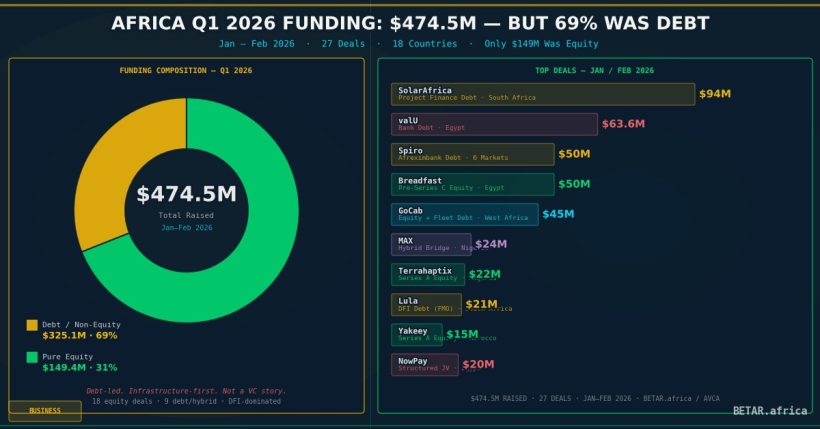

Africa’s technology and innovation ecosystem closed January and February 2026 with $474.5 million in confirmed investment across 27 deals — an attention-grabbing headline that obscures what is actually going on. Look past the total and the picture shifts: only $149.4 million, 31 cents of every dollar, was pure equity. The remaining $325.1 million — nearly 69 percent — arrived as debt facilities, project finance, hybrid instruments, or structured strategic investment. Africa’s biggest Q1 2026 funding story is not a venture capital story. It is a credit and infrastructure financing story.
The Equity Picture: $149M Across 18 Deals
Strip out the debt and hybrids and the equity-only total for January and February stands at $149.4 million across 18 deals — the figure that more closely reflects the venture environment that founders, analysts, and policymakers typically track.
Egypt’s Breadfast led the equity table with a $50 million Pre-Series C backed by Mubadala Investment Company, IFC, Olayan Group, and Y Combinator — the quarter’s single largest pure equity round. Nigerian defence-tech startup Terrahaptix came in at $22 million, extending its Series A in a Lux Capital-led round and bringing its combined Series A total to $33.75 million alongside sister company Terra Industries, making Nigerian security technology the continent’s most active equity sector by deal value in this period.
Morocco contributed four equity deals totalling $21.5 million, anchored by Yakeey’s $15 million Series A led by IFC — the largest proptech round in the country’s history. Egypt’s Flextock ($12.6M, TLcom Capital) and Zambia’s Lupiya ($11.25M, Alitheia IDF) rounded out the top five, reflecting investor appetite for logistics infrastructure and financial inclusion at the growth stage.
The Debt Deals: Where the Real Volume Lives
The nine non-equity deals collectively reached $325.1 million — more than double the pure equity total — and span instrument types that rarely receive the analytical attention they deserve.
The largest single deal of the quarter was SolarAfrica’s $94 million project finance debt facility, arranged by Rand Merchant Bank with Standard Bank and IFC as co-lenders. The Cape Town-based rooftop solar operator is building commercial and industrial photovoltaic infrastructure across South Africa — a textbook example of how development finance institutions deploy African capital: not through equity, but through project-structured debt blending commercial and concessional terms.
Egypt’s consumer finance platform valU drew $63.6 million from the National Bank of Egypt — growth capital for a lending book, not a venture round. Spiro, the e-mobility battery-swap operator active across six African markets, raised $50 million in debt from Afreximbank to expand its network of more than 80,000 electric motorcycles. GoCab, the West African ride-hailing platform, closed $45 million comprising $15 million in equity and $30 million in asset-backed fleet debt from Rand Merchant Bank — a structure increasingly common in asset-heavy mobility businesses.
Rounding out the non-equity set: MAX (Nigeria, $24M hybrid bridge from Mitsui and Novastar), Lula (South Africa, $21M development finance debt from FMO), NowPay (Egypt, $20M structured joint-venture investment into a Saudi entity rather than a direct cash injection), and Fido (Ghana, $5.5M development finance debt via Symbiotics).
Why the Distinction Matters
Conflating equity and debt in Africa funding totals distorts the story in ways with real consequences for founders, investors, and policymakers.
For founders, a $474 million headline implying a hot venture market sends the wrong signal about available equity capital. The $149 million equity pool — split across 18 deals in diverse markets, sectors, and stages — reflects a more competitive, selective environment than the aggregate suggests.
For investors, the composition reveals that infrastructure and credit are the dominant growth engines, not software venture. Development finance institutions, pan-African commercial banks, and hybrid debt-equity vehicles are doing the heavy lifting on volume. That is a structural feature of African capital markets, not a temporary condition.
For policymakers, the data points toward a capital architecture where project finance and blended instruments are essential complements to equity venture — and should be resourced and regulated accordingly.
What Comes Next
March 2026 data collection is underway. Four deals worth $8.55 million have been confirmed through early March, all equity. The BETAR Q1 2026 African Tech Funding Tracker, covering all confirmed deals with full instrument classification, sector breakdown, and country analysis, publishes shortly — and will include interactive visualisations built from the same dataset underlying this analysis.
All figures in US dollars. BETAR’s tracker distinguishes between equity, debt, hybrid, project finance, and strategic investment instruments. Deals are included only when primary source verification is available at medium confidence or above.
— Business Reporter, BETAR.africa

 UphivaBETAR


 Joseph Busari