
Africa’s technology sector raised approximately $537 million in the first quarter of 2026. That headline is real. What it conceals is the more consequential story of the quarter.
Strip out the development finance debt — the infrastructure loans, the DFI facilities, the blended instruments from multilateral banks — and Africa’s venture-backed tech ecosystem raised approximately $219 million in equity and venture debt across 42 verified deals. That is what the funding market looks like when you remove the scaffolding. And right now, the scaffolding is holding up the building.
The Numbers Behind the Quarter
| Metric | Value |
|---|---|
| Total disclosed financing (Tier A: all instruments) | ~$537M |
| Equity and venture debt only (Tier B: methodology-strict) | $219M |
| Deals across countries | 42 deals, 10 countries |
The BETAR Q1 2026 African Tech Funding Tracker, which covers Africa-headquartered tech companies in publicly disclosed rounds of $1 million or above, provides the most granular dataset available on the quarter. Its two-tier methodology separates headline capital from investable equity — a distinction that matters more in 2026 than at any point in recent history. The final closed dataset (v46-final-closed, locked 3 April 2026) captures 42 verified deals across 10 countries.
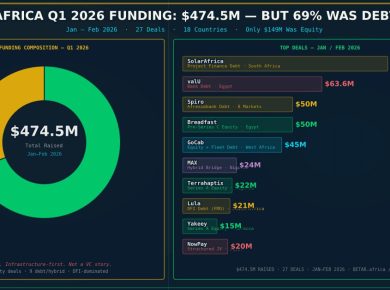
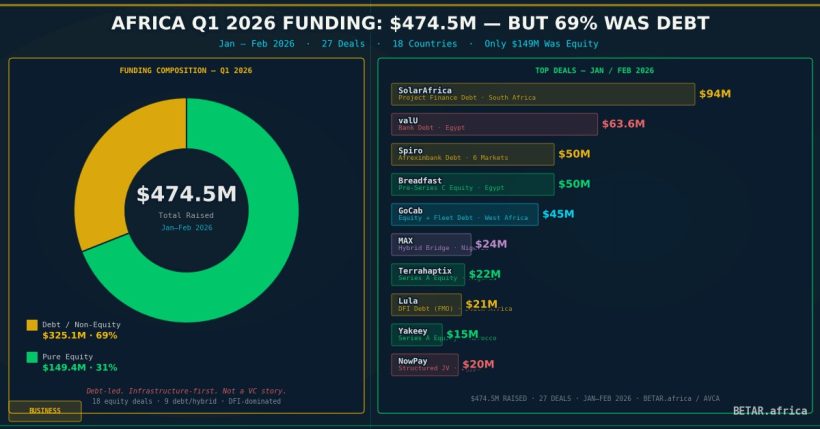
The gap between the two numbers is the DFI story. Six transactions totalling approximately $271 million are classified as development finance debt, project finance, or pure structured instruments: SolarAfrica ($94 million, Metier Sustainable Capital and Norfund), Spiro ($57 million across two Q1 facilities — a $50 million Afreximbank facility in February and a $7 million FAIR working-capital facility from Nithio), valU ($63.6 million, National Bank of Egypt), GoCab’s $30 million debt component, Lula ($21 million, FMO Netherlands), and Fido ($5.5 million, REGMIFA). These are not venture bets on founder-market fit. They are infrastructure capital, plugging a structural financing gap that the retreat of private US venture capital has left behind.
That retreat is now confirmed by data. US investor participation in African deals fell by approximately 53 percent year-on-year, according to analysis by Launch Base Africa. The result: equity financing dropped from 76 percent of total Africa tech funding in early 2025 to roughly 39 percent in Q1 2026. More money on the scoreboard; far less venture risk being taken.
The Series A Drought — Confirmed With One Important Caveat
BETAR’s previous coverage of the Series A drought thesis (Africa’s Series A Desert, 12 March 2026) argued that the $2–$8 million Series A band was becoming a near-vacuum in Africa. Q1 2026 data confirms the broad thesis — with a significant asterisk.
Series A and extension rounds in Q1 2026 number four: Arc Ride ($5 million equity, Kenya), Lupiya ($11.25 million extension, Zambia), Yakeey ($15 million, Morocco), and Flextock ($12.6 million, Egypt). For context, the same period in 2025 recorded more than ten Series A rounds. The mid-stage growth capital market has not recovered.
The caveat is the early stage. Q1 2026 logged 10 seed rounds and 4 pre-seed rounds — 14 early-stage equity deals across the full quarter totalling $27.7 million. Companies including Cybervergent (AI compliance, Nigeria), Orca Fraud (fraud intelligence, South Africa), Weego (multimodal transport, Morocco/Senegal), Points Africa (shared loyalty, Ghana), and Eyone (e-health, Senegal) represent a pipeline of founder bets. The question for Q2 and beyond is whether any of these companies will find Series A capital when they need it — or whether they will hit the same structural wall that their 2023 and 2024 seed predecessors encountered.
The Partech view is more optimistic. Tidjane Dème, General Partner at Partech Africa, noted in the firm’s February 2026 annual report that “equity markets stabilized, with meaningful recoveries at Series A and Series B.” The BETAR Q1 2026 dataset tells a more complicated story at the Series A tier specifically: four Series A rounds across the full quarter, down from more than ten in the same period a year earlier. Whether the Partech stabilisation thesis holds through Q2 will be one of the defining data questions of the year.
The largest pure equity Series A of the quarter came from an unexpected source: Zeno, a Kenyan electric motorcycle and battery-swap company, raised $20.5 million in equity from Congruent Ventures, Active Impact Investments, and Lowercarbon Capital, alongside a $4.5 million debt facility. That deal — backed entirely by commercial impact investors with no DFI involvement — is the strongest signal in the dataset that private growth capital has not disappeared from Africa’s mobility sector.
Country League Table: Egypt Leads Equity, South Africa Leads Volume
| Country | Deals | Total Capital (Tier A) | Equity Only (Tier B) |
|---|---|---|---|
| Egypt | 6 | $148.2M | $64.6M |
| South Africa | 7 | $133.9M | $20.3M |
| Kenya | 6 | $82M | $30M |
| Nigeria | 11 | $70.9M | ~$53.9M |
| Côte d’Ivoire | 2 | $52M | $15M |
| Morocco | 6 | $24.6M+ | $24.6M+ |
| Zambia | 1 | $11.25M | $11.25M |
| Ghana | 2 | $7.5M | $2M |
| Ethiopia | 1 | $5M | $5M |
| Senegal | 1 | $1.7M | $1.7M |
South Africa’s $134 million headline is the largest by volume — and it tells a materially different equity story than the mid-quarter picture suggested. SolarAfrica’s $94 million project debt dominates the Tier A total, but seven deals in Q1 produced $20.3 million in equity. Two late-quarter additions reshaped the picture: Happy Pay ($5 million seed, fintech payments, March 23) and Littlefish ($9.5 million Series A, agri-lending tech, March 24), both backed by Partech Africa. NjiaPay, Orca Fraud, and Yazi round out the equity stack. With a full stack from pre-seed to Series A and Partech’s sustained commitment to the market, South Africa’s Q1 equity story is stronger than the debt-dominated headline implies.
Egypt tells a different story. Six deals produced $64.6 million in equity — 32 percent of all tracked equity capital this quarter. The anchor is Breadfast’s $50 million pre-Series C backed by Endeavor Catalyst and anchored by Mubadala, Abu Dhabi’s sovereign wealth fund — the largest single equity round in the dataset. Breadfast has confirmed IPO plans at a reported $400 million valuation. If it proceeds, it would be Africa’s most significant consumer tech listing in years.
Nigeria leads by deal count with eleven transactions — the most of any country — and approximately $53.9 million in equity. The standout: Terra Industries (formerly Terrahaptix), a Lagos-based autonomous drone and defence technology company, raised $33.75 million across two rounds in six weeks, backed by Lux Capital and 8VC. That Nigeria is producing defence technology companies attracting Tier 1 US deep-tech investors is new and significant.
Morocco is the geographic breakout story of the quarter. Six equity deals — WafR, Enakl, Weego, Woliz, Yakeey, and GoSwap — totalled $24.6 million across pre-seed, seed, and Series A stages simultaneously. It is the first time Morocco has shown a complete early-stage funding stack in a single quarter. Enza Capital, the Nairobi-based VC, led the Yakeey deal at $15 million, marking North Africa’s largest proptech Series A. Sanlam Maroc made its first-ever startup investment. Morocco is no longer a single-deal story in African venture — it is emerging as a diversified early-stage market in its own right, and BETAR will be tracking it as a distinct coverage beat from Q2 2026.
Geographic Diversification: Structural, Not Statistical
Ten countries is the headline count. Zambia (Lupiya, $11.25 million), Ghana (two deals), Ethiopia (Lovegrass Ethiopia, $5 million BII equity for an agri-food company sourcing teff from smallholder farmers), and Senegal (Eyone, $1.7 million in a seed round backed by Oyass Capital, the investment arm of FONSIS — Senegal’s sovereign wealth fund) all appear in the same quarter. Combined, they account for $20.5 million — 4 percent of total capital, but a meaningful signal.
The presence of FONSIS-backed capital in a Senegalese healthtech seed round is particularly notable. When African sovereign wealth funds begin co-investing at seed stage, it signals something more durable than a one-quarter anomaly. The same dynamic appeared in Morocco (CDG Invest co-investing in Yakeey) and in Nigeria, where the government’s iDICE programme backed Ventures Platform Fund II — which in turn backed Cybervergent in Q1.
This is African public capital flowing into early-stage tech in ways that would have been uncommon three years ago. It is not a substitute for private venture capital. But it is building an institutional foundation that did not previously exist.
Sector Reads: Energy by Volume, Fintech by Count, E-commerce by Equity
Energy and Cleantech leads all sectors by total capital at approximately $165 million — and carries zero equity in the tracker. SolarAfrica’s $94 million is project debt for a 114-megawatt solar plant in South Africa’s Northern Cape. Spiro’s combined approximately $57 million across two Q1 DFI tranches — a $50 million Afreximbank facility (February 24) and a $7 million FAIR working capital facility from Nithio (February 12) — is development finance debt for battery-swap network expansion across six African markets. The institutional appetite for Africa’s clean energy infrastructure is evident; the equity-stage opportunity in cleantech remains largely unmapped by private venture.
Fintech leads by deal count (10 deals) but the composition is fragmented across digital lending, payment routing, fraud intelligence, shared loyalty, and stablecoin infrastructure. The most consistent early-stage pattern: the stablecoin-to-fiat corridor is attracting founder attention. Both Paycrest ($404,000 pre-seed) and OneDosh ($3 million pre-seed) are building stablecoin settlement rails for the Africa-US payments corridor — a bet on dollar-denominated stablecoin infrastructure as a structural hedge against African currency volatility.
Two stablecoin pre-seeds targeting the same corridor in a single quarter is a pattern worth naming. The underlying thesis is consistent: African currencies have depreciated against the dollar at rates severe enough to make stablecoin-denominated settlement a structural product rather than a speculative one, and the remittance-to-payments infrastructure layer is still thin enough to sustain multiple competing entrants. What distinguishes the Q1 stablecoin cluster from consumer crypto plays of earlier years is the B2B positioning — neither Paycrest nor OneDosh is building a retail wallet. They are building settlement infrastructure that other financial products will run on, the same layer-one bet that produced Africa’s first generation of payment incumbents in the 2010s. Whether this cohort finds a path to commercial scale before larger global stablecoin players commoditise the rails is the defining risk in the thesis.
E-commerce and retail tech leads all sectors in equity capital at $68.8 million (Tier B), driven almost entirely by Breadfast’s $50 million round. Strip that out and the sector returns to modest territory.
Forward Signal: What Q2 Looks Like From Here
Three data points from Q1 suggest Q2 direction.
First, Zeno’s $25 million Series A — closed March 5 — confirms that commercial impact capital is still writing growth-stage cheques into Africa’s mobility sector without DFI cover. Lowercarbon Capital and Congruent Ventures are return-seeking investors who chose a Kenyan EV startup over the alternatives available to them globally.
Second, the seed pipeline is active. Seven deals closed in the first 20 days of March alone — a pace that would produce Africa’s strongest Q1 deal count since 2022 if sustained through month-end. But the seed pipeline also contains its own structural tension: 14 early-stage companies collectively raised $27.7 million in Q1, an average of under $2 million per company. Each of those companies will require Series A capital in 12 to 24 months. If the Series A market does not recover — or if African institutional capital does not increase its deployment velocity at growth stage — the Q1 seed cohort risks encountering the same funding gap that compressed their 2023 and 2024 predecessors.
Third, Breadfast’s IPO trajectory. If the pre-Series C proceeds toward a public listing at the stated $400 million valuation, it will be Africa’s first major consumer tech IPO in several years and will reset exit expectations for the continent’s venture ecosystem. Comparable transactions provide benchmarks; benchmarks attract follow-on capital.
The implication for founders: Q1 2026 confirms that DFIs and African institutional capital are deploying — but on terms designed for infrastructure and impact mandates, not high-velocity consumer growth. Founders raising Series A rounds should orient their narrative toward operational efficiency, path to profitability, and alignment with sector-specific development mandates. The 2021 playbook of growth-at-all-costs will not find traction with the capital that is active in Africa in 2026.
The implication for investors: The equity gap at Series A is an opportunity. With US venture largely absent and African institutional capital still building its deployment velocity, the $5–$20 million Series A tier is undersupplied relative to the quality of the seed pipeline. The investors — local and international — who close that gap in 2026 are writing the most asymmetric cheques on the continent.
Data source: BETAR Q1 2026 African Tech Funding Tracker v46-final-closed (Q1 2026 CLOSED — January, February, March complete; dataset locked 3 April 2026) — 42 verified deals, $537.054M Tier A, $219M+ Tier B, 10 countries, all 42 HIGH confidence. Cross-reference: BETAR “Africa’s Series A Desert,” 12 March 2026; Launch Base Africa Africa Early 2026 Funding Analysis, 2 March 2026; Partech Africa 2025 Tech VC Report, February 2026.
 UphivaBETAR
 Joseph Busari