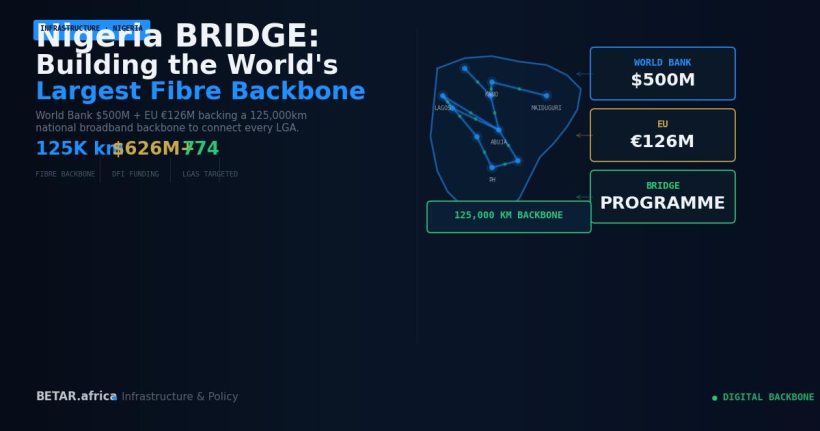

On March 24, 2026, Nigeria’s Federal Ministry of Communications, Innovation, and Digital Economy committed $6.1 million to seven consulting firms to begin technical design work on Project BRIDGE — Broadband Rollout and Infrastructure Development for Growth Enhancement. The announcement, which received limited coverage outside specialist telecom publications, marks the first concrete procurement milestone in what is, by any measure, Africa’s most ambitious broadband infrastructure project.
When complete, BRIDGE will expand Nigeria’s national fibre backbone from approximately 35,000 kilometres of existing routes to 125,000 kilometres — adding 90,000 kilometres of new fibre optic cable across a country where most secondary cities have no backbone infrastructure at all. The $2 billion project is structured around a funding architecture that its architects believe can survive the execution failures that have ended previous Nigerian infrastructure commitments before significant work was done.
The Funding Architecture
The $2 billion total is not primarily a government commitment. Nigeria’s federal government contributes a $1 billion sovereign loan, which it routes through a special purpose vehicle with majority private sector ownership. The government retains a 25–49% minority stake; the SPV’s independent board governs capital deployment. This structure is designed to insulate the project from election-cycle budget resets, which have historically been the single largest source of Nigerian infrastructure project failure.
The multilateral financing layer is significant. The World Bank’s $500 million commitment is structured as a pay-for-results instrument: disbursements are tied to verified construction milestones, not to inputs or spending. Nigeria must demonstrate 5,000 kilometres of completed, verified fibre deployment to unlock the first $155 million tranche in 2027. The EBRD contributes $100 million in concessional lending. The European Union provides a €22 million grant specifically targeted at capacity building and regulatory reform in the ISP licensing process.
This funding architecture represents a structural response to the two most common failure modes in African infrastructure: misaligned incentives that reward spending over delivery, and multilateral co-financing that exits when political conditions change. The World Bank milestone mechanism in particular — designed after the Kenya NOFBI experience — is the architecture’s most important innovation.
The Commercial Angle: 150+ ISPs and the Price Problem
BRIDGE is an open-access project. The national backbone, once built, will be available at regulated wholesale rates to any of Nigeria’s 150+ licensed internet service providers. The commercial opportunity for operators is straightforward: fibre backbone access at wholesale prices they can currently only dream about in markets where MTN and IHS Towers control the infrastructure layer.
The cost case for BRIDGE rests on a number that is hard to argue with. Between 2023 and 2025, the cost of 1GB of mobile data in Nigeria nearly doubled: from ₦287.50 to ₦637.50. This is not primarily a supply constraint — it reflects the absence of competitive wholesale backbone infrastructure that would force retail price compression. In secondary cities and most of northern Nigeria, ISPs cannot build commercially viable businesses because they cannot access wholesale fibre at prices that allow them to undercut mobile data.
BRIDGE’s wholesale open-access commitment, if maintained through SPV governance, would change that. Operators in Kano, Sokoto, Maiduguri, and Enugu — cities with significant commercial activity but minimal current fibre penetration — would have access to backbone infrastructure for the first time. The consumer and SME price implications would be material: there is no structural reason Nigerian broadband should cost more than comparable markets in Kenya or Ghana once wholesale competition exists at the backbone layer.
The Three Barriers
BRIDGE’s project team, to their credit, has documented the barriers to execution rather than treating them as planning footnotes. There are three.
Right-of-way. Nigeria has 36 states. Fibre deployment requires right-of-way approvals in each. There is no national right-of-way harmonisation framework — each state levies its own wayleave fees, sets its own permitting timelines, and applies its own enforcement standards. Operators have been negotiating these individually for two decades; the results are visible in the patchy, radial topology of Nigeria’s existing fibre network, which connects Lagos to major cities but leaves most of the country dark. BRIDGE’s SPV requires federal government intervention to harmonise wayleave policy before the 5,000km Year 1 milestone is achievable. That intervention has been promised but not yet delivered.
Vandalism. MTN Nigeria reported 5,400 fibre cable cuts in a seven-month period during 2025 — roughly 25 cuts per day. The cuts are predominantly in the Niger Delta and northeast, with a mix of deliberate sabotage and incidental damage from construction activity. At that rate, a new 90,000km network requires a maintenance and repair commitment that operators have historically been unable to sustain commercially. BRIDGE’s project documentation acknowledges this but does not specify a funding mechanism for ongoing maintenance costs — a gap that the World Bank’s milestone structure, focused on deployment rather than operation, does not address.
Power. Fibre networks require powered active equipment — repeaters, amplifiers, data centres — at regular intervals along the route. In much of Nigeria, grid power is available for fewer than eight hours per day. Diesel backup is the default, at costs that materially affect ISP unit economics. BRIDGE’s documentation notes the power constraint without resolving it. The implication is that a technically successful fibre rollout could still produce commercially unviable connectivity in markets where operators cannot sustain diesel costs on a subscriber base that has not yet been demonstrated.
The East Africa Benchmark
The challenge of making BRIDGE’s ambition credible is best understood against East Africa’s infrastructure trajectory.
Kenya’s National Optical Fibre Backbone Infrastructure, launched in the mid-2000s, built approximately 9,000 kilometres of government-owned fibre and has been the foundation for East Africa’s broadband development. Kenya is not done — the East African Community’s $400 million regional broadband commitment reflects the infrastructure gap that remains — but the NOFBI baseline enabled Safaricom to build 5G coverage across 1,700 sites reaching 30% of Kenya’s population. Nigeria’s 35,000km baseline is larger by raw kilometres, but its distribution is radically different: it follows colonial-era rail and road corridors rather than population density, leaving the majority of the country unserved.
BRIDGE’s 125,000km target would, if achieved, put Nigeria’s backbone density in a different category — not just in absolute kilometres but in geographic distribution. The $2 billion capital commitment, structured correctly, is sufficient to fund that transformation. The question is execution.
What Happens Next
The $6.1 million consultant commitment is a design phase investment, not a construction start. The SPV must be formally incorporated — a process that requires legislative action the National Assembly has not yet scheduled. Right-of-way harmonisation requires inter-governmental coordination at a level the FMCIDE has committed to but not yet delivered. The 5,000km Year 1 milestone for the $155 million World Bank tranche requires construction to begin before 2027.
The architecture is sound. The funding is committed at levels African infrastructure projects rarely see. The project design has incorporated lessons from NOFBI, from previous Nigerian broadband commitments, and from the IFC’s infrastructure financing experience. What BRIDGE has not yet demonstrated is that it can navigate Nigeria’s institutional environment at the speed required by its own milestone structure.
That is the most important question for the 150 ISPs whose commercial futures depend on whether 125,000 kilometres of open-access fibre actually gets built.
| Funder | Amount | Instrument | Condition |
|---|---|---|---|
| Federal Government of Nigeria | $1 billion | Sovereign loan (via SPV) | 25–49% minority equity stake |
| World Bank | $500 million | Pay-for-results IDA credit | Milestone-linked disbursements |
| EBRD | $100 million | Concessional lending | Co-financing conditions |
| European Union | €22 million | Grant | Capacity building / regulatory reform |
Source: FMCIDE project documentation; World Bank project filings, March 2026.

 UphivaBETAR
 Joseph Busari