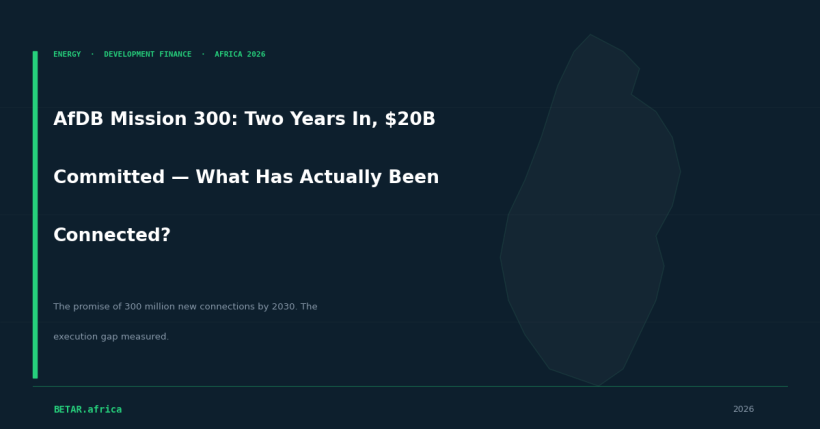

AfDB Mission 300: Two Years, $20B Committed — Three Million Connections Confirmed
The African Development Bank and World Bank committed $20 billion to Mission 300 at launch, targeting electricity access for 300 million Africans by 2030. Two years in, the disbursement ratio stands at roughly 15–20 cents on every committed dollar, and fewer than 4 million new connections are directly attributable to Mission 300 capital. That gap is what infrastructure lead times look like — but the 2030 target requires 43 million connections per year. AfDB Annual Meetings in May will test whether ambition and execution are converging.
In November 2023, the African Development Bank and the World Bank stood together at the Africa Energy Summit in Nairobi and committed $20 billion to Mission 300 — the most ambitious electricity access programme the continent had seen since the US Power Africa initiative a decade earlier. The target: electricity access for 300 million Africans by 2030, delivered through bilateral country energy compacts that would coordinate government, DFI, and private sector investment around national electrification plans.
By early 2026, 26 African countries have signed compacts. The $20 billion headline has been confirmed across AfDB and World Bank project portfolios. Sixteen months of implementation have produced a programme that is proceeding roughly as large infrastructure commitments proceed: slowly at first, with most of the financial activity still in the approval-and-disbursement pipeline rather than in the ground.
The question that AfDB progress reports do not answer directly — how many people have actually gained electricity access as a result of Mission 300 financing — turns out to be answerable only with significant caveats, and the honest answer is approximately 2–4 million confirmed new connections attributable to Mission 300-funded infrastructure, against a two-year pace requirement of roughly 86 million to stay on track for the 2030 target.
The Accountability Number AfDB Does Not Publish
Mission 300 does not publish a single connections counter. The programme measures commitments, compact signatures, and project approval milestones — not delivered connections. That is partly by design: connection data takes 12–18 months to flow through national energy ministry reporting systems into the international datasets (IEA, SEforALL, IRENA) that provide cross-country comparability. A connection made in rural Zambia in mid-2025 will not appear in IEA’s tracking database until late 2026 at the earliest.
Working from the bottom up — IEA Africa Energy Outlook data, national utility reporting, and project-level progress from the largest compact programmes — a reasonable estimate of Mission 300-attributable connections through Q1 2026 runs between 2 and 4 million. The IEA’s preliminary data for 2024 shows Sub-Saharan Africa added approximately 40–45 million electricity connections that year, a record pace that reflects both off-grid solar market growth and accelerated grid investment. Of those, the share directly financed through Mission 300 compacts — as opposed to pre-existing national programmes that Mission 300 subsequently framed — is difficult to isolate. GOGLA, which tracks solar home system sales, reported approximately 12 million SHS units sold in Sub-Saharan Africa in 2024, of which Mission 300-linked financing supported a fraction, primarily through result-based financing windows in Kenya, Rwanda, and Ghana.
The scale problem is mathematical. The 300 million target over seven years (2024–2030) requires approximately 43 million new connections per year. Africa’s pre-Mission 300 baseline pace was 20–25 million per year. Mission 300 needs to roughly double the continent’s historical connection rate — and sustain that doubling for six more years after the first two, in which the acceleration has been minimal.
What $20 Billion Actually Costs Per Connection
The $20 billion committed to Mission 300 implies a cost of approximately $67 per connection against the 300 million target — well below the actual cost of connecting an unelectrified household in sub-Saharan Africa. That apparent inconsistency resolves when you understand what the $20 billion finances: not individual household connections, but the infrastructure layers that make connections possible.
The effective cost per new connection in Africa varies enormously by technology pathway. Grid extension in peri-urban areas — the most common approach for compact countries with established utilities — runs $800–2,500 per household, driven by low-voltage distribution infrastructure, metering, and connection labour. Solar home systems, which deliver basic electricity access without grid infrastructure, cost $150–280 per household in delivered system cost, though ongoing maintenance and battery replacement push the ten-year total higher. Solar mini-grids, which Mission 300 has emphasised as a way to reach dispersed rural populations outside the grid catchment area, run $350–700 per connected household in capital cost, with ongoing revenue requirements that depend on tariff collection from low-income communities.
A weighted average across Mission 300’s technology mix — roughly 40% grid extension, 35% solar home systems, 25% mini-grids, based on compact programme descriptions — suggests an effective programme cost of $350–600 per connection. At that range, $20 billion finances 33–57 million connections. The 300 million target requires the remaining 240–270 million connections to come from sources outside the committed DFI capital: national government spending, private sector investment catalysed by the compacts, and the market-driven off-grid sector that Mission 300 is intended to support but not wholly finance.
The AfDB does not publish a commitments-versus-disbursements breakdown by country compact. Working from publicly available AfDB and World Bank project documentation through Q1 2026, approximately $6–8 billion of the $20 billion headline commitment has been formally approved at the project level and is in active disbursement phases. Actual disbursements — money that has reached programme implementers — are estimated at $3–4 billion. The 15–20% disbursement ratio against headline commitment is not unusual for a two-year-old infrastructure programme; it reflects procurement timelines, government counterpart contribution requirements, and the gap between financial close and construction start. It does mean that the infrastructure that will produce the majority of Mission 300 connections has not yet been built.
Nigeria and DRC: The Two Markets That Determine the Result
Nigeria and the Democratic Republic of Congo together account for approximately 70% of sub-Saharan Africa’s unelectrified population — roughly 175 million people between them. Mission 300’s performance in both markets will determine, more than any other factor, whether the programme’s 2030 target is achievable.
Nigeria’s DARES programme is Mission 300’s most advanced large-scale implementation. The $750 million World Bank-funded programme targets 750,000 solar mini-grid connections across 200,000 households and commercial customers by mid-2026, using a procurement model that competitively selects private mini-grid operators rather than routing all capital through the national utility. The first clusters are operational as of Q1 2026, with the deployment pace tracking ahead of the formal programme schedule. Nigeria is the model for what Mission 300 execution looks like when the regulatory environment is workable and private sector developers are ready to deploy. Even at DARES’ ambitious pace, however, Nigeria’s electrification gap — approximately 90 million unelectrified people — is orders of magnitude larger than one programme can address in one programme cycle.
The DRC compact is at an earlier stage. The country has the largest absolute electrification deficit in Africa and some of the most complex implementation challenges: a vast, partially inaccessible geography, weak utility infrastructure, and an energy ministry whose capacity is constrained by decades of underinvestment. The DRC compact has been signed; project-level approvals are in progress. Connections attributable to Mission 300 in DRC through Q1 2026 are negligible. That is expected at this stage, but the DRC’s trajectory over the next 18 months will be a key indicator of whether Mission 300 can address the hardest cases, not just the tractable ones.
Among the compact countries currently leading on execution: Kenya, Rwanda, and Ghana have moved fastest, benefiting from stronger utility frameworks, established off-grid market ecosystems, and — in Kenya’s case — relatively advanced grid infrastructure that reduces the cost and complexity of last-mile connection. Zambia has moved more slowly, constrained by the hydropower crisis that has consumed energy ministry bandwidth since 2024. The Sahel compact countries — Niger, Mali, Burkina Faso — face security conditions that complicate implementation in the very areas where electrification deficits are greatest.
The Power Africa Gap and What Comes Next
Mission 300 was designed with an assumption of Power Africa co-financing. The US-Africa energy partnership that Power Africa represented was projected to contribute approximately $1 billion per year in DFC financing, EXIM credit support, and USAID grant funding through 2030. US foreign policy changes in early 2025 eliminated the USAID energy portfolio and reoriented DFC and EXIM toward commercial lending rather than development grant financing. That shift does not eliminate US participation in African energy — as BETAR reported from the Powering Africa Summit in March 2026, the Trump administration is actively promoting US gas services and critical minerals partnerships — but it removes the concessional finance layer that made US co-investment compatible with Mission 300’s social electrification objectives.
The AfDB and World Bank have indicated they can absorb the reallocation within their own balance sheets. The practical consequence is that the programme’s concessional finance ratio — the share of total investment that carries below-market rates and social return expectations — will be lower than planned, which pushes the effective cost per connection upward and narrows the range of communities that can be reached with the available capital.
The AfDB Annual Meetings in May 2026 will be the first opportunity for Mission 300 to present two-year progress data publicly. The programme’s credibility depends less on the number of connections confirmed than on whether it can show that the structural conditions for accelerated delivery — utility reform, mini-grid procurement frameworks, result-based financing mechanisms — are being built in the compact countries that matter most. On that measure, the early picture is mixed but not discouraging. Nigeria is showing what the model looks like at scale. The harder work — DRC, the Sahel, rural Southern Africa — is still mostly ahead.

 UphivaBETAR