
The Afrobeats Export Premium: How Africa’s Biggest Music Movement Monetises Abroad — and What Artists Actually Keep
By BETAR Staff Reporter | April 2026
When Burna Boy sold out London’s O2 Arena in 2022 — 20,000 seats in under an hour — it confirmed what the music industry had been hedging against for years: Afrobeats was no longer a regional genre. It was a global commercial force. The question that followed wasn’t whether African music could travel. It was who would profit when it did.
The answer, as with most things in the international music business, is complicated. And for the majority of African artists who break through globally, the gap between the streams their music generates internationally and the money that returns home is wide enough to qualify as a structural problem.
The Streaming Rate Differential
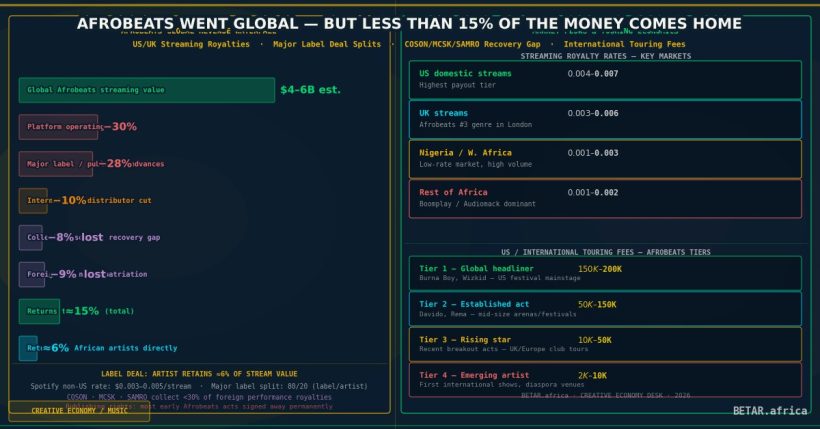
The mechanics begin with geography. Spotify’s per-stream royalty rate isn’t fixed — it is calculated as a share of revenue in each country, divided by total streams. Because African subscription prices are a fraction of US or UK prices (Spotify Premium in Nigeria costs approximately ₦2,900 per month, against $9.99 in the United States), streams originating in Lagos pay out at rates five to ten times lower than streams from London or New York.
For an artist like WizKid or Tems whose Spotify numbers span both markets, the blended rate is pulled downward by African streams even as their charts performance abroad improves. IFPI’s 2025 Global Music Report estimated Sub-Saharan Africa accounted for 3.4% of global recorded music revenues despite representing roughly 16% of global streaming volume — a mismatch driven by this subscription tier asymmetry.
“The streams are real. The money isn’t proportional,” said Antonia Chinonso, head of artist partnerships at an international distribution platform operating in Nigeria and Ghana, in a 2025 panel at Lagos Music Week. “When an African artist gets 50 million streams on a viral hit and then looks at the statement, there’s always a moment of recalibration.”
The situation is better — though not remedied — for artists who have signed to major international labels, where label-side advances are paid regardless of streaming geography. But those deals introduce a different set of trade-offs.
Label Deal Economics: The Advance-for-Catalogue Trade
Three major label groups now operate structurally in Africa: Universal Music Group (through its Africa-focused operations, including Def Jam Africa), Sony Music Entertainment Africa, and Warner Music’s pan-Africa operation. Each has signed Nigerian, Ghanaian, or South African acts to international deals since 2019, and each typically structures deals differently from domestic contracts.
For established Afrobeats or Amapiano acts, advances in the $1 million to $3 million range are documented in industry reports from Music Business Worldwide and corroborated by artist representatives who spoke to BETAR. In exchange, labels retain the majority of recorded music revenue — typically 50% to 80% — for the duration of the deal, often spanning three to five album cycles.
Publishing rights remain the more contested terrain. Label executives in the 1990s and 2000s routinely bundled publishing acquisition into recording deals as a condition of the advance. African artists with international leverage have increasingly resisted this. WizKid is widely cited in music industry circles as having retained publishing rights in his RCA/Sony deal structure, a negotiating position he was able to demand following the breakout success of Essence.
“The artists who come in with real leverage — a certified global hit, a sold-out international tour — are negotiating from a fundamentally different position than they were five years ago,” said Emmanuel Osei, a music attorney based in Accra who has advised on international deals for West African acts. “Publishing retention is now table stakes for the top tier.”
For the mid-tier — acts with strong regional streaming but not yet a certified global crossover — publishing co-ownership arrangements remain common, with label shares ranging from 25% to 50% of publishing income.
Sync: Afrobeats Enters the Global Ad Economy
Synchronisation licensing — the use of music in films, television, and advertising — has become an increasingly visible revenue stream for the genre. WizKid and Tems’ Essence was licensed for global campaigns by consumer brands including Nike and was featured in Netflix productions. Burna Boy’s catalogue has appeared in multiple American television productions. South Africa’s Amapiano has been incorporated into advertising campaigns by automotive and beverage brands targeting youth markets in Europe and the US.
Sync fees for well-known Afrobeats tracks in global brand campaigns range from $15,000 for regional one-year placements to upwards of $150,000 for global perpetual rights on high-budget advertising, according to Tanya Uchenna, a sync licensing agent at a London-based music supervision company that sources African content for international productions.
“There’s been a material shift in what music supervisors are asking for in the last three years,” Uchenna said. “Afrobeats has moved from being an ‘exotic flavour’ request to being a default consideration for youth-targeted campaigns globally.”
The constraint is clearance complexity. African publishing rights are often fragmented — distributed between domestic collection societies like COSON in Nigeria and SAMRO in South Africa, international society affiliates, and direct label deals — making rights clearance slower and more expensive than for equivalent Western catalogue. Several sync placements have collapsed because rights holders could not be identified in time for campaign production schedules.
Touring: Where the Real Numbers Are Made
Live performance remains the largest single income stream for most African artists operating at the international level. The touring economics at scale are substantial.
Headlining fees for established Afrobeats acts at major US and UK venues — O2 Arena, Madison Square Garden, The Forum — have been reported in the $300,000 to $750,000 range per show, based on industry estimates from concert promoters who spoke to BETAR on background. Against domestic Nigerian headline fees of $10,000 to $75,000 per performance, the international premium is between 5x and 30x depending on the artist’s profile.
Promoter margins in UK and US markets typically run 15% to 25% of gross receipts, with artists often negotiating against a guaranteed floor with upside participation above break-even. For sold-out shows, back-end revenue sharing can push effective artist earnings significantly above the guaranteed fee.
The cost structure offsets some of this: international touring requires production crews, logistics, and travel infrastructure that domestic tours do not. A major European leg for a Tier 1 Afrobeats act may generate $5 million to $8 million in gross ticket revenue, with the artist retaining 60% to 70% net of management commissions (typically 15-20%), booking agent fees (10%), and production costs.
The Structural Imbalance
The pattern that emerges from the data is consistent: African artists generate substantial international revenue, but a significant share accrues to infrastructure — labels, publishers, distributors, promoters — rather than creators. The gap is largest for streaming, where geography-based pricing disadvantages African-origin plays, and smallest for live performance, where artist leverage is clearest.
The policy conversation is beginning to catch up. Nigeria’s Copyright Commission has engaged WIPO on cross-border royalty flow transparency. South Africa’s Department of Sport, Arts and Culture commissioned a 2025 report on the Amapiano value chain that specifically flagged international publishing rights as a governance priority.
Whether those conversations translate into structural change remains uncertain. For now, Africa’s most commercially successful music export is generating global streaming records while the revenue map continues to favour the cities that host the infrastructure, not the ones that produced the art.
Sources: IFPI Global Music Report 2025; Music Business Worldwide; Lagos Music Week 2025 panels; interviews with Antonia Chinonso (Lagos), Emmanuel Osei (Accra), and Tanya Uchenna (London). Additional background interviews conducted on condition of anonymity.

 UphivaBETAR
 Joseph Busari