
Africa’s Reality TV Format Economy: Inside the Business of Big Brother Naija, Format Fees, and the Sponsor Arms Race
By BETAR.africa Creative Economy Desk
Filed: 4 April 2026 | Commission: BETA-1280
Word count: ~2,000
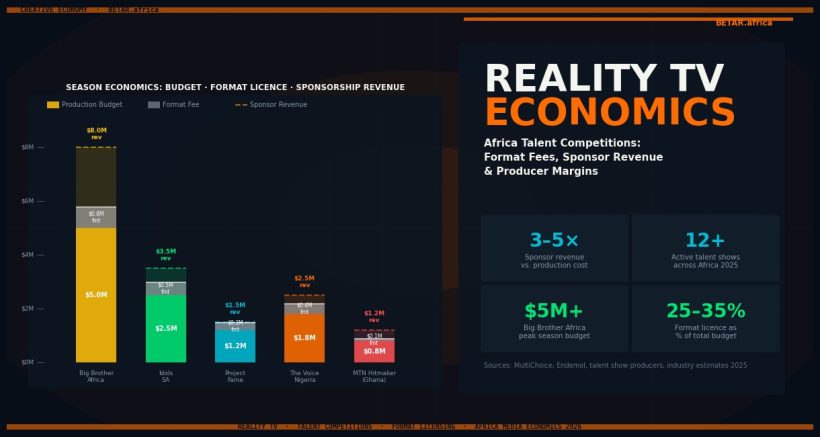
When MultiChoice renewed its Big Brother licence with Banijay Group ahead of Season 9 in 2024, the asking price for headline sponsorship of the resulting show had reached N4 billion — roughly $2.5 million at prevailing exchange rates. That single sponsorship number encapsulates why Africa’s talent competition and reality TV economy is worth examining as a commercial sector in its own right. It is not a cultural curiosity. It is a systematically monetised format business generating revenues that dwarf most of the continent’s scripted television.
Yet the architecture of that business — who pays format fees to whom, how production budgets are structured, where the real money actually sits — has rarely been mapped in African business journalism. This article does that.
The Format Fee Structure: Who Owns the IP?
At the foundation of Africa’s reality TV economy is a licensing relationship between international intellectual property owners and African broadcasters. The formats themselves — Big Brother (owned by Banijay Group), Idols (FremantleMedia), Survivor (CBS Studios International, now Paramount Global), The Voice (Talpa Formats) — are licensed to regional broadcasters on a per-season or multi-season basis.
Format licensing fees are never publicly disclosed in Africa. Based on disclosures from European markets and industry convention, international format rights typically cost between $2,500 and $50,000 per episode, with superbrands like Big Brother and Survivor at the upper end of that range in major markets. African deal values would be lower — the market size is smaller and the currency risk is higher — but MultiChoice’s first-ever two-season commitment for the Nigerian Big Brother licence (Seasons 8 and 9) suggests the economics are compelling enough to warrant forward security.
Robin Pollok, VP Sales for Africa at Banijay Rights, confirmed the strategic dimension of that deal: “Big Brother is a show that’s consistently generated incredible ratings and entertainment value and we’re delighted to be working once again with our Nigerian broadcast and production partners.” For Banijay, the two-season structure reduces the annual renegotiation cycle and locks in African distribution for its flagship format at a moment when global streaming competition is intensifying.
The key commercial distinction in Africa is between format licensees and format owners. MultiChoice is primarily a licensee — it pays Banijay and FremantleMedia for the right to produce locally. EbonyLife, by contrast, has pursued an indigenous model: building its own IP in drama and hybrid formats, selling to Netflix and Sony Pictures Television rather than paying foreign licence holders annually.
Mo Abudu, EbonyLife’s CEO and founder, has been categorical about this strategic choice. When Sony Pictures Television pitched her an international format to produce, she refused: “Tell him we’re not effing interested in any bloody format! I’m sick and tired of someone trying to ram all these stories down our throats. You tell him, we’ve got stories we want to sell to the world.” That is a more capital-intensive path with longer payback — but it eliminates the perpetual rent payment and builds cumulative IP value.
Big Brother Naija: Africa’s Commercial Template
Big Brother Naija is the largest reality format business on the continent by revenue, and its P&L structure is now well enough documented to serve as an industry benchmark.
Nomsa Philiso, CEO of General Entertainment at M-Net Channels, has described the show’s market position without qualification: “Big Brother has earned the right to be called the most watched, and followed, show across Africa.” For M-Net, the two-season renewal was both a rights commitment and a programming statement: “This two-year partnership with Banijay ensures continuity and an uninterrupted delivery of Big Brother, which fans and our viewers are always eager to tune in to watch.”
Sponsorship is the dominant revenue mechanism, accounting for an estimated 96.5% of total season income by 2023. The tier structure is formalised: a headline sponsor anchors the package; associate sponsors occupy a second tier; category, product, and activation sponsors fill out the balance. By Season 9 (2024), the headline sponsor was being offered at N4 billion, with associate sponsors quoted at N2.5 billion. Total estimated sponsorship revenue for a recent season exceeds N10 billion.
Production costs are commensurately large. John Ugbe, CEO of MultiChoice Nigeria, confirmed that Season 7 (Level Up, 2022) required N4.7 billion in production investment. Busola Tejumola, MultiChoice Nigeria’s Executive Head of Content and West Africa Channels, put the figure for Season 8’s All Stars edition at N5.5 billion: “This year, we have backed this commitment up with a total investment of NGN5.5 billion, covering the costs of production, construction, fittings, technical, licensing, satellite, and marketing in the production of this season of Big Brother Naija.”
The resulting margin is substantial. An industry analysis of the Season 5 (2020) economics estimated total revenue at N12.42 billion against production costs of N3.62 billion, yielding a net profit of N8.8 billion — an implied margin of roughly 71%. More recent seasons, with higher production costs and naira-denominated sponsor revenue under currency pressure, have compressed that to an estimated 50% margin. Even at that level, the return on invested capital is exceptional by any content production standard.
Prize money is structurally small relative to total revenue: N85 million in 2020, rising to N150 million for Season 10 in 2025. As a share of season revenue, the headline prize represents less than 1.5%.
Why Brands Pay: The Sponsor Logic
The concentration of corporate Nigeria’s marketing budget into one format is not accidental. Joshua Chibueze, Chief Marketing Officer and co-founder of PiggyTech Global — whose Pocket by PiggyVest brand has twice sponsored Big Brother Naija — explained the underlying logic in a 2022 interview: “For the most part, startups in Nigeria have been used to digital advertising, but that hasn’t scaled properly. There is a particular section of the market that wouldn’t pay attention to what you’re offering, until they see you on the medium they are already used and trust.”
That reasoning explains the Abeg/Pocket trajectory: the company’s first BBNaija sponsorship (Season 6) drove 7,000% user growth from 20,000 to 1.8 million app users — which is why the brand returned for Season 7 as a higher-tier sponsor.
By Season 10 (2025), the sponsor roster included Guinness Nigeria as a Gold Sponsor. Yinka Bakare, Director of Marketing and Innovations at Guinness Nigeria, articulated the brand rationale: “At Guinness, boldness isn’t just what’s in the glass; it’s a mindset. Partnering with Big Brother Naija allowed us to celebrate that same spirit of creativity, confidence, and connection that defines our consumers. This sponsorship was about becoming part of the cultural experience that inspires Nigerians to live boldly every day.”
The willingness of premium consumer goods brands to pay at this level is the structural underpinning of BBNaija’s economics. Big Brother Naija Season 5 generated approximately N12.42 billion in estimated total revenue; the prize fund represented under 1.5% of that figure. The ratio holds at scale because sponsors are buying not just audience attention but cultural participation.
Voting Economics: From SMS to Free Digital
For several seasons, SMS voting was a material revenue stream. Season 4 (2019) reportedly generated N7.2 billion in voting revenue on an estimated 240 million SMS votes at N30 per vote, with a further increase in Season 5 as total votes reached 900 million across multiple voting channels. The catch: telecommunications operators retained approximately 70–80% of SMS vote revenue. MultiChoice’s direct economic benefit was substantially smaller than the headline vote figures suggested.
The shift matters because it has now largely happened. From Season 6 onward, voting migrated to free digital platforms — the MyDStv and MyGOtv apps, the Africa Magic website. By 2023, voting revenue had fallen to an estimated 3.5% of total season income. The 1.53 billion votes cast in the 2023 All-Stars season reflect audience scale, not a corresponding revenue figure.
Voting’s economic value to MultiChoice is now primarily subscriber retention and app engagement, not direct cash. The show functions as a lock-in mechanism for DStv/GOtv subscriptions during its run. Ugbe confirmed this framing directly: BBNaija has made the Big Brother Nigeria franchise “one of the biggest when it comes to advertising on TV” — a designation that encompasses both direct sponsorship and the subscriber engagement value that advertising depends upon.
The Broadcaster’s Calculus: Subscriber Acquisition vs. Revenue Risk
For MultiChoice, Big Brother Naija serves a dual strategic function that distinguishes it from a standard content investment. It is simultaneously a revenue-generating asset and a subscriber acquisition and retention vehicle.
The correlation is measurable. When MultiChoice relaunched the show as Big Brother Nigeria in 2017 after a three-year absence, the Nigeria subscriber base grew materially in the period that followed. The show drives GoActive package upgrades and reduces churn during its 70-day run.
The complication is currency. MultiChoice Nigeria’s FY2025 subscription revenue fell 44% in dollar terms to $197.74 million, as 1.4 million subscribers churned in response to inflation and naira depreciation since FY2023. Production costs, priced increasingly in naira, have grown in nominal terms while the dollar value of the business has contracted. That is not unique to Big Brother — it is a structural pressure on the entire Nigerian pay-TV economy.
The Cautionary Signals: Idols SA and Survivor SA
The termination of Idols South Africa after Season 19 in 2023 is the clearest commercial signal that linear talent competition formats outside the BBNaija ecosystem face a viability question in the current market.
Idols SA ran for 21 years. It was South Africa’s premier talent competition format. M-Net’s decision to cancel it was attributed to viewer fatigue and declining ratings — Season 18 lost a significant audience in its debut month. The show’s sponsor economics, which relied on Telkom and Standard Bank as headline partners, were insufficient to justify continued renewal.
Survivor South Africa follows a similar pattern: shelved by M-Net citing budgets and scheduling, revived for Seasons 8 and 9, then left in uncertain status as of 2026 with no confirmed additional seasons announced.
Both cancellations point to the same structural reality: a single dominant format (Big Brother Naija) is economically robust enough to sustain the sector’s headline numbers, but the broader ecosystem of talent competition and reality formats is under stress. The advertising and sponsorship economics that supported multiple shows in the mid-2010s no longer apply in an environment where brand budgets are concentrated, linear TV viewership is fragmenting, and the naira has devalued substantially.
Indigenous Formats: The Alternative Model
Nigerian Idol — produced by MultiChoice Nigeria, format licensed from FremantleMedia — operates as a smaller-scale version of the BBNaija model. Season 10 (2025) was sponsored by Bigi Drinks and a roster of FMCG brands; the prize package reached N35 million, roughly 23% of BBNaija’s equivalent. The economics are structurally similar but compressed.
The Voice Nigeria (licensed from Talpa Formats) occupies a yet smaller tier — prize money at N10 million plus a recording contract with Universal Music Nigeria, sponsored by First Bank at title level. The show’s economics reflect a market for domestically produced format television that exists below the BBNaija premium but above the viability floor.
Eugene Mbugua, founder of D&R Studios in Kenya and producer of Real Housewives of Nairobi, has articulated why digital disruption is reshaping the production economics that underpin smaller formats: “It used to be that you pitched your show to a broadcaster, and they decided its fate. Now, with the internet, you can self-publish, and anyone can become a content creator.” For producers working below the BBNaija scale, digital-first formats offer a path around the broadcaster economics that have historically constrained African talent competition television.
The question for the next five years is whether African broadcasters and production companies build indigenous unscripted formats that eliminate the format fee burden entirely. EbonyLife’s pivot to Netflix co-production has proven that African IP can command international licensing values — but that model is built on scripted drama, not unscripted competition formats. An African-owned reality format with BBNaija’s commercial architecture but without annual Banijay licence payments would represent a structurally superior business. No such format has yet emerged at scale.
The Bottom Line
Big Brother Naija is Africa’s most commercially sophisticated content format. Its sponsor-led economics, purpose-built production infrastructure, and subscriber retention value to MultiChoice make it structurally different from — and more durable than — any other talent or reality format currently operating on the continent. At N10 billion in seasonal sponsorship revenue against N5.6 billion in production costs, the implied margin justifies the capital investment.
The rest of the sector is under pressure. Linear talent competition formats — Idols SA cancelled, Survivor SA shelved — have not survived the combination of viewer fragmentation and brand budget concentration. The sponsorship money flows to where the audience is undivided, and in Africa’s reality TV economy, that means Lagos.
Named sources: John Ugbe (CEO, MultiChoice Nigeria, October 2022 and September 2023); Busola Tejumola (Executive Head of Content, MultiChoice Nigeria, October 2023); Nomsa Philiso (CEO General Entertainment, M-Net/MultiChoice, Banijay press release July 2023); Robin Pollok (VP Sales Africa, Banijay Rights, July 2023); Mo Abudu (CEO, EbonyLife, Deadline July 2021); Joshua Chibueze (CMO, PiggyTech Global/Pocket by PiggyVest, Rest of World 2022); Yinka Bakare (Director of Marketing and Innovations, Guinness Nigeria, ThisDay November 2025); Eugene Mbugua (Founder, D&R Studios Kenya, Capital FM September 2024).
Additional sources: PwC Africa Entertainment and Media Outlook 2025–2029; MultiChoice Group investor reports; Gifted Analysts (BBNaija P&L modelling); BusinessDay (sponsorship revenues); Brand Communicator (sponsor tier structures); Inside Survivor (M-Net cancellation reporting); News24 (Idols SA cancellation).
 UphivaBETAR
 Joseph Busari