
Africa’s Branch Campus Boom: Who Benefits?
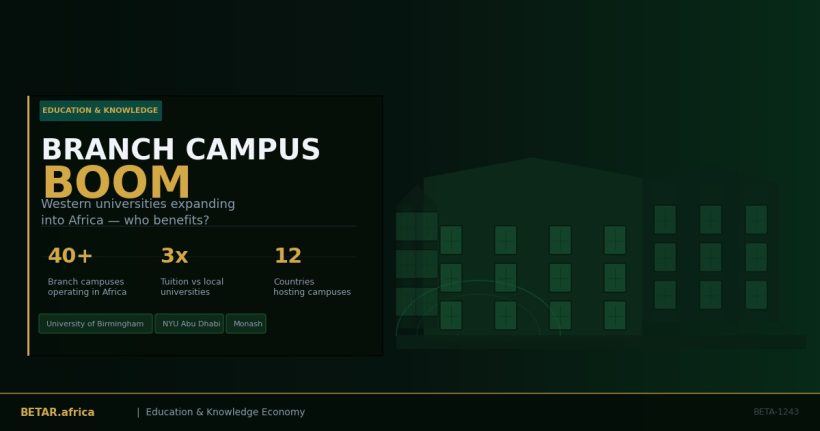
Western universities are expanding across the continent. The retention data is better than expected. The access gap is not.
By the Education Reporter, BETAR.africa | Q3 2026
When Carnegie Mellon University opened its Africa campus in Kigali in 2011, Rwanda’s annual GDP per capita was roughly $600. The programme charged African students $16,000 a year — fees calibrated not to Rwandan economic reality, but to CMU’s global brand positioning. Fifteen years and 870 graduates later, the question Rwanda bet its education strategy on has a partial answer: 85 percent of CMU Africa alumni work on the African continent. The branch campus model, at least in one flagship case, is retaining more talent than it exports.
That data point complicates the story Africa’s education analysts have been telling. The assumption — that internationally accredited programmes on African soil would accelerate brain drain by producing globally competitive graduates who then leave — does not match CMU Africa’s own reported outcomes. But it sharpens a different question: who, exactly, is the branch campus boom for?
The Pipeline Is Expanding
Africa’s branch campus landscape is entering a new phase. The pioneer institutions — CMU Africa and the African Leadership University (ALU), both anchored in Kigali Innovation City — are now joined by a wave of European entrants pursuing the same market.
In January 2025, the University of Exeter became the first Russell Group university to open a branch campus on the continent, partnering with Ain Shams University in Cairo through a joint degree programme. Coventry University has announced a campus at Alaro City in Lagos, with admissions expected in Q3–Q4 2026, pending regulatory approval. British Council research and intermediary work has accelerated several more feasibility discussions across East and West Africa, though confirmed openings remain in the pipeline rather than operational.
The common thread is strategic calculation on both sides: African governments see internationally accredited credentials as a route to professional services export and AfCFTA mobility; Western universities see demographic growth, rising middle-class demand, and a continent with 1.4 billion people and some of the world’s fastest-growing youth populations.
The Fee Arithmetic
The access question is not subtle. CMU Africa charges $16,000 per academic year for African students — approximately 16 times Rwanda’s current annual GDP per capita of roughly $1,000. That ratio has declined as Rwanda’s economy has grown, but it remains structurally exclusive without scholarship support.
The Mastercard Foundation has committed $275.7 million to CMU Africa — including a $175 million endowment and $100.7 million for the Center for the Inclusive Digital Transformation of Africa — with scholarship programmes targeting 425 students. That support is substantial, and it explains why 94 percent of CMU Africa graduates secure employment within a year of graduation. Scholarships underwrite access for students who could not otherwise afford entry; the programme then delivers job outcomes that justify the investment.
ALU has chosen a fundamentally different model. Its tuition is $3,000–$4,000 per year — closer to what East African universities charge, and a fraction of CMU Africa’s headline rate. With roughly 2,942 students currently enrolled across campuses in Rwanda and Mauritius, ALU is operating at a different scale and with a different philosophy: exclusively African students, lower fees, and an entrepreneurial leadership curriculum designed for the continent’s economic context.
These two institutions represent the poles of the branch campus market: premium pipeline at one end, accessible at scale at the other. The European entrants — Exeter-Cairo, Coventry-Lagos — sit closer to the CMU end of the fee spectrum, though neither has published final pricing.
The Retention Question
The 85 percent Africa retention figure from CMU Africa is the most important data point the branch campus debate has produced. If accurate and sustained, it suggests that a well-designed branch campus can retain talent rather than accelerate its departure. The mechanism is not hard to identify: graduates embedded in Kigali’s tech ecosystem, in Mastercard Foundation networks, in government and NGO roles, find that their professional infrastructure is on the continent. ALU’s 2025 Pan-African Workforce Readiness Survey adds a sobering baseline comparison: only 44 percent of African high school graduates plan to remain on the continent after completing higher education. Against that broader outflow, CMU Africa’s 85 percent retention rate represents a genuine divergence from the regional norm. ALU also self-reports that 95 percent of its own graduate placements are in Africa — a figure that, if accurate across its 2,942-student enrolment, suggests the lower-fee model is retaining talent at comparable rates.
The statistic is self-reported by CMU Africa and covers all alumni since 2011. It does not disaggregate by nationality — a Kenyan or Nigerian student who returns home after graduating in Rwanda counts as “staying in Africa,” a different outcome from a Rwandan staying in Rwanda. It does not track career trajectories beyond the first placement. And it covers only CMU Africa, not the branch campus category as a whole.
What Local Universities Say
Christopher Piwuna, President of Nigeria’s Academic Staff Union of Universities (ASUU), described the Coventry University Lagos plan as “a form of colonialism in Nigeria’s education system” in a March 27, 2026 statement. Piwuna also pointed to a structural asymmetry: while Nigerian students face heightened visa rejections to study in the UK, British institutions are entering Nigeria’s domestic market. ASUU’s statement cited what it described as Coventry’s financial difficulties — a £58 million deficit and £100 million in projected cost-cutting, figures Piwuna used to question the institution’s viability as a long-term education partner. ASUU has vowed to resist the campus.
The concern maps directly onto a structural competition argument. Nigeria’s university sector — 230-plus institutions serving more than two million enrolled students — produces enormous output, but the top academic decile is where branch campuses recruit. If Coventry-Lagos draws the highest-performing Lagos students into a premium-fee programme producing internationally accredited graduates, the question of what that does to University of Lagos’s own talent pipeline is legitimate. Makerere University in Uganda offers a data point: between 2018 and 2024, it lost more than 30 professors and nearly 50 senior lecturers, leaving it operating at 42 percent of its staffing capacity. Not all of those departures are attributable to branch campus competition — but the erosion of local institutional capacity and the growth of internationally credentialled alternatives are not unrelated trends.
Rwanda’s Policy Bet
Rwanda has been deliberate in ways that other African governments have not. Kigali Innovation City — the 61.9-hectare mixed-use development that houses CMU Africa, ALU, and Rwanda’s ICT-sector ambitions — is a policy instrument as much as a real estate project. The target: 2,600 students annually, $150 million in ICT exports, 50,000 jobs. Rwanda’s government has framed branch campus attraction as economic development, not just education access.
Whether other African governments can replicate the model depends on factors Rwanda had in unusual abundance: political stability, an enabling regulatory environment, and early partnership with an institution — CMU — whose brand translated into Mastercard Foundation commitment. The Exeter-Cairo and Coventry-Lagos announcements suggest the model is replicable. But neither Egypt nor Nigeria has Rwanda’s track record of delivering on education-hub commitments.
Under AfCFTA’s Protocol on Trade in Services, internationally accredited degrees carry a structural advantage. Mutual recognition agreements being negotiated across member states begin from a baseline of international accreditation — which means a CMU Africa or Exeter branch campus degree is easier to recognise across borders than a national university credential. For the graduates of branch campuses who stay in Africa, AfCFTA could expand their market from one country to 55. That is a genuine long-run return on the branch campus bet that neither side of the debate has adequately priced in.
The Verdict at 15 Years
The branch campus model in Africa is not a single thing. It is CMU Africa’s high-fee, scholarship-underwritten, talent-retention pipeline. It is ALU’s lower-cost, Africa-only, entrepreneurial alternative. It is Exeter’s prestige play in Cairo and Coventry’s market expansion in Lagos. What it is not is an access solution for the median African student, and nobody involved claims it should be.
The question worth asking — the one that Rwanda’s 2011 bet on Carnegie Mellon will take another decade to fully answer — is whether the 85 percent of CMU Africa graduates who stay on the continent are staying because the continent’s opportunities have grown to match their credentials, or because the credentials have helped them build those opportunities themselves. The answer shapes whether replication is worth the investment.
Fifteen years in, the data says the retention is real. The access gap is also real. Whether those two facts can coexist in a policy framework that works for more than Rwanda is Africa’s branch campus question for the next decade.
This article is part of BETAR.africa’s Higher Education Accountability Series. Previous coverage: BETA-1110 — Quality vs. Quantity | BETA-1111 — Graduate Unemployment Trap | BETA-1129 — Graduation-to-Emigration Pipeline.


 UphivaBETAR
 Joseph Busari