
In November 2025, Lagos Fashion Week won the Earthshot Prize — Prince William’s annual £1 million environmental award, placing the Nigerian event in the “Build a Waste-Free World” category, the first African fashion week to win the prize in its history. The prize money is earmarked to establish a circular fashion hub in Lagos and replicate the model across Kigali, Dakar, and Accra. A month later, South Africa Fashion Week announced a “strategic pause” — the first interruption in its 28-year history — citing production cost inflation, supply chain instability, and a sponsorship base that could no longer cover the cost of sustaining the event.
The contrast captures exactly where Africa’s fashion week circuit sits economically: prestigious enough to win a globally recognised prize, structurally fragile enough for the continent’s oldest show to go dark within the same season.
What It Costs to Get on the Runway
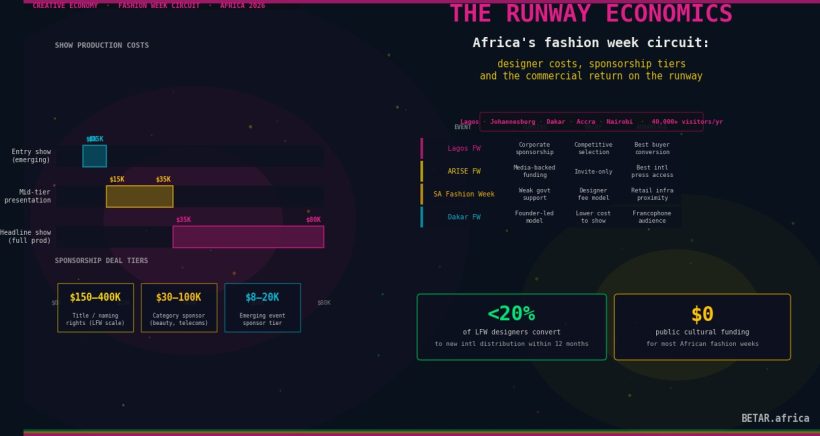
The economics begin with designer participation. At Lagos Fashion Week — operated by Omoyemi Akerele’s non-profit organisation Style House Files — a runway presentation costs a designer between ₦2 million and ₦20 million, equivalent to approximately $1,200 to $12,000 at late-2025 exchange rates, depending on scale and ambition. That range covers venue, lighting, sound, set design, logistics, model fees, hair and makeup, and creative direction. LFW operates a pooled production model, aggregating sponsor funding to provide shared infrastructure — models, glam squads, production support — for invited designers. A designer staging a headline show with significant original set design sits at the top of that cost curve; an emerging designer using the platform’s shared resources sits closer to the floor.
South Africa Fashion Week has historically operated on a different principle entirely. Lucilla Booyzen, the event’s founder and director across its 28-year run, stated explicitly that her organisation covered “the production, marketing and overhead costs of staging a runway show” for invited designers — with “money not a hindrance to participation.” The access model was SAFW’s distinguishing proposition against a global fashion circuit where a Paris or Milan show can cost a brand €100,000 to €500,000. The cost was qualifying for an invitation, not writing a cheque.
That model has hit its limit. Booyzen stated before the 2025 pause: “Instability in the supply chain has made fabric sourcing unsustainable, unpredictable and costly. Production costs have increased, while opportunities for visibility and retail presence for designer-led brands have reduced.” The organiser that absorbed production costs for designers could not continue doing so when those costs were rising and the sponsorship revenues that funded them were not keeping pace.
Dakar Fashion Week, founded in 2002 by Adama Paris (Adama Ndiaye), emerged from an explicitly collective model: Ndiaye did not initially have capital to fund a solo show, so she invited fellow Senegalese designers to share costs in a group showcase. By the event’s tenth year in 2012, the operating budget had grown to CFA 80 million — approximately $150,000 — funded from the programme she built rather than from institutional support. “We need African investors,” Ndiaye has stated publicly, acknowledging the gap between the event’s ambitions and its financial base.
The Sponsorship Architecture
Lagos Fashion Week’s sponsorship stack in 2025 includes Heineken Nigeria as title sponsor — a position the brewer has held since 2015, replacing GTBank, which held the title sponsorship across the event’s first three years from 2011 to 2014. The shift from a domestic bank to a consumer goods multinational is commercially significant: GTBank was investing in brand positioning among Nigeria’s affluent consumer segment; Heineken is activating lifestyle marketing across West Africa’s largest consumer market. The 2025 partner list additionally included Lush Hair, Nivea, Bank of Industry, Africa Finance Corporation, Afreximbank, MTN Nigeria, Lagos State Government, Moët & Chandon, and Meta.
No title sponsorship fee has been publicly disclosed by any LFW partner. The event’s revenue architecture follows the standard African event model: a major-brand title sponsor provides the largest single revenue line; development finance institutions (Afreximbank, AFC, BOI) fund specific programmes rather than pure brand presence; state government involvement is in-kind or co-branding rather than a disclosed cash quantum.
South Africa Fashion Week’s sponsorship base has always been the structural vulnerability Booyzen has described. “It is not funded or supported by the government or any institution,” she has stated — SAFW operates in a country where corporate sponsorship of sport dominates, with fashion competing for a smaller pool of event marketing budgets. The April 2026 relaunch came with a reduced sponsor set: Primedia’s radio stations, JC Le Roux, Magnum, Carlton Hair, and NARS Cosmetics — a more local profile than LFW’s mix and indicative of a scaled-back operating model.
Afreximbank’s Creative Africa Nexus programme represents the largest institutional funding vehicle currently active in the African fashion circuit, with the bank committing $2 billion for the three-year cycle from 2024 to 2027 across the entire creative industries. The programme has directly subsidised African designers’ attendance at Paris Fashion Week, Tranoi Tokyo, and Portugal Fashion — addressing the buyer access problem by taking designers to where buyers are, rather than bringing buyers to Africa.
The Buyer Conversion Problem
The central commercial limitation of African fashion weeks is the one that their organisers most carefully avoid quantifying. Post-event surveys from Lagos Fashion Week in 2025 show that 68 percent of attending brands secured new funding or distribution deals — a figure the organisation self-reports, without disclosing methodology. The same surveys recorded $1.7 million in advertising value equivalent generated across Vogue UK, Vogue US, Vogue Italy, CNN, Harper’s Bazaar, Business of Fashion, and others. Media value is real; wholesale order conversion from international buyers is a different question.
The honest read of the circuit’s commercial architecture is that African fashion weeks generate press, social media reach, and brand credibility — but do not reliably generate the direct wholesale buyer introductions that make Paris, Milan, and New York fashion weeks commercially essential for international designers. International buyers attend those markets specifically to write orders. Their attendance in Lagos, Cape Town, or Dakar remains the exception rather than the structure.
The continent’s clearest case of fashion week exposure converting into international stockist deals arrived via a different mechanism. Thebe Magugu, a South African designer who showed at SAFW before moving to Paris Fashion Week, won the 2019 LVMH Young Fashion Designer Prize — carrying €300,000 and a year of LVMH mentorship, the first African winner in the prize’s history. The prize yielded 19 international stockists including Bergdorf Goodman, Net-a-Porter, and Dover Street Market, plus collaborations with Dior and Adidas. The intervention was a prize awarded at Paris, not a buyer arriving at a Cape Town runway.
The Non-Profit Model and Its Limits
Lagos Fashion Week’s non-profit structure is what has allowed it to absorb the pooled production costs that make participation accessible for Nigerian designers. Akerele has positioned LFW as infrastructure for the broader industry rather than a commercially extractive event. The Earthshot Prize validates that positioning — and the £1 million award provides capital for a circular fashion hub model that extends LFW’s economic development mission beyond the show circuit.
The SAFW pause suggests that the non-profit absorber model has a ceiling defined by sponsorship revenue growth relative to production cost inflation. When that gap inverts — costs rising faster than sponsorship — the event that bore those costs on behalf of designers must either restructure or pause. Booyzen’s April 2026 relaunch shifts SAFW to a hybrid digital-live format specifically to reduce the fixed production overhead that made the model unsustainable.
Nigeria’s fashion industry is valued at approximately $4.7 billion, representing 15 percent of the sub-Saharan African market. Lagos Fashion Week serves as the industry’s most visible promotional platform. Whether that platform can build the commercial infrastructure — wholesale buyer attendance, trade show integration, direct retail conversion — that translates cultural visibility into durable commercial revenue is the question the circuit has not yet answered.
Sources: Omoyemi Akerele, Founder/CEO, Lagos Fashion Week (Business of Fashion; BusinessDay Nigeria); Lucilla Booyzen, Founder/Director, South Africa Fashion Week (Africa Reimagined; CEC Online); Adama Paris (Adama Ndiaye), Founder, Dakar Fashion Week (Essence Magazine); Deeds Magazine, “The Real Cost of Runway Dreams”; Earthshot Prize, Lagos Fashion Week winner announcement (November 2025); Afreximbank CANEX programme documentation and $2bn commitment announcement (2024); Business of Fashion, Thebe Magugu LVMH Prize (2019); Lagos Fashion Week 2025 post-event data (AVE and brand conversion figures).

 UphivaBETAR

 Joseph Busari