
Africa Graduate Unemployment Trap: What a University Degree Actually Gets You in 2026
The continent has more graduates than ever. The labour market data shows exactly what their degrees are worth.
By the Education Reporter, BETAR.africa | July 2026
Kelechi Obi graduated from the University of Nigeria, Nsukka, in 2022 with a degree in computer science. He graduated in the top quarter of his cohort, did an internship at a Lagos software house in his final year, and spent the eighteen months after graduation submitting applications. He now runs a phone-repair stall on Allen Avenue in Lagos. “I applied everywhere,” he said. “I thought computer science was the safe choice. But the companies want two or three years of experience for entry-level roles. I had a degree and an internship. It was not enough.” His is not a fringe case. It is, by the data, the modal outcome for a significant share of Africa’s recent graduates — including those who studied precisely the fields that employers say they need.
Across Nigeria, South Africa, and Kenya — the three largest higher education markets on the continent — a structural disconnect has opened between the credential being issued and the economy’s capacity to convert it into a sustainable livelihood. The data on what a university degree actually earns you in 2026 is, in most markets, bleak.
The Numbers That Don’t Match the Narrative
Africa’s tertiary enrolment story — covered in Part 1 of this series — is one of extraordinary expansion. What the enrolment numbers do not capture is the employment story waiting on the other side of graduation. Those numbers are considerably harder to frame as progress.
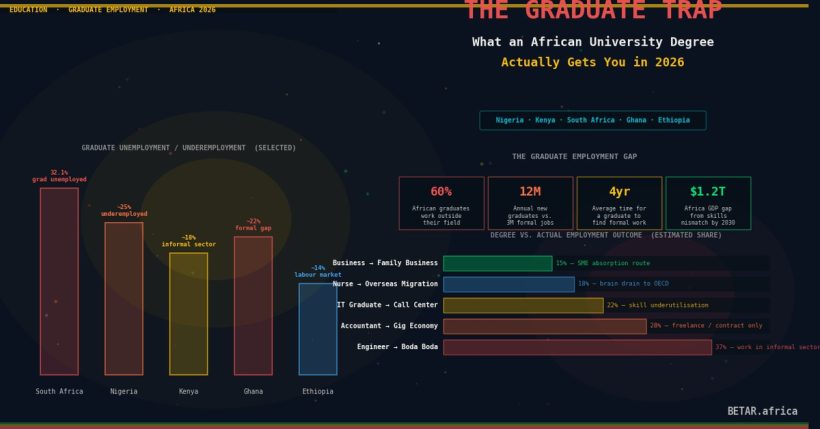
In Nigeria, the National Bureau of Statistics 2025 Labour Force Survey records graduate unemployment above 30 per cent among holders of university degrees aged 15 to 35. An economy that produces an estimated 600,000 university graduates annually has no formal mechanism for absorbing them at the rate they arrive. The informal economy — petty trade, gig logistics, subsistence agriculture — is the effective labour market for a large share of those graduates within five years of graduation.
South Africa’s Statistics SA Labour Force Survey for Q3 2025 puts the figure higher still. Graduate unemployment among South Africans under 35 reached 46 per cent in that survey period — nearly one in two people who completed a university qualification and who are actively looking for work cannot find it. The racial dimension is documented: Black African graduates face unemployment rates approaching 50 per cent in the 25–34 cohort, against 8–12 per cent for white graduates in the same age band. A degree’s labour market value is not socially neutral.
In Kenya, the Kenya National Bureau of Statistics data on graduate employment outcomes shows approximately 70 per cent of degree holders in precarious, informal, or underemployed roles within two years of completing their studies. The formal private sector — banks, telecoms, manufacturing, professional services — absorbs a fraction of annual graduate output. The rest enter an economy that requires adaptation, not the application of the skills a degree theoretically certified.
What Employers Are Paying — and Why
The employer side of the equation explains part of why the numbers look the way they do. When graduate supply substantially exceeds formal sector absorption capacity, wage compression follows. Entry-level graduate salaries in Nigeria for non-engineering, non-technology roles have not materially risen in real terms since 2019, even as the cost of a university education has increased. The degree, as an economic instrument, is yielding a deteriorating return.
“While there are job openings, businesses cannot find candidates with the right skills,” Ope George, Lagos State’s Commissioner for Economic Planning and Budget, said in public remarks on graduate employment reported by Nigerian business media. A 2024 Jobberman survey of Nigerian employers across banking, technology, and professional services found that six in ten graduates lack the skills required for available roles.
The gap shows up in the hiring funnel. “We receive thousands of graduate applications every cycle,” said Temi Adeyinka, Head of Talent Acquisition at Guaranty Trust Bank, in an interview with BETAR. “The academic credentials are there. But when we test for applied problem-solving, communication, or the ability to translate what they have studied into what we actually need, the pass rates are very low. We have had to build our own internal assessment tools because the degree alone tells us very little.” GTBank’s graduate trainee programme accepted fewer than 2 per cent of applicants in 2025, down from approximately 4 per cent in 2019, even as the volume of university graduates entering the applicant pool has increased.
The Decagon Q1 2026 employer survey across Nigeria’s technology sector found that 74 per cent of firms continued to report significant skills gaps among recent graduates — even after filtering for candidates with additional post-university training. The gaps cited are consistent with those reported by the World Bank’s STEP Skills Measurement Survey in Kenya: communication, applied analytical reasoning, and the ability to transfer theoretical knowledge to practical problem-solving. These are not niche technical deficits. They are foundational competencies that a four-year degree programme should be producing.
The result is credential inflation in its most damaging form: employers require degrees for roles that previously required secondary completion, because the degree has become a low-cost screening tool rather than a meaningful competence signal. More graduates compete for the same positions, wages do not rise, and the degree’s premium erodes for everyone.
Nigeria: Volume Without Absorption
Nigeria’s graduate employment problem is ultimately a structural mismatch problem at scale. The formal economy — banking, telecoms, professional services, government — is estimated to employ 10 to 15 per cent of the labour force. It cannot absorb 600,000 new graduates annually. The NBS 2025 Labour Force Survey records that the majority of employed Nigerians, including degree holders, are in vulnerable employment: self-employment without employees, or contributing family workers. For graduates, the informal sector is not a fallback. It is the primary destination.
Technology and finance are partial exceptions. The Lagos tech ecosystem and Nigeria’s fintech sector have generated graduate-absorbing roles at scale — and both consistently report that they look past formal degree credentials toward portfolio evidence, problem-solving ability, and training by providers like Decagon, ALX, and Andela. The degree is not irrelevant. It is simply not the selection signal employers in these sectors weight most.
Kenya: The Precarity Threshold
Kenya’s graduate labour market data tells a story of formal sector saturation and informal absorption. The KNBS Graduate Employment Supplement data suggests that the country’s formal sector — which the country’s Vision 2030 programme was intended to expand — has not grown quickly enough to accommodate the pace of graduate output from Kenya’s 70-plus universities, up from fewer than ten in 1990.
The boda-boda economy — motorcycle taxi networks — became a symbol of graduate underemployment: a significant proportion of operators in Nairobi hold post-secondary qualifications. This is not an anomaly. It is the informal economy’s function. It absorbs labour the formal sector cannot. But it does so at wages that make the financial return on four years of university fees negative for many graduates, particularly those from lower-income households who financed their degrees through loans or family contributions they cannot readily recoup.
Juliet Odera graduated from Kenyatta University in 2021 with a Bachelor of Education degree and spent two years attempting to enter Kenya’s teaching service, sitting three consecutive TSC competitive examinations without securing a posting. Unable to wait further, she now operates a boda boda along the Ngong Road corridor. “I passed the exams,” she told BETAR. “The problem is there are just not enough posts. Hundreds of us passed, but only a few dozen were posted. The rest of us had to figure something else out.” She has not given up on teaching but says she cannot afford to remain inactive while waiting for a vacancy. Elijah Ombuki graduated from Maseno University in 2016 with a degree in education and has operated boda boda in Kisumu for the past six years. He describes the same process: multiple TSC exam cycles, a list of qualifiers longer than the number of available positions, and a formal labour market that produced no viable alternative. “I have the certificate,” he said. “But the job was not there.”
South Africa: The Most Documented Crisis
South Africa produces the continent’s most granular data on graduate labour market outcomes, and the data is unambiguous. Graduate unemployment among under-35s is not a marginal problem. At 46 per cent in Q3 2025, it is the dominant experience of a degree holder under 35 in South Africa who is actively seeking work.
The National Student Financial Aid Scheme (NSFAS) — which funds access for low-income students — has produced a generation of graduates who entered the labour market with the expectation that a degree was a path out of poverty. The Q3 2025 data suggests it is, for a large share of recipients, a path into educated unemployment. The AfDB’s 2026 African Economic Outlook flags this as a systemic risk to growth: investing public and household resources in credentials that do not translate to productive employment is neither equitable nor efficient.
Ghana and Ethiopia: Secondary Signals
Ghana’s formal employment market for graduates follows the same broad pattern: public sector absorption — teaching, civil service, healthcare — remains the primary employer of graduates from regions outside Accra, and formal private sector capacity outside Greater Accra is limited. Graduate unemployment data for Ghana is less granular than Nigeria or South Africa, but proxy indicators — time-to-first-job after graduation, degree-to-wage premium — suggest a similar deterioration in credential value since 2018.
Ethiopia’s graduate employment picture is discussed in the context of its university expansion in Part 1 of this series. For the purpose of labour market returns: research published in peer-reviewed journals has found a statistically insignificant correlation between Ethiopia’s higher education expansion and measurable wage premiums or formal employment outcomes for graduates. The expansion produced credentials at scale. It did not produce labour market integration at scale.
The Investment That Is Not Paying Back
The AfDB’s 2026 African Economic Outlook identifies the jobs-education mismatch as a systemic risk to growth in 22 member states. It is, at its core, a misallocation problem: households and governments are investing in credentials whose labour market return is declining, while the skills the economy actually requires — applied technical skills, digital literacy, problem-solving capacity — are being produced by a much smaller set of alternative providers, and not at anything close to the required scale.
ILO Q1 2026 data shows the NEET rate — youth not in employment, education or training — rising in twelve of eighteen tracked African countries since 2022. Degree expansion has not reduced that number. In several markets, it has been accompanied by its increase.
The question Africa’s policymakers, universities, and employers need to answer is not whether to expand higher education. It is what, specifically, the credential is supposed to certify — and whether the current system actually certifies it. In Nigeria, South Africa, and Kenya, the labour market has already answered that question. A significant share of graduates have found that the answer, in 2026, is: less than they expected.
This is Part 2 of a two-part series on Africa’s higher education quality crisis. Part 1 — on university expansion, credential inflation, and the Ethiopia–Rwanda divergence — is available at 300 New Universities, But Who Is Getting a Degree Worth Having?


 UphivaBETAR
 Joseph Busari