
Nigeria’s Crypto Market Just Got Rules — Without a New Law. Here’s What VASPs Must Do Now.
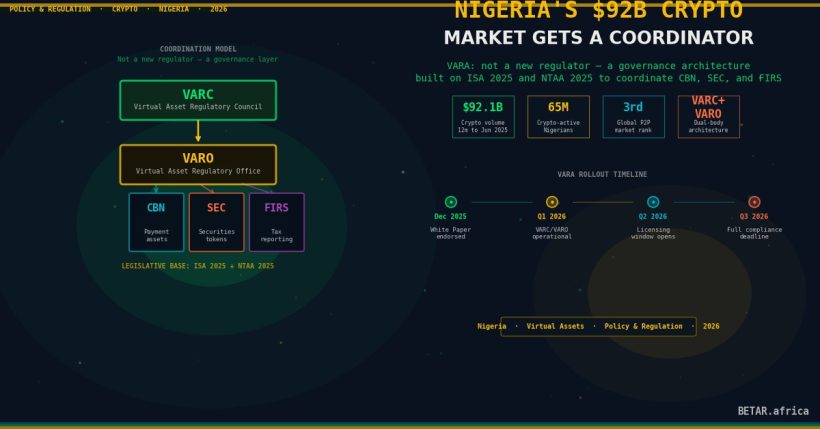
Nigeria processed $92.1 billion in cryptocurrency transactions in the 12 months to June 2025. President Tinubu’s answer to governing that market was not a sweeping new crypto law — it was a coordinating architecture built on top of legislation that already existed.
Africa’s largest crypto market has a new regulatory framework, and it arrived without a single dedicated statute. Nigeria’s Virtual Asset Regulatory Authority (VARA) — formally endorsed by President Bola Ahmed Tinubu in December 2025 via a government White Paper — represents a structural gamble: that Nigeria’s $92.1 billion crypto economy can be governed through institutional coordination rather than legislative novelty.
Whether that gamble succeeds depends on how quickly a dual-headed supervisory model can translate a policy document into operational licensing machinery — while 65 million crypto-active Nigerians and dozens of virtual asset platforms wait for legal certainty.
The Architecture: VARC, VARO, and the Coordination Model
Nigeria’s VARA framework does not create a standalone crypto regulator in the mould of Dubai’s Virtual Asset Regulatory Authority or Singapore’s Monetary Authority. Instead, it establishes two coordinating bodies designed to harmonise the existing mandates of agencies already involved in virtual asset oversight.
The Virtual Asset Regulatory Council (VARC) sits at the strategic apex. It is co-chaired by the Governor of the Central Bank of Nigeria (CBN) and the Executive Chairman of the Federal Inland Revenue Service (FIRS), with representation from the Securities and Exchange Commission (SEC), the Nigerian Financial Intelligence Unit (NFIU), and relevant law enforcement agencies. VARC sets policy, resolves jurisdictional disputes between regulators, and coordinates Nigeria’s international engagement on digital asset governance.
Below VARC sits the Virtual Asset Regulatory Office (VARO), the operational interface for the sector. VARO handles day-to-day supervisory coordination for non-security virtual assets — stablecoins, payment tokens, tokenised deposits, and exchange services that do not involve securities classification. For platforms in this category, VARO is the primary point of regulatory contact.
The architecture deliberately preserves institutional specialisation. Virtual assets classified as securities — those meeting the investment contract criteria under Nigerian law — remain exclusively under the SEC’s existing regulatory purview. The CBN retains oversight of payment-oriented digital assets and banking-related virtual asset services. FIRS governs the tax reporting obligations. VARA does not supersede any of these mandates; it coordinates them.
This is a governance model, not a regulator. And that distinction has significant operational implications for the platforms serving Nigeria’s market.
The Legislative Anchor: ISA 2025 and NTAA 2025
The VARA framework’s authority rests on two statutes passed earlier in 2025, neither of which was a crypto-specific law.
The Investments and Securities Act (ISA) 2025, signed by President Tinubu in February 2025, is the more consequential of the two for the sector’s structural governance. ISA 2025 expanded the statutory definition of “securities” to explicitly include virtual and digital assets, pulling them under the SEC’s regulatory purview for the first time through primary legislation. All Virtual Asset Service Providers (VASPs), Digital Asset Operators (DAOPs), and Digital Asset Exchanges (DAXs) operating in the securities-adjacent segment must now register with the SEC, with a statutory registration fee of ₦30 million.
The Nigeria Tax Administration Act (NTAA) 2025 — effective January 2026 — closed the fiscal loop. Before the NTAA, Nigeria’s crypto market was formally large but informally taxed. The new law changes both the reporting architecture and the enforcement incentive structure.
Under Section 25 of the NTAA, VASPs are now legally required to file monthly transaction-level reports with the Federal Inland Revenue Service. Each report must include the name, address, telephone number, email address, Tax Identification Number (TIN), and National Identification Number (NIN) of individual customers. Platforms are also required to record the nature of service provided, transaction dates, and asset types and values for each trade or transfer.
The penalty structure is unambiguous. Non-compliant platforms face a ₦10 million fine in the first month of default, followed by ₦1 million for every subsequent month, alongside the risk of SEC licence suspension or revocation. Individual users must link all digital asset activity to their TIN and NIN — a mechanism that effectively pulls informal crypto use into the national tax base.
The government has been explicit about its ambition. Monthly reporting requirements will allow FIRS to cross-reference crypto transaction data against personal income tax filings and capital gains disclosures, identifying gaps between reported wealth and digital asset activity. The CBN’s parallel push on AML compliance — including new AI-driven AML baseline standards for Nigerian fintechs — reinforces the surveillance architecture that the NTAA builds at the exchange layer.
The ARIP Pathway: A Sandbox With Teeth
For VASPs seeking SEC registration, the entry route is the Accelerated Regulatory Incubation Program (ARIP). Structured as a regulatory sandbox, ARIP allows platforms to operate under supervised conditions while working toward full SEC authorisation. The model allows the SEC to assess business models, compliance infrastructure, and technical resilience before granting permanent licences — and allows platforms to test market viability before committing to the full cost of institutional compliance.
As of early 2026, the most advanced ARIP participants are Quidax and Busha, both of which received Approval-in-Principle from the SEC in August 2024 — the first crypto exchange licences ever issued in Nigeria. A second cohort includes four digital asset offering platforms and one custodian, alongside five additional VASPs admitted to test specific product models: Trovotech, Wrapped CBDC, HousingExchange.NG, Dream City Capital, and Blockvault Custodian.
The ARIP offers a path. But the compliance cost of full registration — ₦30 million registration fee, independent IT audits, minimum capital requirements, advanced AML monitoring infrastructure — creates a structural filter that advantages well-capitalised platforms over smaller domestic operators. This is a recurring pattern in African VASP licensing frameworks, visible also in Ghana’s 11-firm VASP sandbox and Kenya, where regulatory compliance costs have consolidated market share toward a small number of institutional-scale providers.
What the Market Faces Now
Nigeria’s crypto market is large by any African measure. PwC’s 2025 data puts annual transaction volume at $92.1 billion — nearly triple South Africa’s volumes, the region’s second-largest market. That volume is driven by a specific set of economic conditions: persistent naira depreciation, constrained foreign exchange access for businesses and individuals, high smartphone penetration among a young demographic, and deepening peer-to-peer trading activity that preceded any formal exchange infrastructure.
Stablecoins have become the dominant use case. USDT accounts for the majority of Nigeria’s crypto transaction volume, functioning less as a speculative instrument and more as a dollar-denominated savings vehicle and cross-border payment rail for SMEs locked out of formal FX channels.
The VARA framework does not directly regulate this P2P stablecoin activity at the individual level — but it does place the platforms facilitating it under increasingly granular supervisory obligations. Exchanges, brokers, and wallet providers must now collect and report TIN and NIN data for every user. For platforms serving tens of millions of mostly informal users, KYC compliance at scale is the central operational challenge of 2026.
The tension is structural. Nigeria’s crypto volume is largely a function of formal financial exclusion. Regulatory formalisation — monthly FIRS reporting, identity linkage, licensing requirements — is a legitimate governance objective. But if compliance costs and identity requirements push activity further off-exchange and into unhosted wallets and informal P2P channels, VARA will have formalised an empty market.
The Regional Frame
Nigeria’s VARA framework arrives as West Africa’s regulatory fragmentation deepens. Ghana has its VASP sandbox but no final licensing framework. Senegal and Côte d’Ivoire operate under the BCEAO’s regional framework, which has taken a conservative approach to retail crypto. Nigeria, as the region’s dominant economy and by far its largest crypto market, exerts a gravitational pull on how neighbouring regulators frame their own approaches.
The coordinating model that underpins VARA — anchored in existing legislation, distributed across established agencies, with no standalone crypto law — reflects a deliberate policy choice by an administration that has seen the consequences of premature over-regulation. It also reflects a resource reality: building a functional, well-staffed standalone regulator in Nigeria takes time and institutional capital that the sector cannot wait for.
What the VARA framework offers is legal certainty of a provisional kind. The rules are clear enough to operate within. The licensing pathway exists. The compliance obligations are defined. What remains is the harder work of building a supervisory institution that can enforce those rules consistently — and win the trust of a market that spent the better part of five years operating without any regulatory framework at all.
BETAR.africa covers African technology regulation, fintech infrastructure, and the policy environment shaping digital economies across 54 countries.
Sources:
- Nigeria processed $92.1 billion in crypto transactions — PricewaterhouseCoopers, Africa Crypto Report 2025; covered by Nigeria Communications Week (nigeriacommunicationsweek.com.ng) and BusinessAM Live, October 2025.
- VARA White Paper endorsed December 2025 — Office of the President, Federal Republic of Nigeria; covered by Bitcoin.com News, BusinessDay NG, TechCabal, February 2026.
- VARC co-chaired by CBN Governor and FIRS Executive Chairman — VARA White Paper structural summary; covered by BusinessDay NG, “FG establishes council to coordinate virtual assets regulation,” March 2026.
- ISA 2025 expanded definition of securities to include digital assets — Investments and Securities Act 2025 (signed February 2025); legal analysis by Aluko & Oyebode, ISA 2025 and NTAA 2025: Further Developments in the Regulatory Oversight of Virtual Assets (aluko-oyebode.com, 2025).
- NTAA 2025 monthly FIRS reporting obligations and ₦10M fines — Nigeria Tax Administration Act 2025 (Section 25); covered by TechCabal, “Dodging taxes could cost crypto startups their licences and ₦10m fines” (September 2025); and Enat Digital analysis (January 2026).
- Quidax and Busha Approval-in-Principle, August 2024 — SEC Nigeria press release, August 2024; covered by Techpoint Africa and Punch NG; ARIP details available at sec.gov.ng.
- Tinubu’s no-new-law position — TechCabal, “Tinubu signals cautious path on virtual asset regulation” (February 2026); Bitcoin.com News coverage of December 2025 White Paper announcement.


 UphivaBETAR