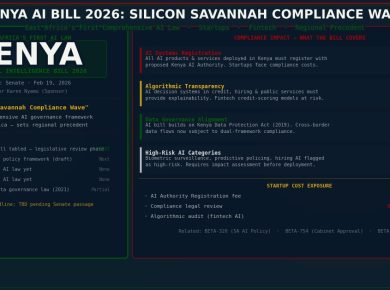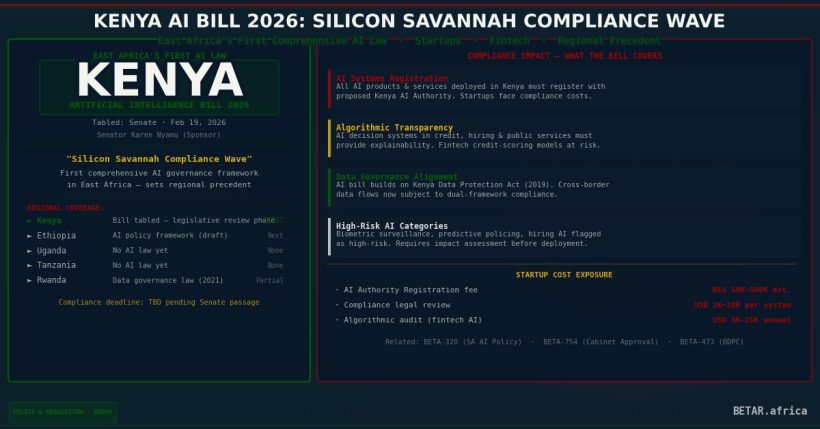

Kenya has become the first East African country to table comprehensive artificial intelligence legislation, with the Artificial Intelligence Bill 2026 introduced in the Senate in February by nominated Senator Karen Nyamu. The bill establishes a three-tier regulatory architecture — an AI Commissioner, an AI Authority, and an AI Advisory Council — and introduces criminal penalties that will reshape how technology companies, fintech startups, and public institutions deploy AI systems across the country.
The legislation marks a decisive shift in African AI governance. Where South Africa embedded its AI policy within data protection frameworks, Kenya is building a standalone AI regulatory body with enforcement teeth. The divergence matters for every company building AI products across both markets.
What the Bill Does
The Artificial Intelligence Bill 2026 classifies AI systems by risk level and assigns proportionate oversight requirements to each tier. High-risk systems — defined as those operating in healthcare, finance, education, and public administration — face the most stringent requirements, including mandatory pre-deployment registration, ongoing audits, and disclosure of how the system works.
The governance structure is deliberately multi-layered. The Office of the AI Commissioner, appointed by the President and approved by Parliament, holds enforcement power: it can investigate complaints, inspect AI systems, summon individuals, and access records. The Artificial Intelligence Authority sits above the Commissioner as the strategic body responsible for Kenya’s national AI strategy, research promotion, and technical and ethical standards. An AI Advisory Council of independent experts provides consultative guidance on emerging global AI trends.
For businesses operating AI in Kenya, the practical implications break down along sector lines.
Fintech and digital lending: M-Pesa’s credit-scoring algorithms, digital lenders’ risk models, and KYC automation systems almost certainly qualify as high-risk under the bill’s definition. That means registration with the AI Commissioner, algorithmic transparency disclosures, and audit exposure before and after deployment. For the dozens of fintechs operating automated credit decisioning in Kenya, the compliance cost is non-trivial.
Healthcare AI: Diagnostic tools, patient triage systems, and any AI application that influences clinical decisions would require pre-approval. This places a compliance burden on a sector that has seen rapid AI adoption, from malaria detection models to maternal health screening tools.
Public sector AI: Government procurement of AI systems — including surveillance infrastructure — will require registration and risk assessment. This matters for ongoing deployments across security, welfare, and identity systems.
The Penalties Are Serious
The bill proposes fines of up to KSh 5 million (approximately USD 38,700) and prison sentences of up to three years for developing, deploying, or operating a high-risk AI system without AI Commissioner approval. A separate provision targets harmful AI-generated content — deepfakes, digital impersonation, and AI-generated misinformation — with fines of up to KSh 5 million and up to two years imprisonment.
The deepfake provision carries particular political weight. Senator Nyamu, who sponsored the bill, introduced the legislation after AI-manipulated images of her circulated online. The criminal provision for digital impersonation — covering AI-generated content that uses a person’s image, voice, or likeness without consent where it causes harm, defamation, or misinformation — is one of the most expansive such clauses in any African jurisdiction.
For media organisations, content platforms, and marketing agencies operating in Kenya, this creates legal exposure that does not currently exist elsewhere in the region.
The Sandbox Concession
Recognising the risk that criminal liability could chill innovation in a market sometimes called Africa’s Silicon Savannah, the bill introduces regulatory sandboxes. Startups and developers can apply to test AI products in a controlled environment under AI Authority supervision, with relaxed compliance requirements during the testing phase.
The sandbox mechanism mirrors precedents in Kenya’s fintech sector, where the Central Bank of Kenya’s regulatory sandbox has been credited with enabling the growth of mobile lending and payment innovation since 2019. Whether the AI sandbox delivers equivalent results will depend significantly on implementation: approval timelines, eligibility criteria, and the size of the compliance reprieve during testing.
Critics, including commentary published in HapaKenya, argue that the bill’s criminal liability framework creates a chilling effect beyond what sandboxes can offset — particularly for foreign AI developers considering Kenya as a deployment market. The right to explanation and human review, while progressive, adds operational overhead that scales with user volume.
Kenya vs South Africa: Two Models
The Kenya bill crystallises an emerging divide in how African governments are approaching AI regulation.
| Dimension | Kenya AI Bill 2026 | South Africa AI Policy 2026 |
|---|---|---|
| Regulatory model | Standalone AI Commissioner + Authority | Embedded in existing data protection frameworks |
| Enforcement body | New Office of AI Commissioner | POPIA/FSCA extended mandates |
| Risk classification | Mandatory, pre-deployment | Risk-referenced, sector-by-sector |
| Criminal liability | Yes — fines + imprisonment | No criminal penalties in current draft |
| Sandboxes | Statutory provision in bill | Ad hoc, sector-specific |
| Timeline | Bill under Senate debate | Cabinet approval pending |
South Africa’s approach prioritises regulatory continuity — layering AI requirements onto an existing enforcement infrastructure rather than building a new regulator from scratch. Kenya’s model creates a dedicated institution with a clear mandate but also a new compliance layer that did not previously exist.
Neither approach is definitively superior. South Africa’s embedded model carries lower implementation risk and faster rollout; Kenya’s standalone model offers greater regulatory clarity and a single point of accountability. For businesses operating across both markets, the divergence means two distinct compliance regimes with no mutual recognition framework currently in sight.
East Africa Regional Ripple
Kenya’s move is likely to accelerate AI governance conversations in neighbouring jurisdictions. Uganda has no AI-specific legislation. Tanzania has an embryonic digital economy policy framework. Rwanda, which has positioned itself as a regional innovation hub, has taken a lighter-touch approach emphasising investment attraction over pre-deployment controls.
The EAC’s 2026 digital trade agenda has not yet addressed AI regulatory harmonisation. That gap is likely to widen if Kenya passes its bill while neighbours hold back — creating a de facto regulatory border within what is supposed to be a single digital market.
For companies scaling AI-powered services from Nairobi into the wider East African region, the Kenya bill creates the first compliance baseline. Whether it becomes the regional template or a market-distorting outlier depends on how swiftly neighbours respond.
What Happens Next
The bill is currently in Senate committee stage following its February 2026 introduction. There is no definitive timeline for passage; Kenya’s legislative process typically involves extended stakeholder consultations, and the AI Authority structure will require budget allocation before operationalisation.
Companies deploying AI in Kenya should monitor three milestones:
1. Senate committee report — likely Q2 2026 — which will reveal whether the criminal liability provisions survive stakeholder lobbying
2. National Assembly referral — if the bill passes Senate, it moves to the National Assembly for a second reading
3. Presidential assent and commencement date — which will trigger the registration and compliance timelines
The AI Commissioner’s office cannot enforce any provisions until it is formally constituted, which requires presidential appointment and parliamentary approval. Even if the bill passes in mid-2026, implementation lead time is likely to run 12-18 months beyond assent.
For now, the practical advice for AI deployers in Kenya is to begin mapping their systems against the bill’s risk classification framework. Companies that can demonstrate compliance-readiness will be better positioned when enforcement windows open — and better insulated from the reputational risk of being the first enforcement target.
Sources: Kenya Senate Artificial Intelligence Bill 2026 text; Cliffe Dekker Hofmeyr legal alert, March 18, 2026; TechCabal, March 17, 2026; TechWeez, March 17, 2026; HapaKenya analysis, March 16, 2026; iAfrica.com Senate debate coverage
BETAR.africa | Policy & Regulation | Filed March 21, 2026 | ~1,350 words
Related Coverage
Policy & Regulation series: South Africa’s National AI Policy: Cabinet Approval and What It Means for Business | Morocco Digital X.0 AI Governance Framework | Africa’s Developer Stack: How the Compliance Wave Is Finally Giving Local Tools a Market

 UphivaBETAR