
Kenya’s Artificial Intelligence Bill 2026 is not yet law, but the compliance wave it sets in motion has already started. For the 600-plus technology companies operating across Nairobi’s ecosystem — fintech lenders, agri-AI platforms, healthtech firms, public-sector contractors — the question is not whether to prepare but how. A pre-deployment approval requirement, criminal liability for non-compliance, and a three-institution governance structure with overlapping mandates make this the most operationally complex AI law tabled anywhere on the continent.
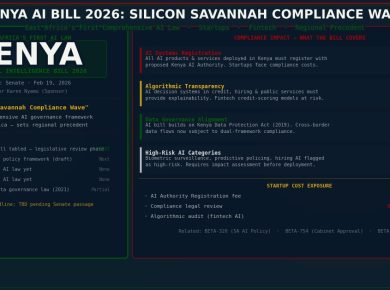
The bill, introduced by nominated Senator Karen Nyamu on February 19, 2026, and currently before the Senate’s ICT and Technology Committee, would establish an Artificial Intelligence Commissioner, an Artificial Intelligence Authority, and an Artificial Intelligence Advisory Council. All three bodies are new. None yet exist. Understanding what each demands of businesses — and when — requires reading the bill not as a policy document but as a compliance architecture.
Who This Bill Catches
The Kenya bill defines “high-risk AI” broadly: systems deployed in healthcare, education, agriculture, finance, security, employment screening, and public administration. In practice, this means that a micro-lender using a credit-scoring model, a school using an AI-powered assessment tool, an agri-platform providing yield predictions to smallholder farmers, or a government contractor running automated permit processing — all fall inside the compliance perimeter the bill establishes.
The threshold is not scale. A seed-stage startup deploying an AI-powered loan product to 200 customers faces the same registration and pre-approval obligations as a Tier 1 bank deploying the same class of system to 200,000. The bill contains no de minimis carve-out, no graduated compliance schedule, and no small-business exemption.
International platforms with active operations in Kenya — including fintech infrastructure providers, cloud AI API vendors, and enterprise SaaS companies — are also captured. The bill’s jurisdictional reach extends to any AI system deployed to users in Kenya, regardless of where the system developer is incorporated.
The Pre-Approval Gate: What It Means for Velocity
The central compliance burden the Kenya bill introduces — which distinguishes it from every other African AI framework currently in force or in draft — is the pre-deployment approval requirement for high-risk AI systems.
Before a high-risk AI system can go live, the developer must apply to the AI Commissioner for registration and approval. The bill does not specify timelines for Commissioner decisions. It does not indicate what the application package must contain beyond “adequate documentation.” And it does not define an appeals process for rejected applications.
This matters operationally. A fintech preparing to launch a new credit product in Q4 2026 cannot currently model how long Commissioner review will take, because that process does not exist yet. Compliance planning for the Kenya bill is being done against an unknown variable — the speed and capacity of an institution that has not yet been built.
South Africa’s draft National AI Policy, by contrast, proposes a sector-specific regulatory approach: the Financial Sector Conduct Authority manages AI in financial services, the Department of Health manages it in healthcare, and so on. There is no single Commissioner, no pre-deployment approval gate, and no cross-sector registration requirement. A Cape Town fintech operating under FSCA oversight will not need separate AI approval; a Nairobi fintech faces a regulatory queue whose length is currently unknowable.
Criminal Liability: The Provision Most Companies Are Underweighting
The Kenya bill attaches criminal liability to non-compliance. Deploying a high-risk AI system without Commissioner approval carries fines of up to KES 5 million — approximately $38,000 at current exchange rates — and up to three years’ imprisonment. Creating harmful AI-generated content — deepfakes, synthetic disinformation — carries separate liability: up to KES 5 million and two years in prison.
Criminal provisions in regulatory legislation are common as deterrents. But the combination of criminal exposure, a vaguely defined trigger (what constitutes “harmful” AI-generated content?), and a novel enforcement institution creates a compliance risk calculus that most legal advisers in Nairobi are still working through. Cliffe Dekker Hofmeyr’s March 18, 2026 analysis of the bill noted: “Questions remain on how the AI Commission will interpret ‘harmful AI-generated content’ in practice, particularly for media companies, marketing agencies, and digital publishers operating in a grey zone between automation and editorial.”
For businesses, the practical implication is this: the bill’s penalties are not administrative fines payable at the company level and absorbed as a compliance cost. They are criminal sanctions with potential personal liability for responsible officers. That changes the risk-management calculus from “what’s our fine exposure?” to “who in our organisation signs off on AI deployment decisions, and are they personally prepared to stand behind those decisions under criminal scrutiny?”
The Open-Source Problem
A significant portion of Nairobi’s AI developer community does not build foundation models from scratch. They take open-source base models — Meta’s Llama, Mistral, Falcon, Google’s Gemma — fine-tune them on local datasets, and deploy them in production. The Kenya bill’s pre-approval regime requires documentation of how an AI system was trained, how its decisions are made explainable, and what data it was trained on.
For a developer using a third-party open-source base model, producing a complete training data audit trail is often structurally impossible. The underlying data provenance is held by the model developer — Meta, Mistral AI — and not disclosed. A startup running a fine-tuned Llama deployment for Swahili-language customer service cannot document what Llama’s pre-training data contained, because that information is proprietary to Meta.
The bill does not address this gap. Neither does any guidance from the institutions the bill would create, because those institutions do not yet exist. This is not a corner case: it describes the technical reality of the majority of AI products being built in Kenya today.
Where the Bill Gets Compliance Right
Despite its compliance burdens, the Kenya bill contains one provision that represents a genuine advance over comparable frameworks: regulatory sandboxes.
The AI Authority would be mandated to establish and manage regulatory sandboxes — controlled environments in which startups can test AI products with relaxed compliance requirements during the testing phase. A company that cannot yet meet the full compliance requirements for a high-risk AI system has a formal legal pathway to operate and iterate while it builds toward compliance.
This matters particularly for early-stage companies. The compliance costs of the Kenya bill — legal advice on system classification, technical documentation for Commissioner applications, potential legal representation during audits — are asymmetric. They are manageable for a Series B company and potentially existential for a seed-stage startup. The sandbox mechanism does not eliminate that asymmetry, but it creates a managed pathway through it.
Nigeria’s National Digital Economy and E-Governance Bill, which passed earlier this year, contains no sandbox equivalent. Neither does South Africa’s current draft. On this dimension — and likely only this dimension — the Kenya bill represents the most startup-progressive AI regulatory architecture proposed on the continent.
What Businesses Should Do Now
The Kenya AI Bill is not yet law. It will go through committee, face amendments, and emerge in a modified form — probably with more guidance on Commissioner application timelines and some narrowing of the criminal liability provisions. But the direction of travel is set, and the compliance lead time for building documentation, governance structures, and application readiness is measured in months, not quarters.
The actionable steps for companies with Kenya operations or user bases:
Classify your AI systems now. Map every AI-enabled product feature against the bill’s high-risk category definitions. Do not wait for implementing regulations — the bill’s category definitions are stable enough to begin classification work. Legal advisory firm HapaKenya’s preliminary guidance suggests classifying in accordance with the EU AI Act’s risk categories as a conservative baseline, since Kenya’s drafters drew on that framework.
Audit your model provenance. For any open-source base model in production, document what you know about its training data — and document the limits of that knowledge explicitly. If a Commissioner audit asks what your system was trained on, “we cannot determine the base model’s training data, and here is why” is a more defensible position than silence.
Assign a responsible officer. Given the criminal liability provisions, companies should designate who is responsible for AI deployment decisions — a Chief AI Officer, Head of Compliance, or equivalent — and ensure that designation is documented. If personal liability follows a deployment decision, the question of who made that decision cannot be ambiguous after the fact.
Engage the sandbox track. Once the AI Authority is constituted and begins accepting sandbox applications, early engagement is likely to confer regulatory relationship advantages — faster review cycles, advance sight of developing standards, and demonstrated good faith during what will be an inherently uncertain early enforcement period.
The Broader Compliance Landscape
Kenya’s bill does not exist in isolation. Nigeria’s AI framework is in force. South Africa’s national AI policy is expected to be gazetted for public consultation this quarter. Rwanda has implemented a fintech-specific AI governance framework. Morocco’s Digital X0 plan includes AI provisions. The emerging patchwork is moving fast, and it is not converging.
For a Nairobi-headquartered company with operations across East Africa, the Kenya bill’s Commissioner-approval model will not map to the regulatory environment in Uganda, Tanzania, or Ethiopia. Country-by-country compliance mapping is now a first-order operational requirement, not a post-launch legal afterthought.
The African Union’s continental AI strategy — developed in partnership with Google and anchored in data protection as the foundational governance layer — may eventually provide harmonisation glue. That timeline is measured in years. In the meantime, the compliance wave the Kenya bill initiates is one that Silicon Savannah’s most sophisticated companies have already begun preparing for, and one that the rest are about to be required to join.
— Policy & Regulation Desk, BETAR.africa

 UphivaBETAR