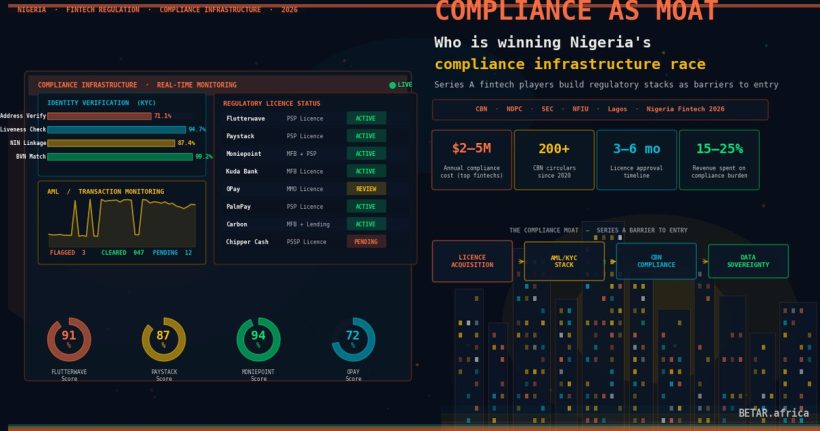

TechCabal ran a piece last week arguing that Nigeria’s next unicorns will be built on regulation. The thesis is correct. But it stops one critical step short. The harder question is not whether regulation creates durable competitive advantage in Nigerian fintech — it clearly does. The harder question is whether the moat protects innovators or gatekeepers.
The distinction matters enormously for where capital should go, and for how Nigeria’s fintech architecture develops over the next five years.
What the Regulatory Cascade Actually Built
The compliance architecture that emerged from Nigeria’s overlapping regulatory mandates between 2020 and 2025 is more structurally significant than most coverage acknowledges. The sequencing matters: FATF grey-listing in 2021 forced the CBN into a mandate-compliance posture that — unexpectedly — became a business logic generator.
NIBSS became the connective tissue. Every licensed payment service provider must integrate with the Nigerian Inter-Bank Settlement System. That integration requirement created an access moat that incumbents accumulated as a structural advantage. Fintechs that built direct NIBSS connections before the 2022 licensing consolidation round now hold infrastructure no new entrant can replicate on comparable terms or timelines.
Layered on top: the CBN’s AI-driven AML baseline standards, published in late 2025, set transaction monitoring requirements that are technically expensive to satisfy. For operators with existing compliance stacks — Moniepoint, Paystack’s parent Stripe, Flutterwave — the incremental cost of meeting the new standards is manageable. For a Series A fintech building from a blank sheet, those same standards represent a capital barrier that shapes what is fundable.
The NDPC’s Compliance Audit Requirements, with their March 2026 deadline, added a data-layer obligation on top of the financial compliance stack. The FCCPC’s digital markets inquiry has put consumer protection obligations into the mix. Each mandate, individually, is justifiable. Cumulatively, they compound into an architecture that rewards incumbents with existing compliance infrastructure disproportionately.
The Capital Flows Argument
FATF grey-listing created two distinct effects on capital flows that analysts tend to conflate. The first was negative: international institutional capital became harder to access for Nigerian fintechs during the grey-listing period, as compliance officers at European and American LPs flagged Nigeria’s risk classification. This is the effect that received the most coverage.
The second effect was less visible but more durable: grey-listing forced the CBN to demonstrate credible regulatory capacity. The AML/CFT improvements the CBN implemented to exit the grey list — Nigeria was removed in 2023 — were not performative. They required genuine institutional investment in supervisory capability. A CBN that can credibly supervise at that level is a CBN whose mandates carry enforcement weight.
That credibility is what makes the compliance moat meaningful for investors. A regulation that will not be enforced is not a moat — it is a compliance cost waiting to be arbitraged. A regulation backed by supervisory credibility is a structural entry barrier. International investors assessing Nigerian fintech opportunities now price CBN enforcement credibility as a positive factor in incumbent valuations, not a risk discount.
The Developer Stack Consequence
The compliance architecture has a downstream effect on Nigeria’s developer ecosystem that is underappreciated. Local developer tools are winning on compliance-critical functions because international alternatives do not carry the necessary Nigerian regulatory integrations out of the box.
KYC/KYC+ solutions built around BVN verification, NIN integration, and CBN liveness-check requirements have no meaningful international competitor product. The CBN’s March 2026 liveness check mandate for account opening effectively mandated the local tool ecosystem. When the regulator writes rules that reference infrastructure only locally-integrated vendors can access, it creates a software market that is intrinsically local.
The question is whether this dynamic compounds. If CBN’s next compliance mandate — AML AI standards, the next NDPC update — continues to be written in ways that require deep local API integration, the developer stack moat deepens. If Nigeria’s regulatory agenda begins to harmonise with international frameworks in ways that commoditise the compliance layer, the local tool advantage erodes.
Current trajectory: the moat deepens. The CBN is writing rules that reflect Nigerian market specifics, not imported frameworks. That is good for local compliance vendors. Whether it is good for the broader innovation ecosystem is a different question.
The Gatekeeper Counterargument
The version of this argument that TechCabal tells is a story of regulatory moat as competitive advantage — compliance as a startup power-up that well-capitalised incumbents deploy to outrun competitors. It is a compelling narrative for founders who have survived the compliance gauntlet.
But there is a version of the same story with a different protagonist. From the perspective of a seed-stage fintech trying to serve the 50 million Nigerians without a formal bank account, the compliance architecture looks less like a moat and more like a drawbridge. The CBN’s licensing tiers, the NIBSS access requirements, the AML monitoring standards — none of these were designed with micro-fintechs in mind. They were designed for institutions.
The result is a market structure that concentrates fintech innovation at the middle and upper tiers of the income distribution, served by well-capitalised licensed entities, while the bottom of the pyramid remains under-served — not because solutions do not exist, but because the compliance cost of delivering regulated services to that segment is not recoverable at the price points that population can bear.
Nigeria’s next unicorns will likely be compliance-moat incumbents. The more important question is whether Nigeria’s fintech architecture will also produce the next wave of financial inclusion — or whether it will build world-class institutions for the bankable market while leaving the last 50 million behind.
What the Evidence Says
BETAR’s reporting across the CBN compliance stack — the AML AI mandate, BVN phone-lock enforcement, liveness-check requirements, and the CBN-NCC refund framework — points to a consistent pattern: each mandate raises the floor for what it costs to operate a licensed financial service in Nigeria.
That floor is not arbitrary. It reflects real supervisory requirements for a market that has had to prove itself to international financial institutions. The compliance architecture is, in that sense, the correct architecture for the problem Nigeria faced.
The question is what happens next. The same regulatory capacity that produced the compliance moat has the tools to produce a regulatory sandbox tier designed explicitly for inclusion-oriented micro-fintechs. Whether the CBN uses those tools — or whether the compliance architecture calcifies around incumbent interests — will determine whether the next chapter is about unicorns or gatekeepers.
Related: Nigeria Fintech Compliance Moat: How the CBN’s Regulatory Stack Is Reshaping Series A Economics (BETAR, March 2026).
Sources: CBN AML Baseline Standards (2025), NDPC Compliance Audit Requirements (2026), NIBSS annual report, FATF mutual evaluation records.


 UphivaBETAR



 Joseph Busari