
Morocco Gotion: Africa’s First Battery Gigafactory Breaks Ground in Kenitra — What It Means for the Continent
The Gotion High-Tech gigafactory in Morocco’s Kenitra Atlantic Free Zone has broken ground — making Africa’s first utility-scale battery manufacturing facility a construction reality rather than a planning announcement. The milestone is genuine. Understanding what it does and does not represent for Africa’s industrial future requires getting past the headline.
The groundbreaking ceremony at the Gotion High-Tech battery gigafactory in Kenitra, Morocco has been described by the Moroccan government, Chinese state media, and international technology press as a historic moment for African industrialisation. That description is accurate. It is also incomplete.
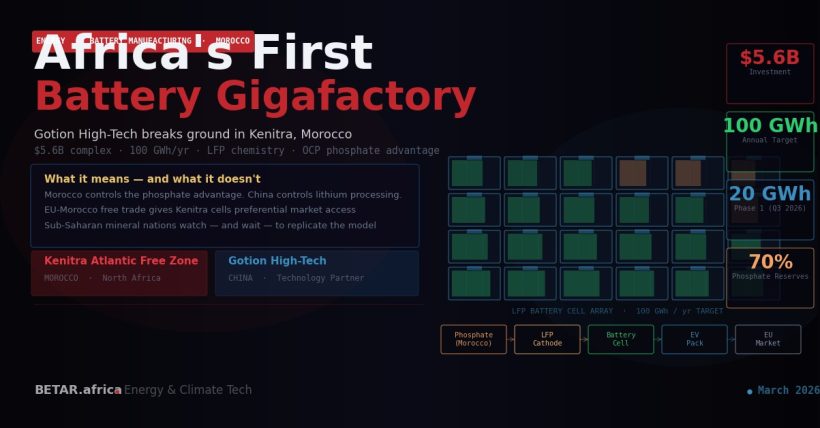
What broke ground in Kenitra is a $5.6 billion manufacturing complex designed to produce lithium iron phosphate battery cells at a rated capacity of 100 gigawatt-hours per year at full build-out — a volume that would make it one of the ten largest battery manufacturing facilities in the world by output. The first phase, targeting 20 gigawatt-hours of annual production, is scheduled for commercial operation in the third quarter of 2026. At that point, Africa will for the first time have a battery cell manufactured on its own soil.
For a continent that supplies a substantial fraction of the world’s battery minerals — cobalt from the Democratic Republic of Congo, lithium from Zimbabwe, copper from Zambia — and has watched the processing and manufacturing value of those minerals flow to China, Europe, and North America, the Kenitra groundbreaking is a data point in an argument that has been building for a decade: that value addition can happen in Africa, and that the continent need not remain permanently at the extractive end of global industrial supply chains.
The argument is stronger than the data point, however. Understanding what Kenitra means requires being precise about what kind of industrial milestone it actually is.
The Phosphate Advantage — and Its Limits
Morocco’s claim to the Gotion investment rests significantly on its phosphate resources. The country holds approximately 70 per cent of the world’s known phosphate rock reserves, according to the United States Geological Survey’s 2025 Mineral Commodity Summaries. Office Chérifien des Phosphates (OCP Group), the state-owned phosphate company, is the world’s largest phosphate exporter and has been actively repositioning itself as a battery supply chain player since 2023.
Gotion’s choice of lithium iron phosphate chemistry — LFP, the battery technology that does not use cobalt — makes Morocco’s phosphate advantage more than notional. LFP cathode production requires phosphoric acid as a critical intermediate, and Morocco can supply that intermediate locally. OCP has announced partnerships with Chinese battery material manufacturers to develop cathode precursor production at its Jorf Lasfar industrial complex, creating the prospect of a Moroccan phosphate-to-cathode-to-cell supply chain that would give the Kenitra facility a genuine local input advantage for its primary cathode material.
The limits of that advantage are real. LFP chemistry still requires lithium — and Morocco has no lithium of significance. The battery-grade lithium carbonate and hydroxide that Kenitra will consume will travel from Australian mines and Chilean brines through Chinese processing intermediaries before arriving at the factory gate. Morocco controls one critical input; China controls the processing of the other.
The groundbreaking therefore marks the opening of Africa’s first battery cell plant — not Africa’s first battery supply chain. The distinction matters for how the continent’s mining states should think about their own positions.
The EU Trade Architecture
Morocco’s deepest advantage over alternative African manufacturing locations is not mineralogical. It is legal and geographic. The Morocco-EU Association Agreement, in force since 2000 and deepened through multiple subsequent protocols, gives Moroccan industrial exports tariff-free access to European markets. As the EU’s Carbon Border Adjustment Mechanism comes into full force and its Battery Regulation creates supply chain documentation requirements for batteries sold in Europe, the regulatory pressure on European automakers to source locally-adjacent battery inputs is intensifying.
Kenitra’s Gotion facility is not incidentally located near Stellantis’s Kenitra plant and Renault’s Tanger-Med facility. It is located there because it is supplying customers who are already in Morocco. The EU trade architecture makes Morocco a manufacturing location that is, for regulatory purposes, almost equivalent to southern Europe — and substantially more competitive on labour and land costs. No other African country has that equivalence.
The EU Battery Regulation’s supply chain due diligence requirements — which from 2027 will require batteries sold in the EU to carry documentation of their carbon footprint, recycled content, and supply chain human rights compliance — create further structural advantages for Morocco-manufactured batteries. Batteries whose entire manufacturing journey can be documented within the Morocco-EU trade zone are substantially easier to certify than batteries whose components pass through multiple third-country processing intermediaries. The regulatory advantage reinforces the tariff advantage.
What Broke Ground, and What Comes Next
The Kenitra groundbreaking initiates a construction programme that Gotion and the Moroccan government project at approximately 30 months to Phase 1 completion. The factory’s design — a series of interconnected production halls with an integrated cathode materials processing facility — has been through the standard Moroccan environmental impact assessment process under the Atlantic Free Zone’s single-window approval system.
Employment projections associated with Phase 1 stand at approximately 2,500 direct jobs, with an additional 8,000 to 12,000 indirect jobs in the supply chain and support services — figures that Moroccan government communications have emphasised heavily. The battery manufacturing workforce requires technical training that is not currently available in Morocco at the relevant scale: cell assembly, quality control, electrochemical testing, and battery management system integration are specialist skills. Gotion has announced a partnership with Mohammed VI Polytechnic University to develop training programmes, but the speed at which a qualified manufacturing workforce can be developed will be a constraint on the factory’s ramp-up.
The Moroccan Agency for Solar Energy (MASEN) has confirmed that the Kenitra factory will source a portion of its operating power from renewable energy under a power purchase agreement — part of the site’s ESG positioning for European customers who require carbon documentation. The full renewable energy supply will not be available at Phase 1 opening, with conventional grid power supplementing renewable supply during the initial operating period.
What DRC, Zimbabwe, and Zambia Should Take From This
The Kenitra groundbreaking will be cited, in Kinshasa, Harare, and Lusaka, as evidence that Africa can manufacture batteries — and therefore as an argument for why mineral-rich African states should develop their own downstream processing and manufacturing capacity. That argument is correct in direction, but the Kenitra model does not directly transfer.
Morocco built the conditions for this investment over a decade: the Stellantis and Renault assembly plants came before the battery factory; the renewable energy infrastructure was built before the Chinese manufacturer committed; the Atlantic Free Zone legal framework was operating for years before the Gotion announcement. The gigafactory arrived at the end of a deliberate industrial strategy, not as its beginning.
DRC, Zimbabwe, and Zambia have mineral endowments that Morocco lacks — cobalt, lithium, and copper that are directly relevant to the battery value chain. But mineral endowment is necessary and not sufficient. Power infrastructure capable of supporting energy-intensive manufacturing, a bilateral trade agreement that creates demand-side pull for locally manufactured products, a logistics network connecting manufacturing sites to export markets, and a sovereign risk profile that enables long-tenor project finance at competitive rates — those are the conditions that Morocco assembled and that the mineral-rich states have not.
The Kenitra groundbreaking is a milestone for Morocco. For the continent, it is a challenge: to build the non-mineral conditions that attracted this investment, while the battery manufacturing investment cycle is still in its acceleration phase and before the European and North African manufacturing base locks in the supply chain relationships that will define the sector for the next thirty years.
The window is open. It will not stay open indefinitely. Africa’s response to Kenitra is what will determine whether the continent captures the manufacturing value of its own minerals — or watches that value travel to Morocco, and to Europe, and to China, as it has always done.


 UphivaBETAR