
In April 2022, the Central Bank of Nigeria directed Access Bank to freeze all accounts connected to Flutterwave’s payment operations pending an investigation into alleged money laundering. No charges were filed. The accounts were eventually unfrozen. Flutterwave survived. But the episode revealed something the company — and the broader Nigerian fintech industry — could not unfind: when your settlement rails run entirely through a licensed deposit money bank, that bank has the power to switch them off.
Four years later, Flutterwave has a microfinance bank licence of its own.
The Central Bank of Nigeria confirmed Flutterwave’s MFB approval this week, making Nigeria’s most valuable privately-held fintech the latest payment aggregator to graduate into the licensed deposit-taking tier. It is a significant structural move — and not primarily because of what Flutterwave can now do. It is significant because of what Flutterwave no longer needs to depend on others for.
What the Licence Actually Unlocks
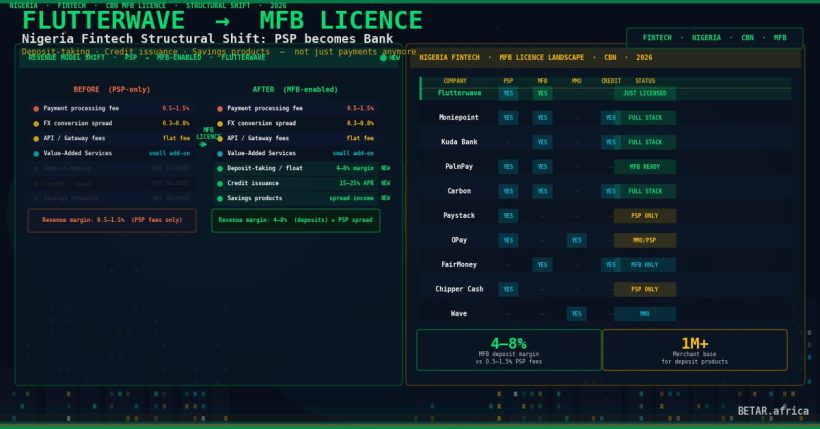
An MFB licence under the CBN framework is not a commercial bank charter. It does not give Flutterwave access to the interbank lending market, the ability to issue dollar-denominated products, or the full liquidity infrastructure of a tier-one DMB. But it gives Flutterwave three capabilities that payment service providers operating purely on agency arrangements cannot access: the right to take deposits in its own name, the right to originate loans, and — most consequentially for its core business — the ability to settle transactions on its own books without routing every naira through a correspondent bank account.
For a company processing several billion dollars in payment volume annually, the last point is not marginal. Settlement float held in a correspondent bank’s account is float that Flutterwave earns no yield on, float that can be frozen pending a regulatory dispute with a third party, and float that represents a dependency Flutterwave cannot operationally hedge without its own licence. The 2022 Access Bank episode made that dependency visible. The MFB licence removes it.
The Competitive Map Has Shifted
Flutterwave’s MFB approval draws a sharper line through Nigeria’s payment aggregator landscape than any previous licence cycle has.
Two of Flutterwave’s largest domestic competitors — Opay and Moniepoint — already hold MFB licences and have had them long enough to build product layers on top: Opay’s wallet is deposit-backed, Moniepoint’s merchant lending product is funded from its MFB balance sheet. Both companies have used their licences not just to reduce bank-partner dependency but to generate new revenue lines that Flutterwave, operating purely as a PSP, could not offer.
Paystack — acquired by Stripe in 2020 for a reported $200 million — does not hold an MFB licence. Its business model is built around payment processing for merchants, with Stripe’s global infrastructure as its primary structural advantage. For Paystack, the competitive implications of Flutterwave’s MFB approval are second-order: Paystack does not compete aggressively in the merchant deposit or SME lending market. But as Flutterwave builds out its MFB capabilities, the product differentiation between a pure payment aggregator and a full payment infrastructure company will widen, and that gap will press Paystack toward a similar licensing decision or an acceptance of a more narrowly defined market position.
For the mid-tier Nigerian payment companies operating below the Flutterwave-Opay-Moniepoint tier — Paga, Baxi, TeamApt-affiliated operators — the approval raises the compliance bar and the licensing aspiration simultaneously. The message from Abuja is consistent: at scale, operating as an unbanked PSP is a transitional structure, not a permanent business model.
The Broader MFB Wave and What Drives It
Flutterwave’s licence is not an isolated decision. It is part of a pattern.
The incentive structure for large fintechs to acquire MFB licences has been building for three years, driven by two parallel forces. The first is regulatory: as BETAR documented in its analysis of the Q1 2026 CBN compliance wave, the CBN has systematically imported bank-equivalent standards into the fintech operating environment — AI/AML mandates, BVN phone-lock requirements, VASP registration frameworks. For companies already absorbing bank-grade compliance costs, the marginal cost of holding a bank-grade licence is declining. If you are paying for the compliance infrastructure, you may as well hold the licence that captures the commercial benefits.
The second force is the partner-bank risk calculation. The Access Bank episode was the most prominent example of a fintech experiencing acute disruption from its banking relationships, but it was not the only one. Nigerian payment companies have navigated account freezes, settlement delays, and correspondent bank de-risking decisions throughout the 2020-2026 period. The MFB licence is, in part, a hedge against a counterparty whose regulatory exposure is not within the fintech’s control.
Flutterwave was named earlier this month as one of six VASPs placed under CBN AML supervision pilot monitoring, with monthly reporting requirements and a Travel Rule readiness obligation. That designation, while framed as regulatory recognition of systemic significance, also carries compliance overhead. Holding its own MFB licence gives Flutterwave a cleaner regulatory relationship with the CBN — one principal-to-principal relationship rather than a fintech licence mediated through a partner bank’s CBN standing.
What Follows
The immediate effect of the licence is operational: Flutterwave’s treasury function simplifies, its settlement infrastructure gains resilience, and its product team now has a lending and deposit mandate to design around. Whether and how quickly Flutterwave moves to activate lending products — the highest-margin MFB capability — will be the performance indicator to watch in the next 18 months.
The second-order effect is competitive signalling. Analysts tracking the Nigerian fintech market have argued for two years that the consolidation dynamic in payments would ultimately be driven not by acquisition but by licence differentiation — that the companies able to operate across the full financial services stack would structurally outcompete those limited to a single activity. Flutterwave’s MFB approval confirms that thesis as company strategy, not just market theory.
The question now is which payment aggregators follow, and on what timeline. The CBN has not closed the MFB licensing window, and the business case for large PSPs to pursue similar approval has only strengthened as compliance costs have risen. If two or three more significant payment companies secure MFB licences before the end of 2026, the Nigerian fintech sector will have undergone a structural reorganisation that no single funding round or acquisition could have achieved: the normalisation of a bank licence as the floor-level operating credential for a serious payments business.
Four years after Access Bank reminded Flutterwave who controlled the settlement account, Flutterwave has its own.
— Business Desk, BETAR.africa


 UphivaBETAR


