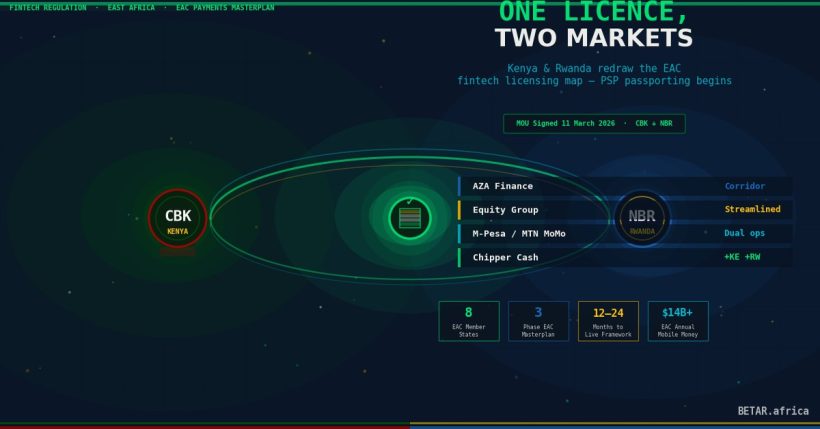

The Central Bank of Kenya and National Bank of Rwanda signed a landmark agreement on March 11 to build a mutual recognition framework for payment service providers — the first concrete step in a five-year plan to integrate East Africa’s fragmented payments landscape.
A payment company operating across the Kenya-Rwanda corridor today faces a familiar obstacle: duplicate licensing processes, separate compliance teams in each jurisdiction, and months of regulatory lag before a single product can go live in both markets. As of this week, the region’s two most fintech-forward central banks have committed to ending that friction.
On March 11, 2026, the Central Bank of Kenya (CBK) and the National Bank of Rwanda (NBR) signed a Memorandum of Understanding to develop a Licence Passporting Framework for Payment Service Providers (PSPs) — a system under which a PSP fully licensed in one country could gain operational recognition in the other without a full re-licensing process.
The MOU is the first bilateral initiative to emerge from the EAC Cross-Border Payment System Masterplan, a regional blueprint approved by the East African Community’s Monetary Affairs Committee in May 2025.
What Passporting Actually Means
Licence passporting is a well-established concept in financial regulation, most associated with the European Union’s single passport for banks and investment firms. The principle is simple: a rigorous licence from a trusted home regulator should be accepted — or at least fast-tracked — by a host regulator, rather than triggering a full parallel review.
The Kenya-Rwanda framework is not yet a full passport. The MOU commits both central banks to developing a mutual recognition regime — meaning they will recognise each other’s licensing standards as broadly equivalent and build an administrative pathway for certified PSPs to expand under a lighter-touch approval process. Both the CBK and NBR retain independent supervisory authority over operations within their respective jurisdictions.
A joint technical committee will develop the specific technical and administrative mechanisms. Implementation timelines have not been published. Based on the technical committee’s mandate — establishing compatible licensing standards across two distinct regulatory frameworks — and comparable regional integration timelines in Southern and West Africa, a live framework is realistically 12–24 months away.
The Business Case
The regulatory friction the MOU targets is real and quantifiable. For a fintech firm seeking to operate in both Kenya and Rwanda today, the compliance burden includes separate capital requirements and reserve structures under each regime, parallel applications to the CBK and NBR that can each take three to six months, country-specific AML/CFT reporting infrastructure, and in-country presence requirements in each market.
For companies like Chipper Cash, Nala, and pan-African fintechs such as AZA Finance — which target the Kenya-Rwanda corridor as a core expansion path — this duplicated overhead adds both cost and time-to-market delay. The MOU signals that this will change.
For larger incumbent players, the implications are equally significant. Equity Group’s pan-African banking arm, I&M Group, and bank-led mobile wallets already operating across both markets would benefit from streamlined regulatory reporting and potentially harmonised compliance standards.
M-Pesa’s cross-border play is a particular case to watch. Safaricom and MTN Mobile Money Rwanda already offer cross-border transfer capabilities at the product level; a passporting framework would allow them to formalise their regulatory posture in each market without maintaining two full licensing structures.
First Step in a Bigger Blueprint
The EAC Masterplan lays out a three-phase roadmap that makes this week’s MOU look modest by design. Phase one — short-term, one to two years — focuses on regulatory harmonisation and foundational infrastructure upgrades. Phase two — three to five years — targets full interoperability of all partner states’ payment systems. Phase three, beyond five years, envisions deeper integration including the exploration of Central Bank Digital Currencies for intra-regional settlement.
The Kenya-Rwanda bilateral is a phase one deliverable. The EAC bloc currently comprises eight member states — Kenya, Rwanda, Tanzania, Uganda, the Democratic Republic of Congo, Somalia, Burundi, and South Sudan — and the Masterplan’s ambition is to bring all of them onto a unified payments architecture. But the regional track record on such integration is cautious: the EAC Payments System (EAPS) has existed for years without achieving the network effects of comparable ECOWAS or SADC infrastructure.
The bilateral-first approach — start with the two markets most aligned on digital financial regulation, prove the model, then expand — is a deliberate sequencing strategy. CBK Governor Kamau Thugge and NBR Governor John Rwangombwa both characterised the agreement as a template for broader regional rollout, per the joint CBK-NBR press release issued on March 11, 2026.
How East Africa Compares
The EAC has historically lagged peer regional blocs on payments integration, a gap the Masterplan was designed to close.
In West Africa, the BCEAO’s interoperability platform links all mobile wallets and banks across the eight WAEMU countries in real time, enabling instant bank-to-wallet and wallet-to-wallet transfers across borders. The single FCFA currency eliminates exchange rate friction entirely for WAEMU members.
In Southern Africa, the SADC-RTGS links eight countries — South Africa, Namibia, Eswatini, Lesotho, Malawi, Tanzania, Zambia, and Zimbabwe — for high-value settlement.
The EAC, by contrast, has six functioning national currencies (the Kenyan shilling, Ugandan shilling, Rwandan franc, Burundian franc, Tanzanian shilling, and South Sudanese pound — with the DRC franc and Somali shilling effectively displaced by dollar usage in their respective economies), a delayed common currency project, and until now, no functional cross-border licensing architecture. The Kenya-Rwanda MOU is the first structural move to change that.
Regulatory Risk Factors
Several structural challenges will determine whether the framework translates from MOU to operational reality on schedule.
Technical harmonisation costs. Mutual recognition requires both regulators to agree that their respective licensing standards meet a comparable threshold. Kenya’s national payment system framework, anchored in the National Payment System Act 2011 (revised 2024), and Rwanda’s PSP licensing rules under the National Bank of Rwanda Law differ in capital adequacy thresholds, AML reporting frequencies, and consumer redress frameworks. Closing these gaps requires either convergence or explicit carve-outs.
Supervisory capacity. Passporting creates a cross-border supervisory obligation: if an entity passported from Rwanda into Kenya causes consumer harm in Nairobi, the CBK must coordinate with the NBR to take enforcement action. Building the bilateral supervisory protocol is non-trivial.
Scope definition. Not all PSPs are likely to be in scope. The framework will likely initially apply to Tier 1 payment institutions — those with full licences, minimum capital, and clean supervisory track records — rather than smaller fintechs. Clarity on eligibility criteria will be critical for market planning.
What to Watch
The joint technical committee’s first deliverables — expected within six months — will reveal whether this MOU moves faster than its predecessors. Key milestones to track: the publication of draft passporting criteria, a public consultation on harmonised standards, and any announcement of a pilot cohort of companies pre-approved to test the framework.
Broader EAC expansion is also in motion: the EAC has separately begun building a regional instant payment network with a Rwanda-Tanzania pilot, funded in part through the World Bank’s Eastern Africa Regional Digital Integration Project (EARDIP). If Rwanda can simultaneously progress on Kenya-Rwanda passporting and Rwanda-Tanzania instant payments, Kigali’s position as the EAC’s regulatory laboratory — already established through its crypto sandbox and CBDC pilot — will be significantly reinforced.
For the continent at large, the template matters. The African Continental Free Trade Area’s digital trade protocol is still being negotiated, and one of its hardest problems is exactly this: how do national financial regulators extend recognition to each other’s licensed entities without compromising their own supervisory mandates? The Kenya-Rwanda framework, if it works, is a proof of concept that the rest of Africa will be watching.
Kenya’s Office of the Data Protection Commissioner is separately ramping up enforcement against non-compliant data processors — including fintechs operating cross-border. See BETAR’s full analysis of the ODPC enforcement era.
South Africa’s integration of crypto assets into its Currency and Exchanges Act capital flow framework is covered in BETAR’s report on SA CARF and crypto reporting enforcement.


 UphivaBETAR


 Joseph Busari