
COMESA probes Meta over WhatsApp AI lockout across 21 African markets
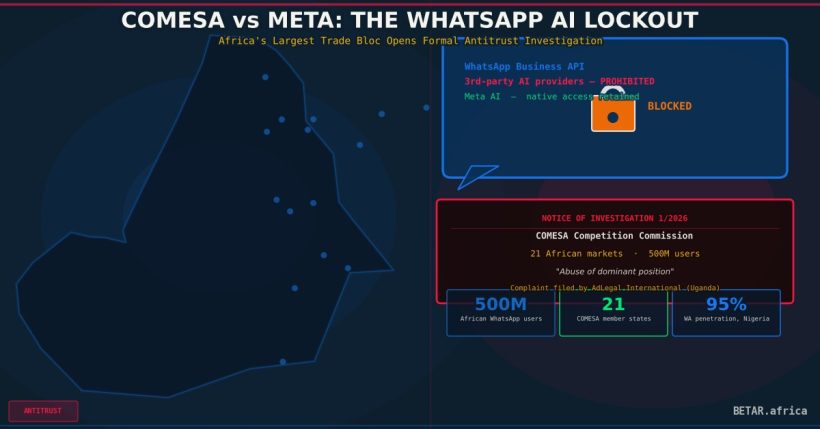
Africa’s largest regional trade bloc has opened a formal antitrust investigation into Meta after October 2025 changes to the WhatsApp Business API effectively locked out third-party AI providers — while Meta’s own assistant retained full access to the platform’s 500 million African users.
The COMESA Competition and Consumer Commission (CCCC) issued Notice of Investigation 1 of 2026 on February 17, 2026, formally opening proceedings against Meta Platforms Ireland Limited over alleged abuse of dominant position across the 21-nation Common Market for Eastern and Southern Africa. The complaint, filed by Ugandan campaign group AdLegal International, alleges that Meta’s amendments to its WhatsApp Business Solution Terms “restrict cross-border provision of digital services within the Common Market and foreclose competition in existing and emerging AI markets.”
At stake is control over the primary digital channel through which hundreds of millions of African consumers, small businesses, and enterprises already conduct commerce — and, increasingly, interact with AI.
What Meta actually changed
On October 15, 2025, Meta amended its WhatsApp Business Platform terms to introduce a categorical prohibition on general-purpose AI providers — defined as services where a large language model is the core product, capable of open-ended conversation on any topic. The ban covers assistants like OpenAI’s ChatGPT, Microsoft Copilot, and Perplexity, all of which had been active on WhatsApp before the change.
The restriction does not prohibit AI entirely. Businesses may still deploy AI as an auxiliary tool within a narrowly scoped customer-service workflow — a bank’s loan-eligibility chatbot, a retailer’s order-tracking assistant. What is forbidden is a general-purpose conversational agent that competes with Meta AI in breadth of capability.
The effective date for new deployments was October 15, 2025. Existing integrations were given until January 15, 2026 to comply — a deadline that has now passed. Microsoft confirmed in November 2025 that Copilot would exit WhatsApp on that date.
Meanwhile, Meta AI — the company’s own general-purpose assistant — is natively embedded across WhatsApp, Instagram, and Messenger, with full access to the platform’s distribution and personalisation infrastructure that third parties cannot match.
The African AI ecosystem caught in the crossfire
Africa’s WhatsApp penetration rates make this structural shift acutely consequential. WhatsApp reaches an estimated 95 percent of Nigerian internet users, 93.9 percent in South Africa, and 91.8 percent in Ghana — figures that no competing channel approaches. For AI startups on the continent, WhatsApp was not one channel among many; it was the market.
Botlhale AI, the Johannesburg-based startup building conversational AI in indigenous African languages — Setswana, IsiZulu, IsiXhosa, Sepedi, and others — is squarely within the category of affected providers. Its voice-enabled chatbots for public services and enterprise clients deploy across WhatsApp, Messenger, and Telegram. The API restriction forces either a product pivot or reliance on Meta’s own AI infrastructure for WhatsApp reach, undermining the independence of African-language AI development.
The impact extends well beyond AI startups. Banks, logistics firms, and informal sector merchants that reduced call-centre costs through automated WhatsApp workflows now face a forced migration decision: rebuild on Meta’s AI stack, or absorb the cost of standalone applications that reach a fraction of the same audience. For startups operating at the margins of Series A viability, neither option is cost-neutral.
“This isn’t just about chatbots,” one Nairobi-based developer community lead noted in a February post that circulated widely in the local tech community. “WhatsApp is the internet for most of our customers. Taking away third-party AI access is taking away our distribution.”
COMESA’s legal theory — and its vulnerabilities
COMESA’s investigation proceeds under Regulation 36 of the COMESA Competition and Consumer Protection Regulations, 2025, adopted by the Council of Ministers in December 2025. The new regulations — the first major overhaul of the bloc’s competition framework since 2004 — introduced explicit “gatekeeper” provisions that prohibit dominant digital platforms from self-preferencing their own products, restricting data portability, or imposing anti-steering conditions on users.
The CCCC’s notice characterises WhatsApp as “a crucial gateway for AI service providers to access their customers in the Common Market” — invoking the essential facilities doctrine, which holds that a dominant firm controlling infrastructure indispensable to competitors cannot exclude those competitors from access without objective justification.
The legal theory is aggressive, and not without challenge. A March 9 analysis published in Truth on the Market by Onyeka Aralu argues that COMESA may be conflating essential-facilities doctrine with the refusal-to-deal doctrine — two distinct legal standards with different evidentiary thresholds. The essential-facilities test requires demonstrating that WhatsApp has no viable substitute for reaching consumers — a high bar that Meta will contest vigorously.
The CCCC’s enforcement track record, while improving, adds further uncertainty. The CAF and beIN Media restrictive-practices case — the first to result in financial penalties, handed down in January 2024 — took multiple years from complaint to decision. The Meta investigation’s stakeholder submission deadline is March 16, 2026. No interim order has been issued.
Meta AI’s Africa strategy — and what the API ban signals
The restriction did not arrive in a vacuum. Meta trialled Meta AI on WhatsApp in South Africa and India in April 2024 before expanding to 60-plus countries and 13-plus languages by late 2025, covering the continent and Middle East. The company has described business messaging as a multi-billion-dollar annual revenue run-rate business growing at double-digit rates. External analysts projected WhatsApp Business revenue at $6–7 billion in 2025.
The API change is structurally consistent with that growth strategy. By defining third-party general-purpose AI as non-compliant, Meta narrows the space of alternatives and positions its own AI as the default intelligent layer for every WhatsApp business interaction — without triggering the costs associated with full vertical integration. Businesses remain free to build on the platform; they are simply no longer free to bring their own brain.
What Europe’s experience suggests for Africa
The COMESA investigation does not exist in isolation. Regulators on three continents have moved against the same October 2025 policy shift:
- Italy (AGCM): An emergency suspension order in December 2025 prompted Meta to suspend the ban in Italy. From February 2026, third-party AI providers can continue using the WhatsApp API in Italy at approximately $0.069 per message (AGCM, February 2026) — a new per-message fee structure created under regulatory pressure.
- European Union: The European Commission issued a formal Statement of Objections on February 9, 2026. Meta reversed the ban across the EU for 12 months under the Digital Markets Act, again with a per-message pricing model.
- Brazil (CADE): An injunction issued January 12, 2026 was overturned on appeal January 23, before Meta later extended the EU arrangement under court order.
- COMESA: Formal investigation opened February 17, 2026. No interim order. Stakeholder deadline March 16, 2026. Outcome timeline unknown.
The EU comparison is the critical reference point. Regulators with mature enforcement infrastructure and credible penalty threat — up to 10 percent of global turnover under the DMA — forced Meta to reverse its policy within months of the original change. COMESA’s maximum penalty is 10 percent of annual turnover within the common market, not global revenue. Meta’s COMESA-region turnover is a fraction of its EU exposure.
If COMESA prevails and secures a comparable concession — access restored at a per-message fee — the economics of that outcome will determine whether African AI startups genuinely benefit. At $0.069 per message, the cost structure for a Nairobi chatbot serving informal sector customers at high message volume may not be viable, even with the channel re-opened. African regulators may need to negotiate not just access, but pricing terms suited to the continent’s market realities.
What happens next
The CCCC stakeholder submission window closes March 16, 2026 — three days from publication of this article. The commission has not announced an expected timeline for a final decision. Under the 2025 regulations, it has powers to issue interim orders and compel document production, but has so far exercised neither in this case.
Meta has not publicly responded to the COMESA investigation. BETAR.africa sought comment from Meta’s Africa communications team; no response was received before publication.
The outcome will be an early stress test of whether Africa’s new generation of digital competition rules — modelled partly on the EU’s DMA gatekeeper framework — can produce timely results against the world’s largest platform companies. For the African AI startups that built their businesses assuming WhatsApp would remain an open channel, the clock has already run out once. They need COMESA to move faster than its history suggests it will.
 UphivaBETAR