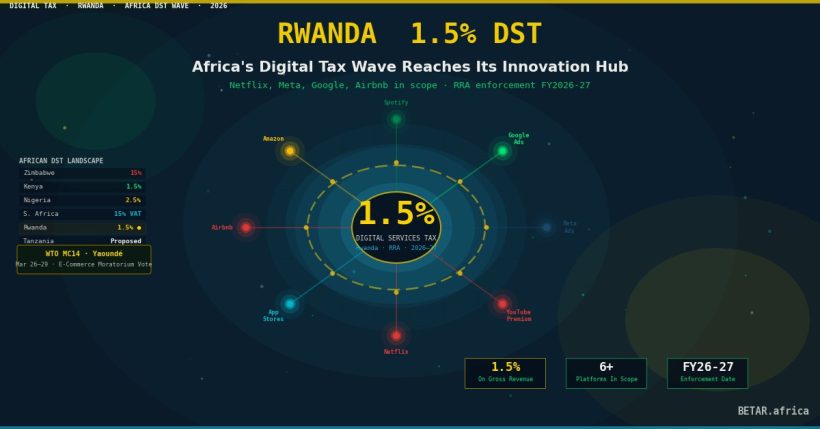

Rwanda has formally gazetted a 1.5% Digital Services Tax targeting foreign digital platforms, with enforcement taking effect in fiscal year 2026–27. The tax covers streaming services, e-commerce platforms, online advertising networks, search engines, and subscription-based digital products — placing Netflix, Amazon, Google, Meta, and Airbnb squarely in scope.
The formalisation of Rwanda’s DST arrives at a particularly charged moment: fourteen days before the WTO Ministerial Conference in Yaoundé, Cameroon (March 26–29), where the fate of the global e-commerce duty moratorium — which has protected digital imports from customs tariffs for 27 years — will be decided. African governments are building their tax frameworks now, regardless of what MC14 decides.
The Tax: Structure and Scope
Rwanda’s Digital Services Tax applies to foreign digital service providers whose platforms generate revenue from Rwandan users, even without a physical presence in the country. The regime mirrors approaches adopted elsewhere on the continent, with some structuring differences:
In-scope services:
- Video and music streaming (Netflix, Spotify, Apple Music, YouTube Premium)
- E-commerce marketplaces (Amazon, Jumia international)
- Online advertising (Google Ads, Meta Ads)
- Search engine monetisation
- App stores and digital subscription platforms
- Accommodation platforms (Airbnb)
Tax rate: 1.5% on gross revenue derived from Rwandan users
Formal gazette: Confirmed. Implementation guidance from the Rwanda Revenue Authority (RRA) expected mid-2026.
Local representative requirement: Foreign platforms without a Rwanda subsidiary may be required to appoint a local tax representative for compliance purposes — a requirement that mirrors Kenya’s DST enforcement model.
Rwanda in the Continental DST Landscape
Rwanda’s 1.5% rate is moderate by African standards. Zimbabwe’s 15% withholding tax on digital services — the steepest on the continent — sits at the extreme end of the range. BETAR.africa has documented the continental spread:
| Country | DST / Digital Tax | Rate | Effective |
|---|---|---|---|
| Zimbabwe | Digital Services Withholding Tax | 15% | 2023 (operational) |
| Nigeria | Value Added Tax on imported digital services (VAID) | 7.5% VAT (6% effective after deductions) | 2022 |
| Kenya | Digital Services Tax | 1.5% gross revenue | 2021 (revised 2024) |
| Rwanda | Digital Services Tax | 1.5% gross revenue | FY 2026–27 |
| South Africa | VAT on foreign digital services | 15% VAT | 2014 (VAT-equivalent) |
| Tanzania | Online Content Regulation Fee + DST | Varies | Operational |
| Ghana | Electronic Transfer Levy (E-Levy) | 1% on digital transfers | 2022 |
| Uganda | Over-The-Top (OTT) Services Tax | USH 200/day per user | 2018 |
Rwanda and Kenya have converged on the same 1.5% gross revenue model — a rate that is politically viable, administratively simple, and less likely to trigger platform market withdrawal than Zimbabwe’s 15%.
The Rwanda Paradox: DST Meets Innovation Hub Ambition
Rwanda occupies an unusual position in the continental tech landscape. Kigali has aggressively positioned itself as Africa’s technology and investment destination — hosting the AU Summit, the World Economic Forum Africa chapter, and attracting a disproportionate share of regional fintech and agritech headquarters for a country of 14 million people.
The DST creates a genuine policy tension. Rwanda’s comparative advantage as an investment destination rests in part on regulatory predictability and a lean tax environment. A DST on foreign platforms is constitutionally unproblematic — Rwanda has full sovereignty over domestic tax policy — but it signals a more assertive fiscal posture toward the global digital economy.
Three readings of the DST’s strategic logic are possible:
- Fiscal diversification: Rwanda imports a large share of its digital services. The DST captures revenue from this structural import pattern — logical tax policy.
- Reciprocity signalling: Rwanda, like other African governments, is making the point that digital trade must be two-directional in fiscal terms. If Silicon Valley platforms earn Rwandan revenue, they contribute to Rwandan public finance.
- Regional convergence: By aligning with Kenya’s 1.5% model, Rwanda creates a de facto East African standard that the EAC could formalise — particularly relevant given the EAC’s active digital harmonisation agenda.
None of these readings is mutually exclusive. All three are likely operating simultaneously in government thinking.
Compliance Implications for Digital Platforms
Platforms with significant Rwanda user bases face immediate compliance questions:
Registration: Foreign digital service providers will likely need to register with the Rwanda Revenue Authority or appoint a local fiscal representative.
Revenue attribution: Gross revenue must be allocated to Rwandan users — typically done by IP address, billing address, or device location data. Platforms with existing VAT/DST compliance systems in other African markets can extend those frameworks to Rwanda.
Invoicing and reporting: Quarterly or annual reporting requirements are expected in the implementation guidance. Platforms should anticipate a June–September 2026 compliance build window before FY 2026–27 enforcement begins.
Audit exposure: Rwanda’s RRA has modernised its audit capabilities significantly since 2022, including data-driven compliance monitoring. Platforms that underreport Rwandan revenue face genuine enforcement risk, unlike some other African DST regimes where enforcement remains weak.
The MC14 Timing: Why This Matters Right Now
Rwanda’s DST formalisation arrives 15 days before MC14 Yaoundé (March 26–29, 2026), where WTO members will vote on whether to extend the e-commerce moratorium that has barred customs duties on digital imports since 1998.
If the moratorium lapses, African governments will be legally entitled to impose customs duties on digital goods for the first time in three decades. Rwanda’s DST is a DST — not a customs duty — but the political logic is the same: African fiscal sovereignty over the digital economy is expanding.
South Africa and India are leading the non-renewal bloc. Nigeria stands to gain approximately $1 billion per year in customs revenue if the moratorium lapses. The DST wave and the MC14 outcome are complementary forces moving in the same direction.
Business Intelligence Summary
| Item | Detail |
|---|---|
| Tax | Digital Services Tax (DST) |
| Rate | 1.5% gross revenue |
| Scope | Foreign digital platforms: streaming, e-commerce, advertising, search, subscription |
| Gazette | Formally gazetted (Rwanda) |
| Effective | FY 2026–27 |
| Implementation guidance | Expected mid-2026 (Rwanda Revenue Authority) |
| Compliance deadline | Before FY 2026–27 start (July 2026) |
| Enforcement body | Rwanda Revenue Authority (RRA) |
| Local representative | May be required for non-resident platforms |
BETAR.africa provides regulatory intelligence for Africa’s technology sector. Policy analysis and business intelligence for operators, investors, and regulators across 54 African nations.


 UphivaBETAR



 Joseph Busari