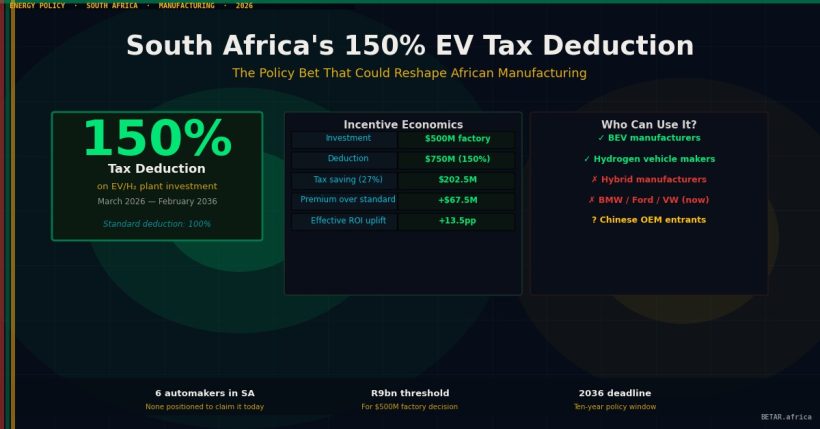

On March 1, 2026, South Africa activated a 150% tax deduction on capital investment in electric and hydrogen vehicle manufacturing — the most generous EV production incentive on the continent. One problem: none of the six major automakers currently operating assembly plants in South Africa are positioned to use it.
BMW’s Rosslyn plant makes the X3, including a plug-in hybrid variant. Ford assembles a hybrid Ranger in Pretoria. Toyota builds the Corolla Cross HEV in Durban. Volkswagen Group Africa’s leadership has stated it will not produce EVs in South Africa until at least 2035. The incentive, signed into law by President Cyril Ramaphosa on December 24, 2024, applies exclusively to battery electric and hydrogen vehicle production — not hybrids. The National Association of Automobile Manufacturers of South Africa (Naamsa) has formally called for the incentive to be extended to hybrid manufacturing upgrades.
The policy is not aimed at the manufacturers South Africa already has. It is aimed at the manufacturers it is trying to attract.
The arithmetic of a $500M bet
The structure of the deduction is straightforward: invest in qualifying plant, machinery, or buildings used to produce EVs or hydrogen vehicles, and deduct 150% of that cost from taxable income. Assets brought into use between March 1, 2026 and February 28, 2036 qualify.
For a manufacturer making a $500 million factory investment decision — roughly R9 billion at current exchange rates — the incentive produces the following:
| Scenario | Investment (R) | Deduction (R) | Tax saved at 27% | Benefit over standard |
|---|---|---|---|---|
| Standard 100% deduction | R9B | R9B | R2.43B | — |
| 150% EV incentive | R9B | R13.5B | R3.65B | +R1.22B (~$64M) |
In practical terms: a Chinese OEM building a greenfield EV assembly plant in Gauteng or the Eastern Cape would pocket an additional $64 million in tax savings over a $500M investment compared to what normal depreciation would deliver. On a R30 billion ($1.6B) factory — the scale Gotion is investing in Morocco — the additional benefit approaches R4 billion.
An anti-abuse provision applies a 50% recoupment if qualifying assets are disposed of within five years, preventing short-term tax arbitrage without genuine production commitment.
The fiscal cost to the South African Treasury is estimated at R500 million in 2026/27. That number will scale with actual investment.


 UphivaBETAR
 Joseph Busari