
Africa Corporate Training Gap: Employers Are Not Investing in the Workforce They Claim to Need
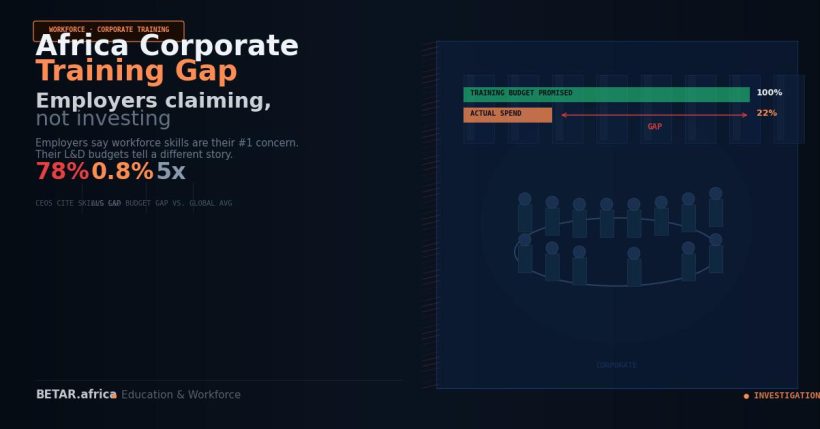
CEOs say the skills crisis is their biggest problem. The data shows most of them are doing almost nothing to fix it.
By the Education Reporter, BETAR.africa
Every year, Africa’s chief executives tell the same story: the continent’s skills crisis is their most pressing operational challenge. Labour is abundant; competent, job-ready labour is scarce. Universities produce graduates who cannot apply what they studied. The skills gap is holding back growth, holding back investment, holding back Africa’s economic potential. The story is told in boardrooms, at investment conferences, in World Economic Forum sessions. It is, broadly speaking, true. What goes largely untold in those same venues is that the private sector is not paying to fix it.
World Bank Enterprise Survey data for sub-Saharan Africa shows that fewer than 12 per cent of firms provide formal training to their workers — against 30 to 40 per cent in OECD economies. The IFC’s enterprise survey data released in the first quarter of 2026, covering manufacturing, banking, and professional services firms across twelve African markets, shows that on-the-job training rates have remained flat over the past decade, even as corporate profits in banking and telecoms hit record levels in 2024 and 2025. Africa’s skills crisis is real. But employers are not only victims of it. They are, in measurable ways, co-creating it.
The Investment That Is Not Happening
The World Bank Enterprise Surveys ask firms directly whether they fund formal employee training programmes. In sub-Saharan Africa, the regional average has never broken 15 per cent in any survey cycle. Among small and medium enterprises — which account for the majority of employment in most African economies — the figure sits closer to 6 to 8 per cent. The large-firm exceptions are concentrated in a specific set of sectors: financial services, telecommunications, and multinational extractives. Remove those three, and African firms’ investment in workforce development is, at the sector-adjusted median, negligible.
The IFC Q1 2026 data adds a damaging context. In Nigeria, manufacturing firms reported spending an average of 0.3 per cent of annual payroll on training. In South Africa, SMEs in business services reported 0.5 per cent. Both figures are well below the 2 to 3 per cent of payroll that international research identifies as the minimum investment required to produce measurable productivity gains from training. African employers are not underspending. They are, for the most part, barely spending at all.
Nigeria: The Levy That Is Being Ignored
Nigeria has had a legal mechanism for compelling employer training investment since 1971. The Industrial Training Fund levies firms with five or more employees at 1 per cent of annual payroll, channels that revenue into training disbursements, and allows firms to reclaim up to 50 per cent of their levy in approved training expenditure. Designed well, it creates an incentive structure: invest in training or lose the levy. In practice, enforcement has been inconsistent enough to render the incentive largely theoretical.
The ITF’s own annual reports show a chronic gap between levy assessment and levy collection. In its 2024 report, the fund estimated that only about 60 per cent of eligible firms were registered with the ITF at all. Of those registered, a significant share were not current on levy payments. Nigeria raised ITF enforcement intensity in January 2026, deploying compliance officers and issuing formal demand notices to multinationals with outstanding assessments — but the fund acknowledges that the legal costs of pursuing non-compliance have historically made enforcement economically unviable for smaller assessments. The levy exists. The compliance architecture to make it effective does not.
South Africa: A Broken Machine
South Africa operates the continent’s most elaborate employer training levy system. The Skills Development Levy mandates a 1 per cent payroll contribution from all employers above a wage threshold, channelled through 21 Sector Education and Training Authorities covering everything from agriculture to financial services. In design, the SETA system is sophisticated: employers contribute, claim back through approved training spend, and SETAs fund learnerships, apprenticeships, and bursaries for their sectors. On paper, it is a multi-billion-rand investment in skills aligned to economic need.
In practice, the SETA system has been in governance crisis for most of the past decade. The Department of Higher Education and Training placed multiple SETAs under administration between 2020 and 2025 for financial mismanagement. The Manufacturing, Engineering and Related Services SETA (merSETA) and the Health and Welfare SETA (HWSETA) both underwent administrations in this period. Funds levied from employers have consistently not reached their intended beneficiaries — skills programmes, apprentices, and workplace training — at the rates the system was designed to deliver. South Africa collects the levy. It does not reliably deploy it.
An employer who claims the system has not served them is not wrong. But the same employer has typically not pushed to fix it. The South African Business Coalition on Health and the Banking Association of South Africa have both engaged on SETA reform over the years. The urgency employers bring to complaining about skills gaps has rarely matched the urgency they bring to demanding functional disbursement of the levies they are already paying.
Kenya: The Mandate Without the Volume
Kenya’s National Industrial Training Authority operates a competency-based training mandate that, from 2026, requires firms in designated sectors to provide structured workplace training to their employees. NITA’s framework is technically sound — it draws on the same competency-based education and training (CBET) model that has produced measurable employment outcomes in Rwanda’s workforce development system. The problem is volume. Kenya’s formal private sector is not large enough, and NITA’s compliance monitoring is not yet resourced enough, to make mandatory workplace training a mass intervention. The mandate is in place. The inspection capacity to enforce it is still being built.
The Outliers: Where Investment Does Work
The broad picture of non-investment has exceptions, and those exceptions are instructive. Standard Bank Group’s workforce development programme, which it expanded across ten African markets between 2020 and 2025, covers technical skills, digital literacy, and leadership development for staff from teller to senior management. The group tracks training investment as a line item in its human capital reporting: in 2024 it spent approximately R1.3 billion (about $70 million) on employee development across the group, and reported a 12 per cent reduction in voluntary attrition among trained cohorts compared to untrained control groups in the same period. “When we stopped treating training as a cost and started treating it as a retention investment, the return became obvious,” said Nomvula Khumalo, Standard Bank’s Group Head of People and Culture, in an interview with BETAR. “We were losing experienced staff to competitors. The training spend cut that loss significantly. The business case is not complicated.”
Standard Bank is the exception because it can measure the outcome. The majority of African employers — particularly SMEs — do not have the human capital infrastructure to track training ROI at Khumalo’s level of granularity. But the evidence that training investment reduces turnover, reduces rehiring costs, and improves productivity is consistent enough across the academic literature and the large-firm evidence base that “we don’t know if it works” is not a credible reason for non-investment at the scale being observed.
The Excuse That Perpetuates the Gap
The logic that large African employers most commonly deploy to explain low training investment runs roughly as follows: graduates arrive without the skills we need; training them is expensive; once trained, they leave for competitors or for a better opportunity abroad; therefore the rational decision is not to invest in training and instead hire the minority of workers who arrive job-ready. The argument has a surface coherence. It is also, in aggregate, self-defeating: if every employer applies this logic simultaneously, the pool of job-ready workers never grows, the skill premium on trained workers rises, the skills complaint intensifies, and the cycle repeats.
CESA 2026–2035 — the African Union’s Continental Education Strategy for the decade — calls explicitly for public-private partnerships on skills development, citing the private sector as a necessary co-investor in workforce capability. The strategy was launched in January 2026 with ministerial endorsement across 40 member states. It does not include a mechanism to compel private sector participation. Whether African employers will choose to show up for the partnership CESA envisions is an open question. The enterprise survey data suggests that, left to voluntary action alone, most of them will not.
The Accountability Gap
Africa’s skills crisis is routinely framed as a supply-side failure: too few good universities, too little TVET capacity, too many graduates trained in the wrong fields. The World Bank Enterprise Survey data and the IFC Q1 2026 findings suggest the demand side of the equation is doing equally little to improve the situation. Fewer than one in eight sub-Saharan African firms invests in formal training. The ITF levy goes underenforced in Nigeria. The SETA system misfires in South Africa. NITA in Kenya is building compliance capacity while the mandate outpaces the infrastructure to implement it.
Africa’s employers complain about the graduates they hire. The data on how much those employers invest in developing their workers says something about whether that complaint is a genuine call for partnership — or an excuse for inaction.
This is Part 3 of a three-part BETAR series on Africa’s workforce accountability gap. Part 1 — on the school-to-work transition failure — is at Africa’s School-to-Work Gap: 60% of Young People Are Being Lost Before They Start. Part 2 — on graduate unemployment and credential inflation — is at Africa Graduate Unemployment Trap: What a University Degree Actually Gets You in 2026.


 UphivaBETAR



 Joseph Busari