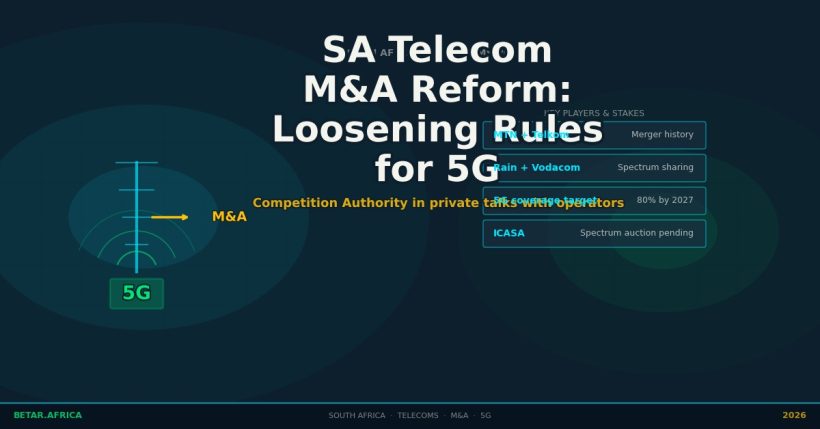

South Africa’s Competition Commission is in private discussions with the country’s major telecommunications operators about relaxing merger and acquisition rules — a quiet regulatory realignment that, if completed, would reshape the country’s broadband landscape and hand MTN a second shot at Telkom.
The talks, first reported by Semafor in March 2026, signal a notable policy pivot. The Competition Commission blocked MTN’s bid to acquire Telkom in 2022 on competition grounds. Now the same authority is exploring whether that framework needs updating for a world where 5G rollout economics are fundamentally different.
The Mupita Argument
MTN Group CEO Ralph Mupita — also current chair of the GSMA — has been the most prominent voice pushing consolidation as infrastructure policy. His argument is not primarily about market share. It is about capital.
Mupita points to Europe, where national regulators forced open markets in the 2000s on competition grounds. The result, he argues, was fragmented operators that underinvested in networks relative to US and Asian peers with more consolidated markets. The UK, Germany and France are now dealing with the downstream consequences: slower 5G deployment speeds and persistent rural coverage gaps.
“You can’t build the infrastructure Africa needs at spectrum-scale investment on the margins of a fragmented market,” Mupita told the GSMA Mobile World Congress in Barcelona in early 2026. “Consolidation is not anti-competitive. Lack of investment is.”
South Africa’s Competition Commission is not yet endorsing that framing. But the decision to open private-track conversations with operators rather than waiting for a formal merger application suggests it is at minimum willing to test the parameters.
Telkom: The Obvious Target
Telkom remains the most strategically significant asset in the equation. MTN’s 2022 acquisition approach failed primarily because the Commission concluded that a merged MTN-Telkom entity would control too much mobile spectrum and fixed-line infrastructure to preserve workable competition.
The competitive landscape has changed since then. Rain has scaled meaningfully in the consumer 5G segment. Vodacom has deepened its fibre-to-the-home footprint. The arrival of Starlink’s direct-to-cell service has introduced a new vector of fixed-wireless competition in peri-urban markets. Telkom’s fibre assets — the part of the business MTN most covets — face more credible challengers than they did in 2022.
Whether that evolution is sufficient to change the Commission’s competition math is the core question the private-track talks are designed to resolve before a formal filing.
Telkom’s board has not commented publicly on renewed consolidation interest. Its most recent earnings signalled stable but pressure-prone margins, particularly in the enterprise segment. A strategic sale remains more attractive to Telkom shareholders than continued standalone operation in an intensifying infrastructure market.
The Regulatory Paradox
The timing creates an interesting policy tension. South Africa is simultaneously tightening competition scrutiny on digital platforms and relaxing it for telecommunications infrastructure. The Competition Commission’s landmark R688 million settlement with Google — mediated through the Media and Digital Platforms Market Inquiry — demonstrated a regulator willing to use structural remedies against concentrated platform power. Elsewhere in the region, COMESA is probing Meta’s WhatsApp API practices on interoperability grounds.
Relaxing merger rules for telecoms while tightening them for platforms is not incoherent — it reflects a specific industrial policy logic. Infrastructure requires scale to generate the capital expenditure returns that fund deployment. Platforms accumulate market power through data network effects that compound without equivalent capital investment. The rules should arguably differ.
Whether the Commission will articulate that logic publicly — or quietly manage it through investment undertakings attached to any approved transaction — is an open question.
What Reform Would Actually Look Like
The private talks are not about wholesale elimination of merger scrutiny. The more likely outcome is a conditional approval framework: a merged entity would be permitted on the basis of binding investment undertakings — specific 5G rollout commitments, rural coverage targets, and wholesale access pricing obligations.
This is the model South African competition authorities have used in other infrastructure-heavy sectors, including energy and ports. It shifts regulatory attention from preventing consolidation to managing the terms on which consolidated entities must operate.
For the mobile broadband market specifically, the relevant undertakings would likely include: minimum 5G population coverage milestones, open-access pricing for Telkom’s fibre backbone, and spectrum-sharing arrangements with smaller operators that would not survive a post-merger market on their own.
GSMA and MTN’s policy teams have been modelling what such a framework would require. The private-track discussions are, in part, an attempt to pre-negotiate the contours of a deal structure that could pass regulatory review the second time.
What This Means for the Market
South Africa’s 5G buildout is moving more slowly than the country’s infrastructure ambitions require. An approved MTN-Telkom combination — under the right conditions — would concentrate the capital needed to accelerate it. The risk is that conditional undertakings become negotiated down over time, leaving a more concentrated market without the promised infrastructure payoff.
That is the political economy question the Competition Commission is working through in private. The public filing — if it comes — will be the test of whether the framework it is designing is durable enough to hold.
Sources: Semafor (March 2026), MTN Group FY2025 results, GSMA MWC 2026 proceedings, Competition Tribunal public record (MTN-Telkom 2022).

 UphivaBETAR