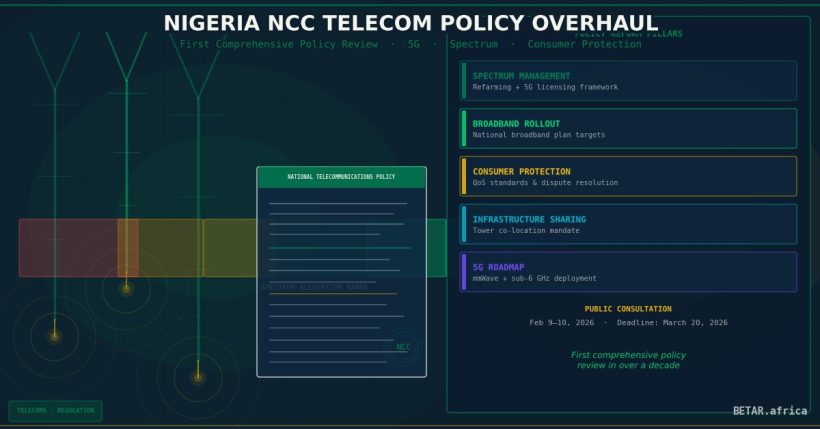

Nigeria is rewriting the rules of its telecommunications sector for the first time since 2000 — and businesses have until 20 March 2026 to help shape the outcome.
The Nigerian Communications Commission (NCC) opened a public consultation on 9 February 2026 on a draft National Telecommunications Policy (NTP 2026) that would replace the 26-year-old NTP 2000. The stakes are significant: right-of-way charges that have grown 62 times the agreed rate in some states, a broken permitting system that adds months to every infrastructure project, and an unlicensed spectrum roadmap that could transform last-mile connectivity — all are on the table.
“The most consequential telecoms policy overhaul in 25 years,” NCC Executive Vice Chairman Dr. Aminu Maida said of the process.
What the 2000 Policy Was Built For — And Why It’s Obsolete
The NTP 2000 was a privatisation blueprint. It solved the problem of the era: dismantling a state monopoly, issuing GSM licences, and connecting a country where just 1.2 million subscribers had telephone access. It worked. Nigeria now has approximately 180 million telecom subscribers and 148 million internet users.
But the economy that policy created has long since outgrown its framework. The NTP 2000 has no chapters on data services, OTT platforms, cloud computing, digital financial services, LEO satellites, or 5G. It makes no mention of broadband targets, right-of-way harmonisation, or platform regulation.
The NTP 2026 consultation paper — released on the same day that NCC EVC Maida publicly described the current policy as “outdated” — proposes a comprehensive rewrite across every dimension of the sector.
The Right-of-Way Problem: Why This Policy Matters Most for Business
If there is one reform in the NTP 2026 that will determine the pace of Nigeria’s digital infrastructure buildout over the next decade, it is right-of-way (RoW) harmonisation.
The problem is well-documented. A National Executive Council agreement in 2013, reaffirmed in 2018 with the signatures of all 36 state governors, set a standard RoW rate of ₦145 per linear metre of fibre laid. In practice, that agreement has had almost no enforcement. Lagos charges between ₦850 and ₦1,500 per metre. Some states charge up to ₦9,000 per metre — 62 times the agreed standard. Only the FCT and a handful of states actually honour the ₦145 rate. Meanwhile, 12 states — including Zamfara, Katsina, and Anambra — have waived RoW fees entirely to attract investment, only to find that non-financial barriers remain the real obstacle.
The result has been a profound distortion of infrastructure economics. Operators reported that operating costs jumped 85% to ₦5.85 trillion in 2024, with RoW charges and multiple-taxation identified as significant contributors. Fibre rollout outside Lagos, Abuja, and Port Harcourt has been stunted not by a lack of investment appetite, but by an inability to predict and manage permitting costs.
The NTP 2026 proposes a new policy chapter mandating harmonisation of RoW charges across all three tiers of government — federal, state, and local. What it does not yet specify is a new rate or, critically, an enforcement mechanism. This is the central question the consultation is asking stakeholders to answer: whether the new policy should embed an enforceable cap on state RoW charges, or rely again on voluntary compliance.
The Association of Licensed Telecoms Operators of Nigeria (ALTON) has been explicit in its position. In a statement last month, ALTON called on the NCC to ensure the NTP 2026 includes not just a harmonised rate but a penalty mechanism for non-compliant states. Without enforcement, ALTON argues, a new agreed rate will produce the same outcome as the 2013 agreement.
One-Stop Permitting: Consolidating a Multi-Agency Maze
Alongside RoW charges, the NTP 2026 proposes the introduction of a unified permitting window for telecom infrastructure deployment. Under the current system, a telecoms operator deploying fibre along a road corridor may need approvals from state and LGA planning authorities, the Federal Ministry of Works, the Federal Airports Authority of Nigeria (for airport-proximity projects), state environmental agencies, the Standards Organisation of Nigeria, and the NCC itself — all separately, with no coordinated timelines.
The NTP 2026 consultation asks stakeholders to identify which agencies should be consolidated into a single window and what statutory SLA timelines that window should carry. The principle — one application, one coordinated decision — is already well-established in comparable markets. The design challenge in Nigeria’s federal structure is determining which tier of government has the authority to bind state-level agencies.
The Spectrum Roadmap: 6GHz and 60GHz Unlicensed Bands
Running in parallel with the NTP 2026 process is the NCC’s Spectrum Roadmap 2026–2030, which includes two unlicensed band releases with significant commercial implications.
Lower 6GHz Band (5925–6425 MHz): Draft regulatory guidelines were published by the NCC in August 2025 for Wi-Fi 6 (802.11ax) and broadband access applications. The band will be licence-exempt on a shared basis, but businesses and equipment vendors should note that an Operational Licence-Exemption Certificate from the NCC will be required before deployment. All equipment must pass NCC type-approval before importation, sale, or use. Biannual usage reports will also be mandatory. Legal firm Aluko & Oyebode, which published a detailed client briefing on the guidelines, advised that “early compliance — type approval, notification, technical planning — will be decisive for market participants seeking to deploy or sell 6GHz equipment in Nigeria.”
60GHz Band (V-Band): Draft guidelines published in January 2026 target short-range, multi-gigabit enterprise applications — think Wi-Fi 7 (WiGig), 5G offload links, and smart city backhaul. The NCC has publicly committed to deploying both bands before the end of 2026.
For enterprises, data centres, and campus network operators, the 6GHz and 60GHz bands open the possibility of licensed-quality wireless performance at unlicensed cost structures — a meaningful change to last-mile economics in urban areas.
The MTN/IHS Towers Wildcard
The NTP 2026 process does not happen in isolation. Last month, MTN announced a $6.2 billion bid to acquire IHS Towers — a transaction that, if approved, would give Nigeria’s dominant telecoms operator control of the country’s largest passive infrastructure provider. The NCC and the Ministry of Communications are conducting a separate regulatory review of that transaction.
The deal raises questions that the NTP 2026’s infrastructure-sharing chapter will need to address: Should a single operator be permitted to own the towers its competitors depend on? What open-access obligations should apply? Operators including Airtel — most exposed to an MTN-controlled tower market — have strong incentives to ensure the NTP 2026 includes robust infrastructure-sharing provisions and access-price caps.
What Changed — and What Hasn’t
The NTP 2026 introduces entirely new policy chapters for areas the 2000 policy ignored: broadband targets (70% national penetration), OTT regulation, online safety and content moderation, LEO satellite and Direct-to-Device (D2D) services, digital financial services, and critical national infrastructure (CNI) protections for fibre networks and telecom towers.
The one area where the consultation paper remains deliberately vague is the mechanism for enforcement — specifically how the NCC will ensure states and local governments comply with harmonised RoW obligations. This is a constitutional design question: telecom infrastructure sits across federal and sub-national jurisdiction in ways the 2003 Nigerian Communications Act did not fully resolve. The NTP 2026 will test whether a policy-level instrument can do what the 2013 NEC agreement could not.
What Businesses Should Do Before 20 March
The consultation is open to all stakeholders — not just licensed telecoms operators. Submissions are invited from businesses, industry associations, civil society organisations, and individuals.
For enterprises, three issues are worth engaging:
1. Right-of-way enforcement: If your business deploys or depends on fibre infrastructure — data centres, logistics, financial services, manufacturing — the enforceability of the proposed RoW harmonisation directly affects your infrastructure cost projections for the next decade.
2. One-stop permitting SLAs: Statutory timelines for the single-window permit system will determine whether the reform produces real reductions in deployment lead times. Submissions that propose specific, realistic SLAs are more likely to influence the final text.
3. Unlicensed spectrum compliance: If you are importing, selling, or planning to deploy Wi-Fi 6 or 60GHz equipment in Nigeria, the finalisation of the 6GHz and 60GHz guidelines — likely triggered by the NTP 2026 finalisation — creates a compliance preparation window. Type-approval applications can be prepared in advance.
Submissions should be sent to stakeholders@ncc.gov.ng by Friday, 20 March 2026. The NCC consultation paper and submission template are available at ncc.gov.ng.
What Comes Next
The March 20 deadline closes Stage 1. The NCC will compile submissions into a first draft NTP 2026, which will undergo a second round of stakeholder consultation before going to the Minister for statutory approval. A realistic timeline for the final policy suggests late 2026 at the earliest, with the new 6GHz and 60GHz guidelines potentially finalised ahead of the broader policy.
For a sector that has operated without an updated policy framework for 26 years, the process itself is the story. Whether Nigeria uses this window to produce an enforceable, investment-grade regulatory environment — or repeats the 2013 experience of well-intentioned agreements with no teeth — will depend significantly on what stakeholders submit over the next ten days.
Sources
- NCC Consultation Paper on NTP Review, February 2026 (ncc.gov.ng)
- Nairametrics, 9 Feb 2026
- TechAfrica News, 10 Feb 2026
- This Day Live, 19 Feb 2026
- This Day Live, 23 Feb 2026 — ALTON statement
- Nigeria Communications Week
- TechCabal, 17 Feb 2026 — MTN/IHS
- Aluko & Oyebode — 6GHz guidelines analysis
- NCC Draft Lower 6GHz Guidelines (PDF)
- NCC Draft 60GHz Guidelines (PDF)
- The Cable — RoW state charges analysis
- ICLG Nigeria Telecoms Report 2026


 UphivaBETAR


