Starlink, Amazon Kuiper and Meta’s 2Africa are reshaping internet costs for African SMEs. What the 2026 price war means for businesses in Nigeria and Kenya.
Nigeria’s CBN recapitalisation deadline has passed. Three banks remain non-compliant. Here is what the regulator’s enforcement toolkit looks like — and what it means for Union Bank, Polaris, Keystone, and Nigeria’s banking map.
Africa has $50 billion in LNG and gas infrastructure under construction or at final investment decision — while 54 governments have signed climate pledges. As COP30 approaches, the contradiction is becoming impossible to ignore.
MTN’s $2.2B IHS Towers acquisition consumes 60% of its fintech war chest. BETAR analyses the balance sheet impact, dividend risk, and what it means for MoMo’s product ambitions in 2026-2027.
Across Africa, millions of young people are neither in education, employment, nor training. The NEET crisis is not a youth problem — it is a structural failure of education systems to connect learning to labour markets.
Across sub-Saharan Africa, millions of children are taught to read in English, French, or Portuguese — languages they do not speak at home. The research is unambiguous. The political will to act on it is not.
Africa generates 16% of global streaming volume but earns just 3.4% of revenues. How Afrobeats artists are navigating label deals, sync fees, and touring economics in the international market.
Africa is in its first serious AI data centre investment wave. MTN Lagos (M, diesel-constrained) versus Microsoft Kenya (B, geothermal-powered) reveals the real variable: power, not capital, determines whether African AI infrastructure succeeds.
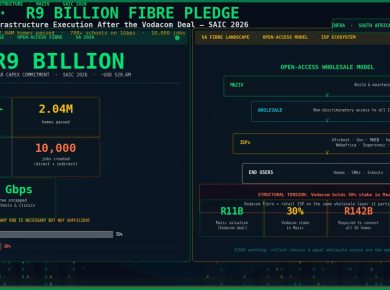
Maziv CEO Dietlof Maré committed R9 billion over five years at SAIC 2026 — the capital deployment moment the Vodacom deal was building toward. BETAR analyses what the pledge means for open-access accountability, ISP competition, and South Africa’s broadband gap.
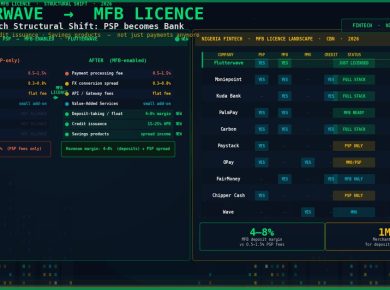
Four years after Access Bank froze its accounts, Flutterwave has secured an MFB licence — eliminating the settlement dependency that made it vulnerable. The structural implications extend well beyond one company.

 UphivaBETAR